
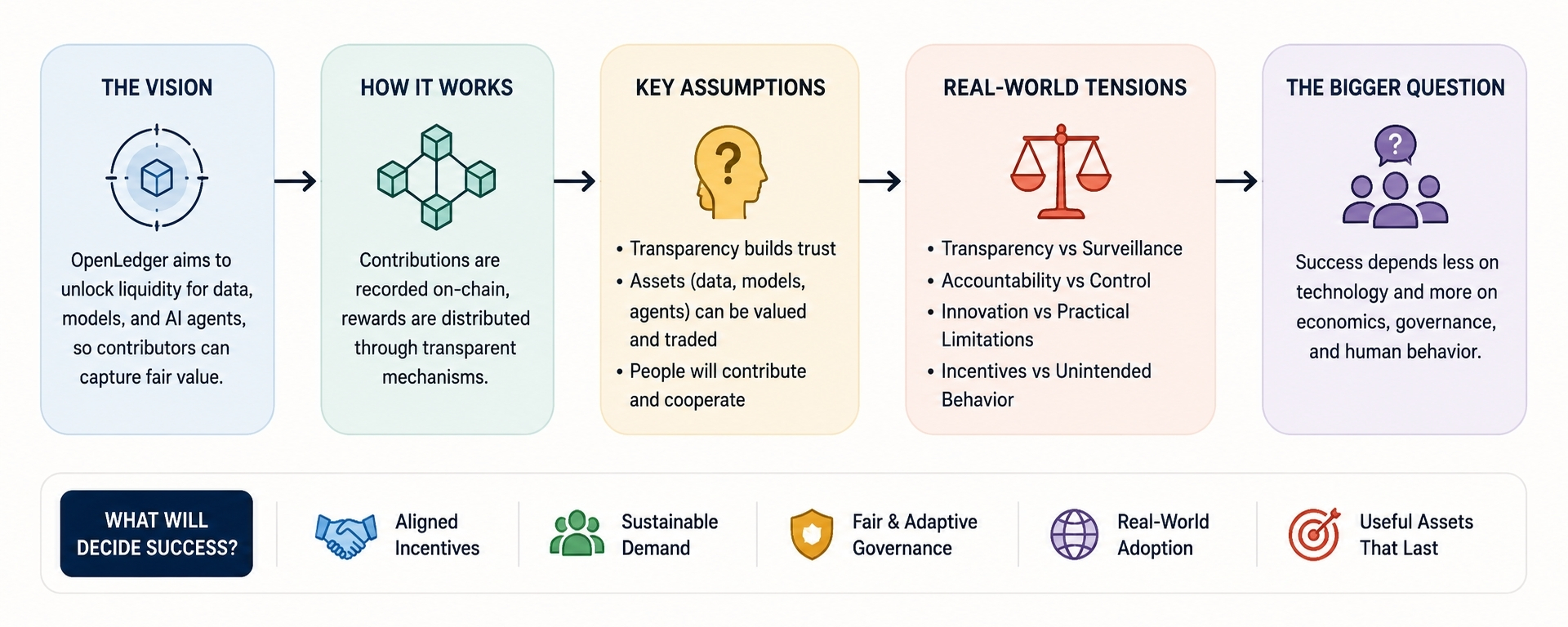

When I look at OpenLedger, I find myself thinking less about the technology itself and more about the assumptions it makes about people. The idea of creating a system where data, AI models, and agents can be owned, rewarded, and traded sounds appealing on the surface. It taps into a growing feeling that the people contributing value to AI ecosystems should receive something in return. That part makes sense. What I'm less certain about is whether human behavior will fit as neatly into the system as the design suggests.
A lot of these projects are built around transparency. The assumption is that if contributions and rewards are visible, trust naturally follows. But transparency has always been complicated. The same systems that make activity verifiable can also make it highly traceable. Over time, there can be a thin line between creating accountability and creating an environment where everything is watched, measured, and recorded. Not everyone wants participation in a digital economy to come with that level of visibility.
I also wonder about the balance between decentralization and control. Blockchain projects often position themselves as alternatives to centralized platforms, yet rules still have to be written, incentives still have to be designed, and decisions still have to be made. Power doesn't disappear; it just moves around. Sometimes it ends up concentrated in places that are less obvious but no less influential. That's not necessarily a flaw, but it's something worth paying attention to.
The economic side feels even harder. Turning data and AI-related assets into something liquid assumes there will be a reliable way to determine their value. In reality, value is messy. One dataset might be useful today and irrelevant tomorrow. One model might look promising until a better one appears a few months later. Creating markets is one thing; creating sustainable demand is another. The gap between those two can be larger than people expect.
What makes OpenLedger interesting is that it's trying to address a real issue. AI is generating enormous value, and there is a growing debate about who should benefit from that value. The project seems to be betting that ownership and incentives can solve part of that problem. Maybe they can. But incentive systems often have unintended consequences. Once rewards are attached to contributions, people naturally start optimizing for rewards. Sometimes that improves the network, and sometimes it fills it with activity that looks valuable without actually being useful.
I don't see OpenLedger as something that should be dismissed, but I also don't see it as an obvious solution. The technology may work exactly as intended and still run into challenges that have more to do with economics, incentives, and human nature than code. For me, that's the most interesting part. The long-term outcome probably won't depend on whether the protocol functions correctly. It will depend on whether people behave the way the protocol expects them to.