


OpenLedger sits in a space that still feels unfinished to me, not in the sense of being early in a marketing way, but in the sense that I can’t yet tell what it will eventually be forced to become once real usage starts shaping it more than its own framing.
I’ve been watching this pattern in crypto for a long time now. A system is introduced with a fairly clean idea at the center—usually something about coordination, ownership, transparency—and then, slowly, the idea starts to bend under the weight of how people actually use it. Not in dramatic ways. More like small deviations that accumulate until the original language no longer quite fits what’s happening on-chain.
With OpenLedger, what keeps catching my attention is how it tries to sit between two things that don’t naturally stabilize together: crypto-style ownership logic and machine intelligence that doesn’t wait for permission to produce output. AI systems don’t behave like scarce assets. They don’t slow down to let governance catch up. They generate continuously, and that alone makes them difficult to fit into the older structures crypto is comfortable with.
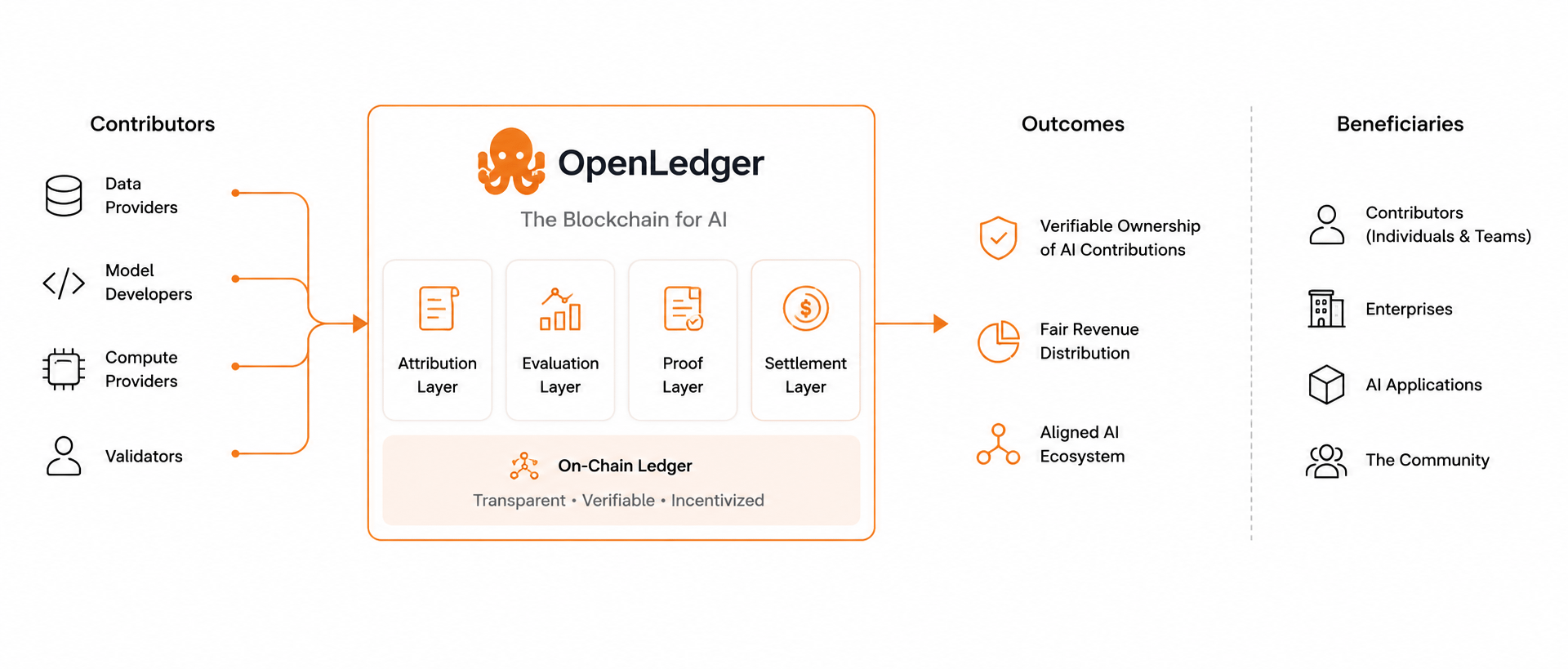
I keep coming back to a basic uncertainty: what exactly is being owned here? The data? The models? The outputs? Or just the pathways that decide who gets to claim value from something that was already generated elsewhere? Each answer leads to a different kind of system, and I don’t see a single one that resolves cleanly without trade-offs.
There’s also a familiar tension that shows up in almost every crypto narrative once it gets close to real adoption. The language stays broad just long enough for multiple groups to project their own version of the future onto it. Builders see infrastructure. Investors see alignment between emerging technologies. Researchers see attribution problems finally being formalized. And none of these interpretations are wrong on their own, but they don’t necessarily add up to a coherent whole either.
That’s usually where the interesting part of the story is, at least in my experience. Not in the clarity of the pitch, but in the gaps between interpretations. Those gaps are where incentives start to move differently than expected.
What makes this cycle feel slightly different is that the “asset” being discussed isn’t static. Intelligence isn’t something that waits to be packaged. It’s already being produced at scale outside any blockchain system. So crypto is not creating the underlying value here—it’s trying to wrap ownership and coordination around something that is already flowing.
That inversion changes the pressure on the design. In earlier cycles, you could define the primitive and then build usage around it. Here, usage already exists, and the question is whether ownership frameworks can meaningfully attach themselves without distorting what they’re trying to measure.
I don’t think that question has been answered yet, not by OpenLedger or by anything else in this intersection. What I mostly see are early attempts at making machine-generated output legible inside economic systems that were designed for human-paced actions. And those attempts always run into the same problem: once you formalize the output too much, you risk losing the qualities that made it valuable in the first place.
There’s a quieter concern underneath all of this as well. Systems that depend on attribution tend to assume that attribution is stable. But in machine intelligence, attribution is often probabilistic, layered, and sometimes indistinguishable from aggregation. That makes ownership harder to define without simplifying the system into something less accurate than the reality it’s trying to represent.
So I stay uncertain about where this ends up. It doesn’t feel like a story with a clear endpoint yet. It feels more like a system being stress-tested by reality while still being described in future tense.
And maybe that’s the only consistent signal right now—the gap between how OpenLedger is described and how a system like this will actually behave once incentives harden. In crypto, that gap is usually where the real structure begins to show itself.