
I didn’t take Pixels seriously the first time I saw it.
That is the truth.
Not because it looked bad, but because the market has made everything feel familiar. After a while, every project starts arriving with the same kind of promise. A game, a token, a community, a digital world, a better version of ownership. You read enough of that and your mind starts protecting itself. You stop reacting. You place things into categories before they have a chance to breathe.
Pixels went into that category for me at first.
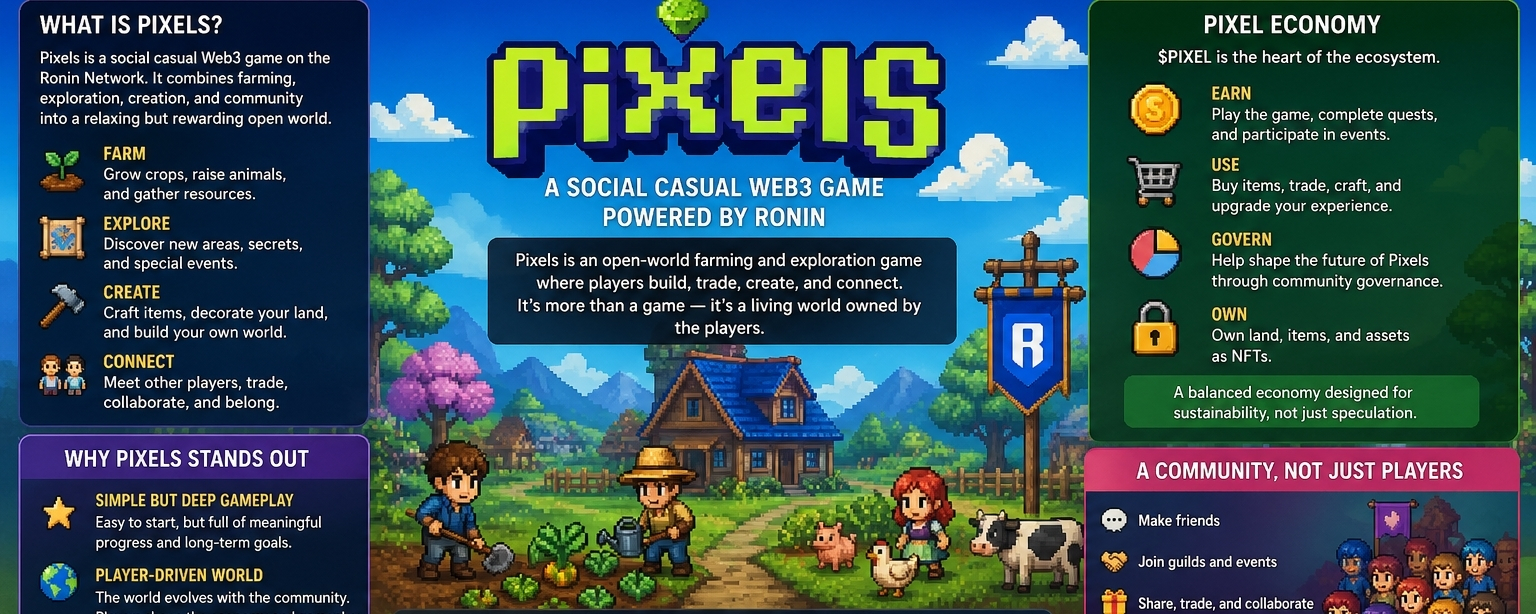
A social casual Web3 game on Ronin. Farming, exploring, creating, building inside a small digital world. Simple enough to understand. Maybe too simple to stop for. In crypto, people often ignore simple things because they are waiting for something that sounds bigger, sharper, more complicated.
But Pixels kept coming back into view.
Not in a loud way. Not like it was trying too hard to prove itself. It was just there. People were still playing. Still farming. Still returning. Still treating the world like it had some reason to exist beyond one quick moment of attention.
That part stayed with me.
Because attention in crypto is easy to create for a short time. You can push a token. You can create hype. You can build a campaign. You can make people look for a week. But making people return is different. Return is quieter. Return is harder. Return says there may be something inside the loop that people actually feel, even if they cannot explain it clearly.
Pixels feels interesting because it does not need to look massive to raise a real question.
At the surface, it is a farming and exploration game. You enter the world, do simple tasks, collect things, build, interact, and slowly shape your place inside it. None of that sounds new. Games have been doing this for years. But when crypto enters the picture, those small actions start carrying extra weight. A task is no longer just a task. A record is created. A wallet connects. A reward may exist. A token gives the activity a market shadow.
And that is where the project becomes more than just casual play.
For me, Pixels is circling the question of how digital action becomes meaningful. Someone plants something. Someone gathers something. Someone finishes a quest. Someone comes back again tomorrow. These are small actions, but the internet has always been built from small actions. Posts, points, usernames, badges, progress, reputation, memories. Crypto did not invent that. It only made the record harder, more visible, and sometimes more valuable.
That can be powerful.
It can also make everything uncomfortable.
Because a blockchain can show that something happened, but it cannot automatically prove that it mattered. A token can reward activity, but it cannot automatically create trust. A game can count every move, but counting is not the same as caring.
This is where Pixels feels worth watching.
It is not trying to impress through complexity. Its strength, if it has one, is in how ordinary the loop feels. You do something small. You come back. Something changes. The world does not need to shout at you every second. It works through habit, through routine, through the soft pull of return.
That is a very different kind of test from most crypto projects.
Most projects want attention.
Pixels needs presence.
That is harder.
Presence means people are not only watching from outside. They are inside the world, doing things that may look minor but slowly build attachment. And attachment matters in games more than any big claim. A project can have a token, a network, a roadmap, and a strong launch, but if people do not feel a reason to return, the rest becomes decoration.
Still, I don’t want to make it sound cleaner than it is.
Pixels also carries the same tension every Web3 game carries. Once rewards enter the system, play can start feeling like work. Once a token becomes part of the loop, every action can become a calculation. Once the market starts watching, a simple game can slowly turn into a dashboard.
That is the risk.
The farming can become farming for value only. The world can become a place people enter because the numbers tell them to. The community can become activity without attachment. And when that happens, the game may still look alive from the outside, but something inside it becomes thin.
Pixels has to live inside that pressure.
That is why the project is interesting to me, not because everything is solved, but because the tension is real. It sits between play and economy. Between action and proof. Between a user doing something because it feels good and a user doing something because it might be rewarded.
That line is not easy to hold.
And it is bigger than Pixels.
It is bigger than Web3 gaming.
It is the same old problem digital platforms have always had. How do you make people’s time feel like it counts without turning every moment into a metric? How do you reward participation without making participation feel forced? How do you create a record without removing the human part from the action?
Pixels brings that problem into a simple place.
A farm.
A world.
A character.
A task.
A return.
That simplicity helps. It makes the question easier to feel. You don’t need heavy language to understand it. You just need to ask why someone would keep coming back when the market is noisy and there are always new things to chase.
Maybe it is the game.
Maybe it is the rewards.
Maybe it is habit.
Maybe it is community.
Maybe it is all of them mixed together in a way that cannot be separated neatly.
That is usually how real digital behavior works. People rarely stay for one clean reason. They stay because something becomes part of their routine. They stay because their actions begin to feel connected to a place. They stay because leaving would mean losing a small piece of progress that has started to feel personal.
That is what Pixels seems to be trying to build around.
Not just ownership.
Not just earning.
Not just gameplay.
A sense that small digital actions can gather meaning over time.
That is a difficult thing to protect in crypto because the market always wants to speed everything up. It wants the chart to move before the culture forms. It wants the token to explain the game before the game has enough time to explain itself. It wants proof quickly, but games need time.
Pixels is still in that test.
The real question is not only whether people notice it. People already have. The question is whether people keep returning when the noise fades. Whether the world feels good enough without constant incentives. Whether the economy supports the game instead of swallowing it. Whether the token adds depth or pressure.
I don’t know the answer.
But I do think Pixels is more focused than it first looked.
It is not just another farming game with crypto attached. It is trying to make a casual world carry a real economy without losing the casual feeling that makes the world approachable in the first place. That balance is fragile. Too much economy, and the game becomes work. Too little meaning, and the actions feel empty. Too much hype, and the project becomes another short-lived market story.
The project has to stay human.
That might sound simple, but it is probably the hardest part.
Because the human part is not the token. It is not the network. It is not the data. It is the small reason someone logs in again. It is the feeling that the world remembers them. It is the sense that their time did not disappear completely. It is the slow trust built through repeated action.
Pixels has not answered every question.
It does not need to.
What makes it worth paying attention to is that it keeps sitting near a real one. Can a Web3 game make digital effort feel meaningful without turning every action into extraction? Can it use ownership without making everything feel financial? Can it build a world where people return because they want to, not only because they are being pulled by rewards?
That is the part I keep thinking about.
Not the loud part.
The quiet part.
Pixels may look simple from the outside, but simple things can reveal more than complicated ones when people keep returning to them. And in a market where so many projects fight for attention and disappear once the noise moves on, a small world that keeps pulling people back is not something I would ignore too quickly.