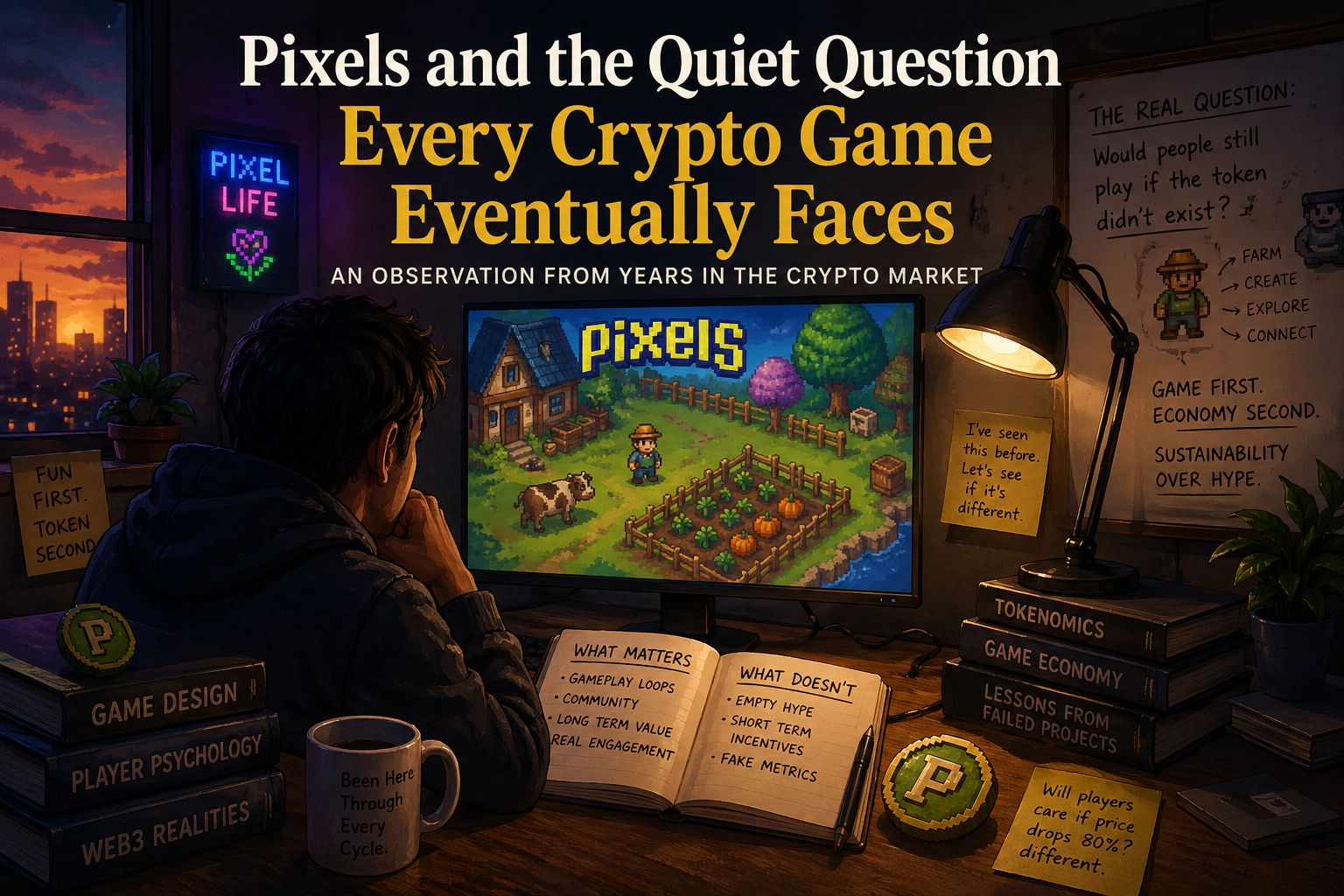
I’ve been watching crypto long enough to become numb to the excitement.
Every cycle brings the same promises dressed in slightly different language. A new project appears, people rush to call it “the future,” early traction gets treated like proof, and for a while everyone plays along. Then the cracks begin to show. Users disappear, rewards dry up, the economy weakens, and what looked like momentum turns out to have been incentives doing all the heavy lifting.
That pattern has repeated so many times that I’ve stopped reacting to the noise around most Web3 games.
So when Pixels started gaining attention, I didn’t see innovation at first. I saw another familiar setup: a farming game, a token economy, digital land, community ownership, all built inside the usual Web3 narrative that says players are finally going to “own” the value they create.
I’ve heard that line too many times.
Because the truth is, most crypto games never really become games in the way players understand games. They become economic systems wrapped in game mechanics. The gameplay is often little more than a vehicle to distribute rewards, and once rewards become the center of the experience, everything else starts orbiting around extraction.
That’s where most of these projects quietly fall apart.
People like to talk about user growth and wallet activity as signs of adoption, but those numbers often hide what’s really happening. A lot of users in crypto games aren’t there because the gameplay is compelling. They’re there because the incentives make participation profitable—or at least seem profitable for a while.
That’s not loyalty. That’s temporary behavior.
And once the rewards stop being attractive, that behavior vanishes.
I’ve watched this happen enough times to become suspicious whenever a crypto game starts showing rapid growth. Not because growth is meaningless, but because in this market, growth can be manufactured. Incentives create activity, activity creates attention, and attention creates a story that people want to believe.
Pixels entered that same environment, and naturally I assumed it would follow the same path.
But the more I watched it, the more I felt that something about it was… quieter.
Not revolutionary. Not groundbreaking. Just quieter.
Pixels doesn’t try to overwhelm people with grand claims. It doesn’t pretend to be some massive technological leap. It doesn’t wrap itself in the kind of dramatic language that so many Web3 projects rely on. It’s simple—farming, crafting, social interaction, progression loops, familiar mechanics presented in a straightforward way.
At first glance, that simplicity almost feels unimpressive.
But after years of watching projects promise too much, simplicity has started to look like one of the few honest signals left.
Because the projects that usually fail the hardest are the ones that try to sound the most important. They promise to reinvent gaming, disrupt entire industries, and redefine digital ownership, all before proving that players even want what they are building.
Pixels doesn’t seem obsessed with proving it is revolutionary.
And that restraint makes it interesting.
Still, I don’t confuse restraint with sustainability.
That’s where the harder questions begin.
The central problem in Web3 gaming has never really been technology. Cheap transactions, wallet integration, digital ownership—those are infrastructure issues, and infrastructure can improve over time.
The real problem is behavioral.
Once money becomes part of the gameplay loop, players stop behaving like players.
That change is subtle, but it alters everything.
In a traditional game, grinding for resources feels like progression. Players tolerate repetitive actions because they are emotionally invested in the outcome. But in a tokenized game, that same grinding starts to feel like labor. Every action gets measured against its reward value. Time becomes an economic input.
And once a game starts feeling like labor, the relationship changes.
Players begin asking the same questions workers ask: Is this worth my time? Is the reward enough? Can I earn more somewhere else?
That mentality is incredibly hard to design around.
It turns a game into a marketplace of effort, and marketplaces are ruthless. People stay only as long as the economics justify staying.
That’s why so many “play-to-earn” ecosystems struggle to hold users once token rewards decline. The people who came for the economy leave when the economy weakens.
Pixels is not immune to that.
No matter how approachable the game feels, no matter how smooth the onboarding becomes, the same structural pressure remains. If too much of the motivation depends on token incentives, then the system is fragile.
And fragility in crypto often hides behind strong short-term numbers.
That’s why I remain skeptical when people point to traction as proof that a model works. Traction in crypto is often just the byproduct of good incentives. Real resilience only becomes visible when incentives weaken.
That’s the real test.
Would people still log in if the token price dropped hard?
Would they still care if the financial upside disappeared?
Those are the questions that reveal whether a game has real value beyond its economy.
And I’m not sure anyone truly knows the answer for Pixels yet.
That uncertainty matters, because crypto has a habit of declaring victory too early. The market rewards momentum, not durability. If a project grows fast enough, people start speaking as if the long-term outcome has already been proven.
But I’ve seen too many “successful” projects disappear to believe early momentum means much on its own.
What makes Pixels worth paying attention to isn’t that it has solved these problems. It hasn’t.
What makes it worth watching is that it seems to understand the problems better than most.
There’s a noticeable difference between a project trying to engineer speculation and a project trying to build something players might actually enjoy. Pixels feels closer to the second category.
That doesn’t guarantee success.
It simply means the effort appears more grounded.
The game doesn’t rely on the fantasy that ownership alone creates value. That’s another trap crypto gaming keeps falling into—the belief that on-chain assets automatically improve the experience.
Most players don’t care whether an item is on-chain. They care whether it matters.
Ownership has no value unless the underlying asset has meaning inside the game. Owning something nobody values is not empowerment. It’s just ownership without relevance.
This is where many crypto projects lose touch with reality. They build systems around assets before proving those assets deserve to matter.
Pixels, at least from what I’ve observed, seems less obsessed with selling the ownership narrative and more focused on making the loops engaging enough that ownership might eventually matter.
That’s a healthier starting point.
But it still leaves the same unresolved tension: can a game remain fun once financial incentives become part of the design?
That question still hangs over every Web3 title, including this one.
And maybe that’s why Pixels stands out to me—not because it has answered the question, but because it doesn’t seem to be hiding from it.
There’s less illusion here.
Less of the exaggerated confidence that defined earlier cycles.
Less of the belief that tokenization automatically creates innovation.
Instead, Pixels feels like a project operating with a more realistic understanding of how difficult this is.
That may not sound impressive, but after years of watching crypto chase easy narratives, realism has become rare.
I’m still cautious.
I still think token economies create incentives that can quietly distort gameplay. I still think crypto projects often underestimate how quickly economic behavior can replace genuine engagement. I still think many of the same risks remain.
But I also think Pixels reflects a more mature stage of experimentation.
It feels less like a project trying to prove that Web3 gaming has arrived, and more like a project trying to figure out what parts of Web3 gaming are actually worth keeping.
That is a far more honest place to start.
Maybe it still fails.
Maybe the incentives fade, the user base shrinks, and the market moves on—just like it has with countless projects before.
That outcome is still very possible.
Years in this market have taught me that skepticism is usually safer than belief.
But every now and then, something appears that doesn’t fit perfectly into the old patterns.
Not because it promises more.
Because it promises less.
And sometimes, in crypto, the projects that speak the least tell you the most.
That’s why I keep watching Pixels.
Not because I think it has solved Web3 gaming.
But because for the first time in a long time, I’m seeing a project that seems to understand why so many others failed.