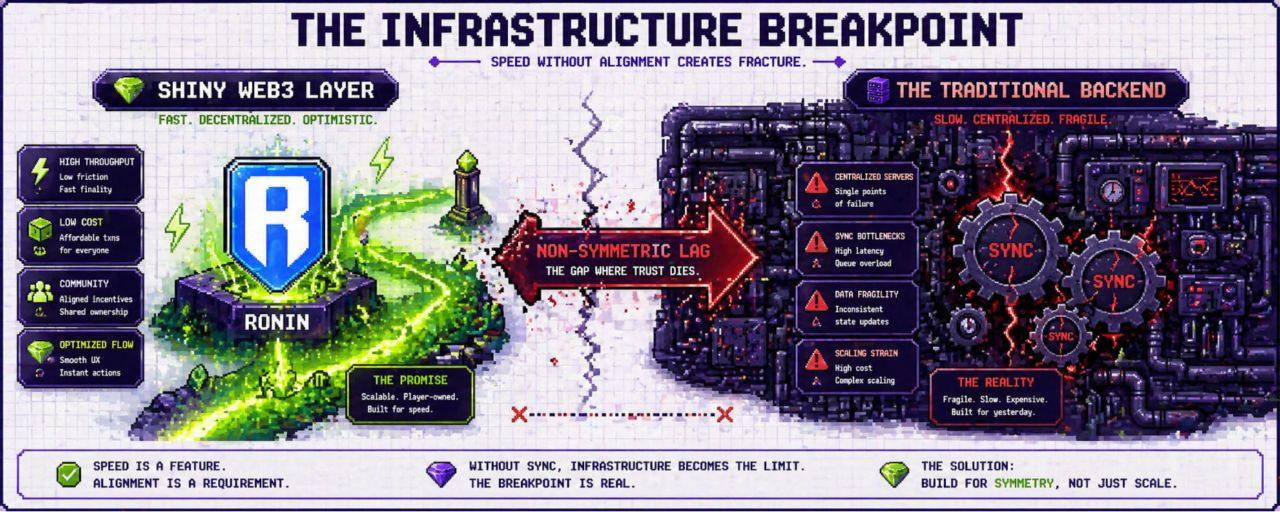
Most observers are staring at the Ronin transaction throughput, thinking that because the chain is fast, the game is solved. They are missing the most dangerous bottleneck in Web3 gaming: the Non-Symmetric Sync. After auditing the latest stress tests and Chapter 3 performance data, it’s clear that #PİXEL is fighting a battle that isn’t on the blockchain - it’s in the memory of the backend.
The Mirage of On-Chain Speed
We’ve been conditioned to believe that RPC bandwidth is the only metric that matters. But in a high-concurrency environment like Pixels, where thousands of actions hit the server every millisecond, the blockchain is just the final ledger. The real "friction" lives in the Traditional Backend (Centralized Layer).
When a user executes a crop harvest or a trade, that action must be validated by the server before it ever touches the #RONIN network. If the backend lag exceeds 100ms, you get a "Desync Event". In 2026, this isn't just a technical glitch; it’s an economic failure that leads to missed actions and asset loss.
The "Non-Symmetric Sync" Problem
This is the "ugly" problem nobody in #GameFi wants to touch. The chain is nearly instantaneous, but the server logic execution is sequential. This creates a Systemic Fragility:
The Gap: The time difference between your UI interaction and the server's confirmation.
The Risk: In high-stakes Union coordination or sabotage events, a 1-second delay can cost a guild their Yieldstone. Pixels is currently engineering a proprietary sync layer to bridge this gap, ensuring that the Logic Timing matches the Chain Finality. Without this, the "Humanity Moat" is irrelevant because the system can't distinguish between a human lagging and a bot exploiting the lag.
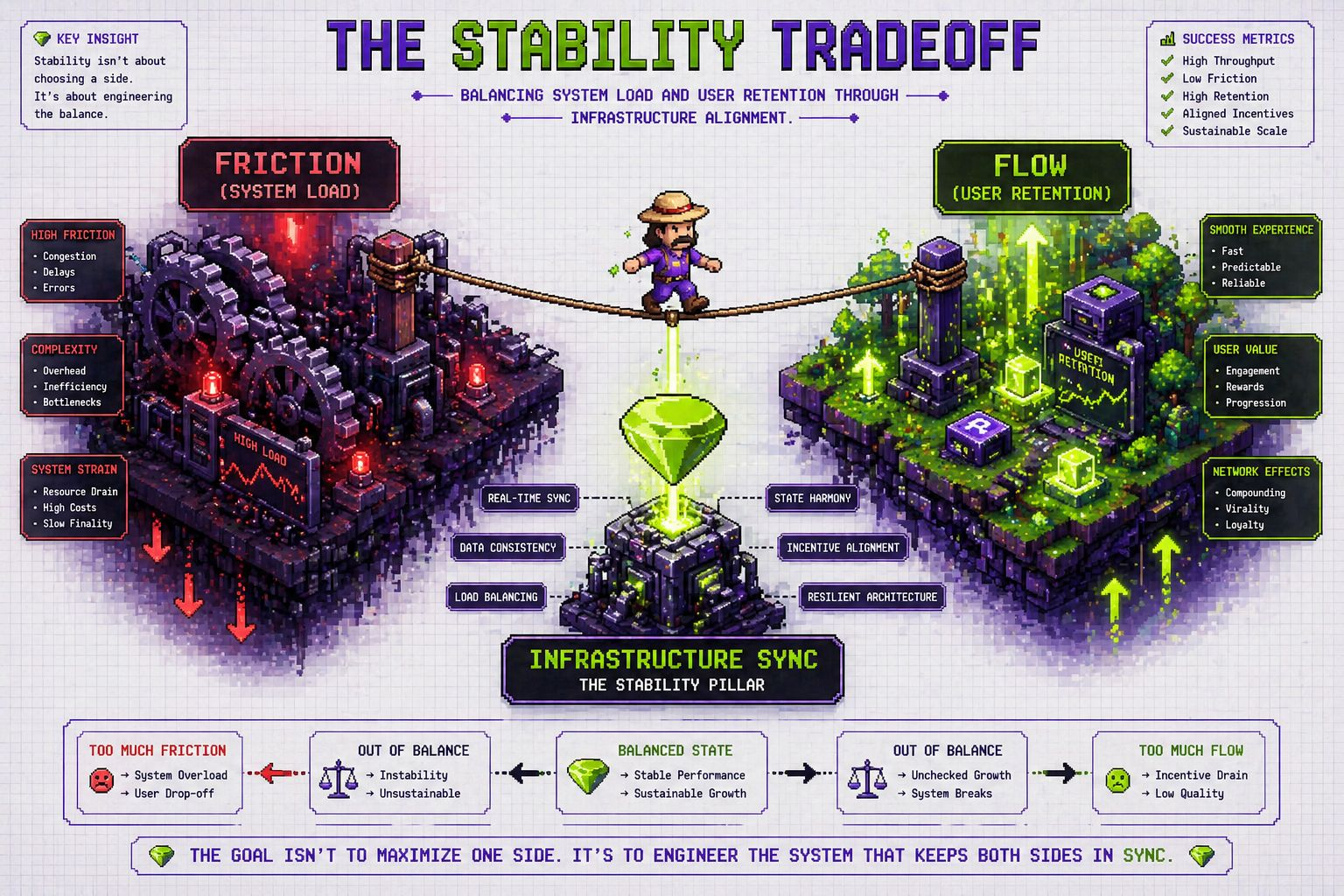
Stability as the Ultimate Retention Metric
The market is obsessed with token supply, but traders should be watching Backend Uptime.
If a system is too smooth, there is no friction to skip (reducing $PIXEL demand).
If a system is too laggy, users disengage (collapsing the economy). The "Sweet Spot" is a system that remains stable under insane growth. Pixels’ transition to a more robust LiveOps infrastructure is an attempt to turn stability into a product. When the infrastructure fades into the background, the user spends more on "Control over Time" $PIXEL rather than fighting the interface.
The Backend is the Silent Killer
Pixels is no longer just a game; it is a stress test for how #Web3 handles massive real-time pressure. The projects that survive 2026 won't be the ones with the most "fun" loops, but the ones that solve the Breakpoint of Sync.