

There is a building in Terra Villa called Buck's Galore.
It does not look like much from the outside. Nothing in Pixels really does, that is part of the aesthetic. But once you figure out what Buck's Galore actually does, you start to understand that almost every decision a serious player makes in this game flows directly back to what is written on the board inside it.
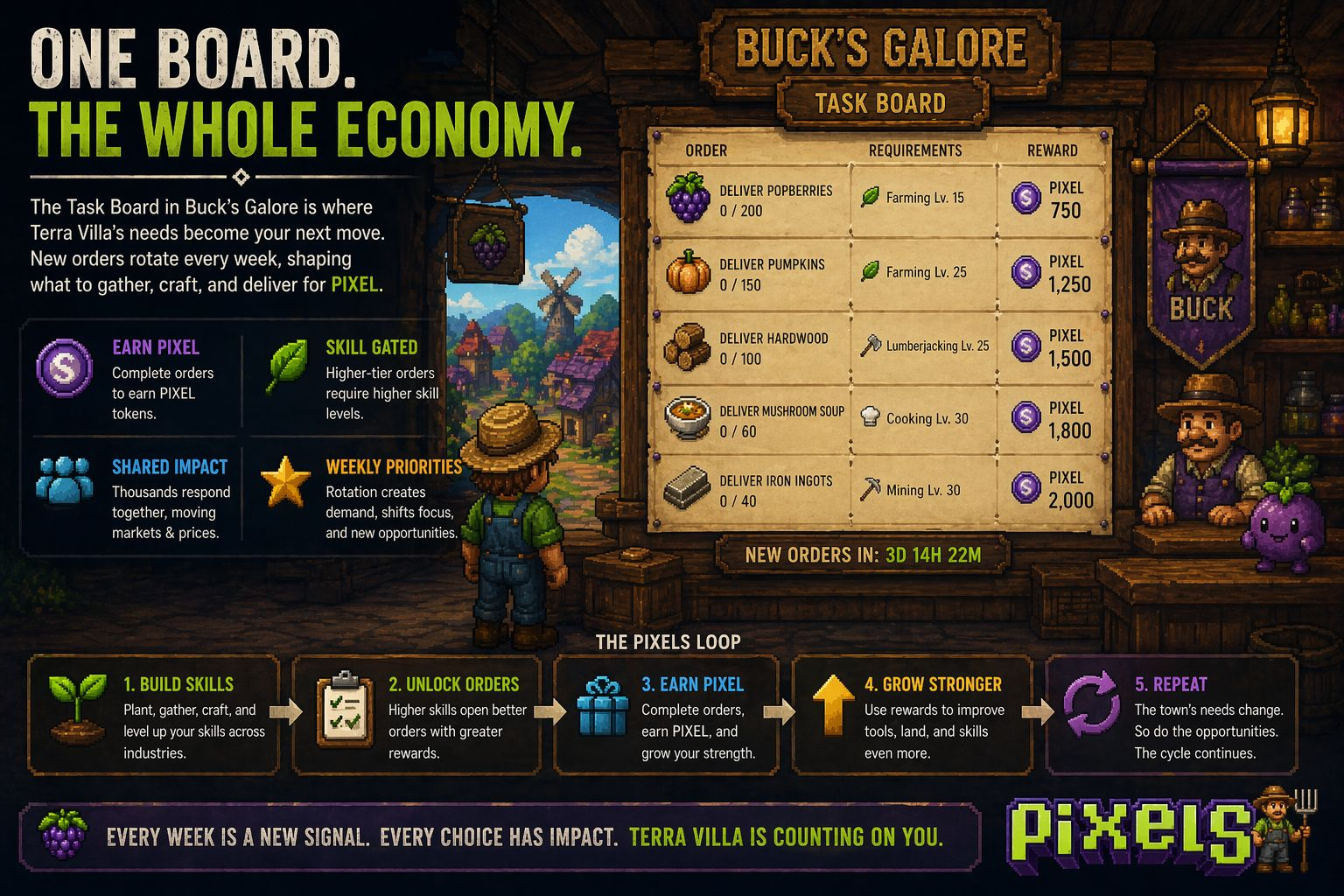
The task board. A rotating list of orders that tells you what the economy needs this week, which resources to gather, which crafted goods to deliver, and how many PIXEL tokens you will earn for doing it.
I have been in games with economy mechanics before. Most of them feel like spreadsheets dressed up with animations. The task board in Pixels feels different. It feels like someone left a note on your door every Monday morning telling you what the town needs, and you either decide to respond or you do not.
The task board at Buck's Galore is the primary way to earn PIXEL in the game. Players fulfill orders by delivering specific resources, with higher-tier orders requiring advanced skill levels, like Level 35 Farming or equivalent thresholds in other industries.
That skill gate is the part that sneaks up on you when you first start playing. You arrive at Buck's expecting to grab whatever order looks best and immediately get started. Then you read the requirements and realize the best-paying orders are locked behind skill levels you do not have yet. You have to look down the list for something you can actually do and settle for a smaller reward while you build toward the ones you actually want.
The first few weeks of playing Pixels are basically just that process, repeated daily. Looking at what you cannot do yet. Doing what you can. Slowly closing the gap.
What nobody told me early on was that the board does not just list what pays well. It tells you what to prioritize with your time. A week when forestry orders dominate the board is a week when every player who has been quietly leveling Lumberjacking feels vindicated, and every player who ignored that skill starts doing math about how long it would take to catch up.
In late 2025 Pixels rolled out a significant taskboard update specifically designed to better reward the dedicated player base, adjusting order values and rotation mechanics to reflect actual player skill distribution and resource availability.
That update mattered more than it got credit for. The version of the task board before it had some structural issues where certain orders were clearly more efficient than others, which meant everyone was converging on the same strategies and the same resources. When too many players chase the same orders simultaneously, the raw materials for those orders get depleted fast, prices on the market spike, and the actual earnings from completing them shrink. The theoretical reward and the practical reward diverge, and players who did not notice the divergence quickly ended up worse off than those who adapted.
The updated board is better at distributing demand across different industries. It still rotates and still creates clear weekly priorities, but the rotation is less predictable now, which forces players to stay genuinely attentive rather than running the same optimized loop on autopilot.
I know players who check the task board before they check the token price. That tells you something.
There is a meta-game that develops around the board over time. Experienced players start reading the rotation the way a market analyst reads order flow. If cooking recipes have been highlighted for two weeks running, there is a reasonable chance the board shifts away from cooking next week. If lumber orders have been absent for a while, they are probably due. You start forming opinions about which resources to stockpile before they become relevant, which is essentially the same skill as anticipating demand before it shows up in an asset price.
Players build skills through planting crops like Popberries, gathering resources like wood and stone, and crafting items, with the task board translating that accumulated skill and inventory into actual PIXEL earnings.
The loop is elegant in a way that only becomes visible when you have been inside it for a while. You build skills. Skills unlock orders. Orders reward specific behaviors. Behaviors build more skills. The task board sits at the center of that cycle, quietly directing the whole thing without ever feeling coercive about it. Nobody forces you to take any order. The board just shows you what is available and lets you decide.
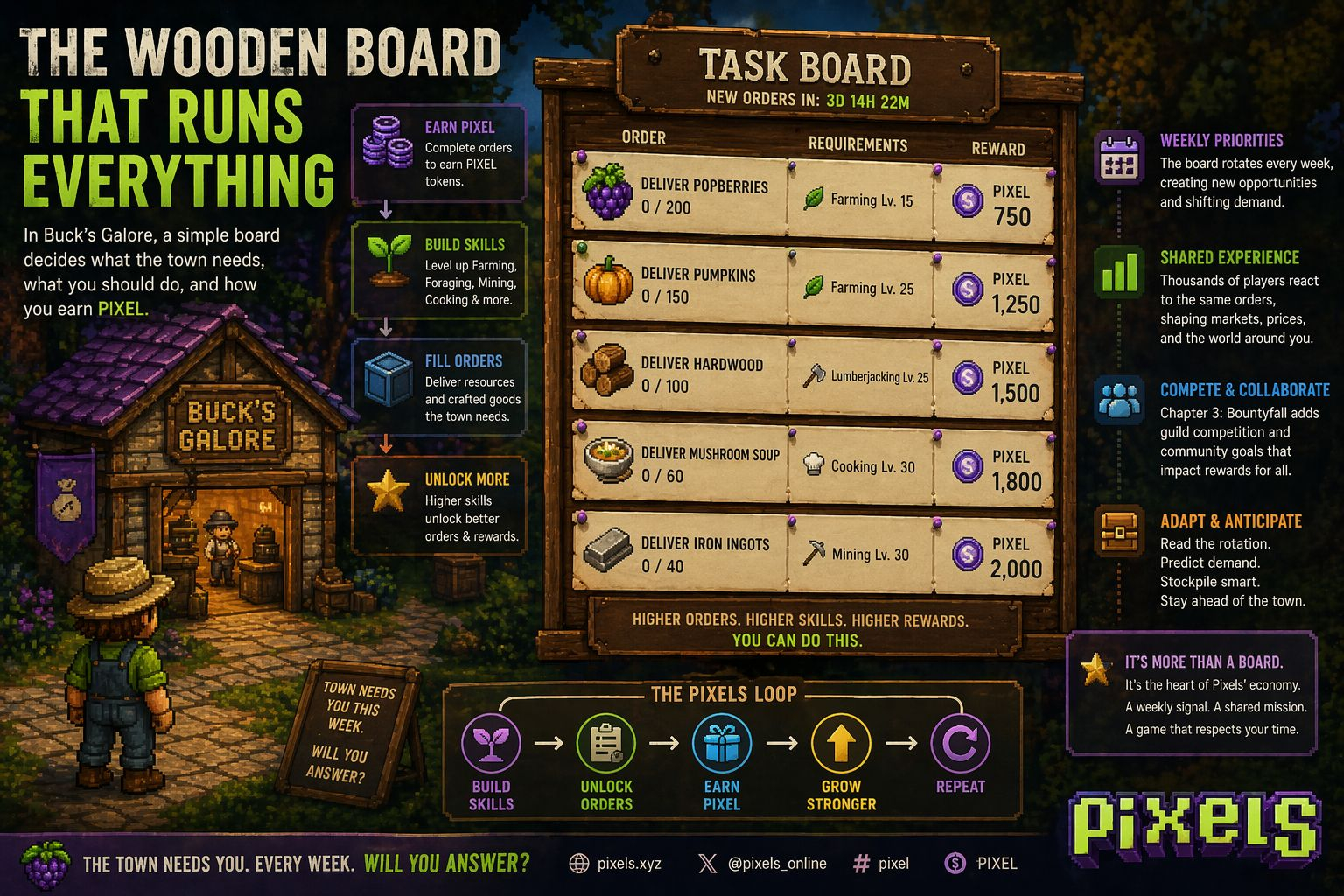
What the board also does, less obviously, is create shared experience across the entire player base simultaneously. When a particular order is up, thousands of players are thinking about the same resource at the same moment. The forests around certain public lands get busier. The market price for a specific ingredient ticks up slightly. Players who were not even looking at the board start noticing that something is different today because the behavior of other players reveals it.
Chapter 3, called Bountyfall and launched in late October 2025, deepened the task and reward systems further, introducing competitive and community-driven mechanics that let players collaborate and rival each other in ways that directly influence how in-game economy rewards get distributed.
That competitive layer added something the earlier task board lacked, which was stakes beyond your individual earnings. Now how your guild performs relative to others affects outcomes that flow back to individual players. The board went from being a personal to-do list to something closer to a shared market signal that organized groups respond to collectively.
I sometimes think about what Pixels would feel like without the task board. Probably fine for the first few weeks. Peaceful, even. Lots of farming, lots of crafting, lots of wandering around talking to other players.
But after a while you would notice something missing. The sense that what you are doing today matters specifically today. That the town needs something from you right now, this week, not just generically whenever you feel like it. The urgency that comes from a deadline, even a soft one, even a fake one in a browser farming game.
That urgency is not manufactured by token prices or whale activity or market cycles. It is manufactured by a rotating list of orders on a wooden board in a building called Buck's Galore.
And somehow it works.