
What stands out about Pixels at first isn’t even the game itself… it’s everything that had to
to be built around it.
On paper, @Pixels is simple. A social casual web3 game on Ronin. Farming, exploring, building, just existing in a shared world. Easy to understand in a few seconds.
But the moment a game like that actually gets traction, something changes.
It stops being just about gameplay or visuals. It starts becoming about something less visible but way more important how the system reacts to different kinds of players over time.
And in web3, that’s usually where things start to break.
Because now rewards aren’t just in-game points or cosmetics. They have real value attached. And that changes everything.
The moment value enters, player behavior splits.
Some players are there for the game.
Some are there for earnings.
Some are there to optimize every possible edge.
And then bots eventually enter the system too. They always do.
So the real question isn’t:
“Can a game reward players?”
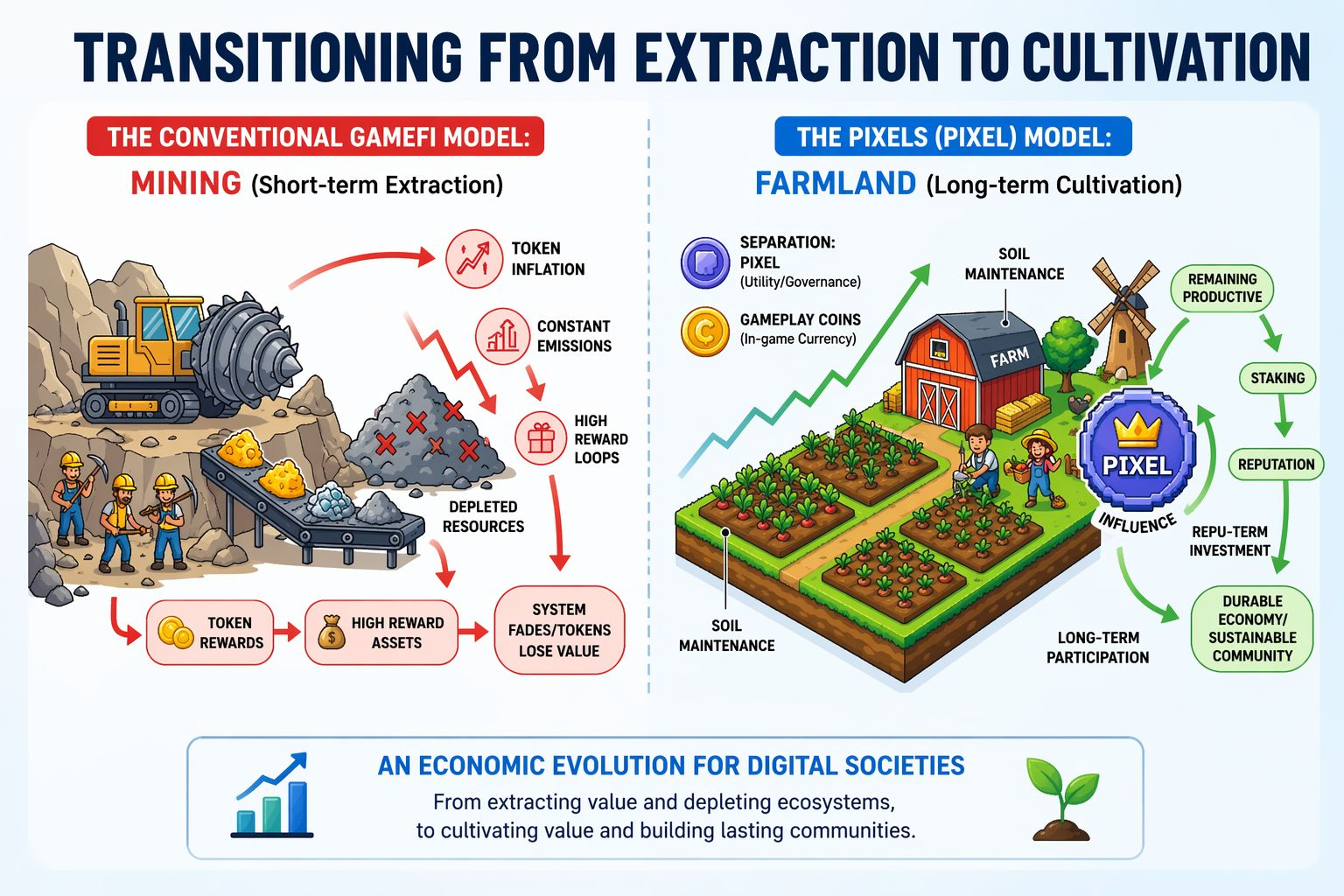
Can a game reward behavior without slowly training the entire ecosystem to exploit itself?
That’s the part most systems fail to handle.
And that’s where Stacked becomes interesting.
Stacked isn’t just a feature layer. It’s a LiveOps reward engine built by the Pixels team, with an AI game economist sitting inside it.
But the important part isn’t the label.
It’s what it actually does.
It helps studios decide:
when rewards should be given
which players should receive them
what behavior they’re trying to encourage
and whether any of it actually worked afterward
Because handing out rewards is easy.
Understanding whether those rewards improved retention, revenue, or long-term player value… that’s where things get difficult.
Most systems can show activity.
Very few can show meaning behind activity.
And that difference is bigger than it sounds.
You can usually feel it in games.
Some reward systems feel like they exist just to keep numbers up — login spikes, temporary activity, short bursts of engagement.
Others feel more intentional. Like the system is actually learning what players respond to, and adjusting over time.
One creates noise.
The other creates direction.
Not perfect direction… but at least something that evolves instead of repeating mistakes.
What makes Stacked more believable is where it came from.
It wasn’t designed in isolation. It came from the Pixels team actually dealing with broken incentives inside their own ecosystem.
Watching players adapt in unexpected ways.
Watching economies get stretched.
Watching every weak point get tested the moment real value entered the system.
That kind of environment changes how you think about game design.
So when Stacked is described as infrastructure instead of just a tool, it starts to make sense.
It’s already running inside Pixels, Pixel Dungeons, Chubkins. It’s already been tested where rewards actually matter — not just where they look good on paper.
And in web3 gaming, that matters.
Because every reward system eventually runs into the same problem:
What happens when players stop behaving like players… and start behaving like extractors?
If a system can’t handle that shift, it slowly breaks no matter how strong it looked at launch.
That’s also where fraud resistance becomes part of the design. Not as a headline feature, but as survival logic. Because once value enters gameplay, systems get stress-tested in ways normal game design never really prepares for.
And then there’s $PIXEL.
Instead of being locked to one game economy, it sits across multiple experiences as a shared rewards and loyalty layer.
That sounds small, but it changes how value flows.
Most gaming tokens fail because they depend too heavily on a single loop. Once that loop weakens, everything collapses with it.
Here, the idea is more distributed. Less dependent on one moment. More about repeated utility across systems.
And maybe that’s the real shift.
Stacked isn’t interesting because it’s “AI-powered” or “web3-native”.
It’s interesting because it treats rewards like something fragile.
Something that can improve a system when used carefully… or slowly destroy it when used blindly.
And systems like that don’t come from theory.
They come from breaking things first… and then learning what actually holds up when real players show up.