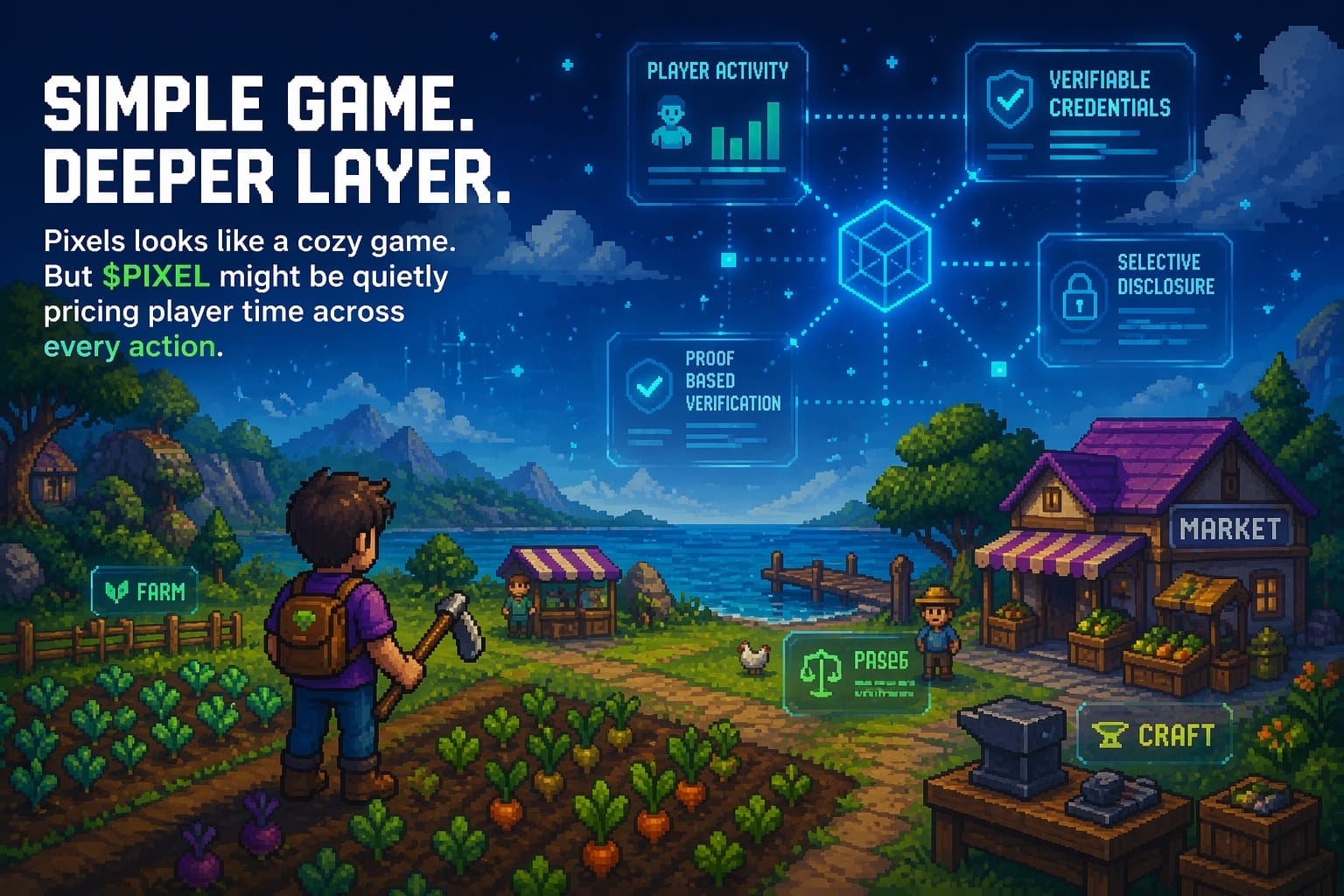
At first, Pixels just feels… easy.
You log in, plant some crops, walk around, maybe trade a bit. Nothing feels heavy. There’s no moment where the game forces you to stop and “figure things out.” It just flows. And honestly, that’s probably why most people don’t look too deeply at it.
But if you spend a little more time with it, something starts to feel different.
It’s not just what you’re doing—it’s how often you show up, what you choose to focus on, how you interact with others. Farming, trading, crafting… they stop feeling like random actions and start feeling like patterns. Like the game is quietly paying attention, not in an obvious way, but in a consistent one.
And that’s where it gets interesting.
Pixels doesn’t seem like it’s trying to rebuild your identity from scratch, which is what a lot of Web3 projects push for. There’s no pressure to define yourself through some new system or attach your name to a rigid on-chain profile. Instead, it feels like the game is doing something more natural—just watching what you already do, and slowly turning that into something that can be understood, maybe even verified.
Not your whole story. Just enough to say, “this player shows up,” or “this player trades well,” or “this player contributes.” That’s a very different approach to trust. It’s quieter. Less forced.
And if you look at it that way, $PIXEL starts to feel less like a simple reward token and more like a way of valuing time—specifically, the kind of time you spend inside the game. Not all time is equal. Someone who farms casually isn’t the same as someone who understands the market or helps keep the economy moving. Over time, those differences seem to matter more and more.
That idea is strong. If it works, it means your actions slowly turn into credibility, and that credibility could become something you can actually use or prove—without exposing everything about yourself.
But this is also where things get messy.
The moment people realize their time has value, they start optimizing it. That’s just natural. Players will test limits, find shortcuts, maybe even automate parts of the process. So the system has to figure out what’s real participation and what’s just noise dressed up to look real. And that’s not an easy line to draw.
Then there’s the bigger question—does any of this matter outside of Pixels?
Because if all this behavior, all this “trust,” stays locked inside the game, then it’s still useful, but only within its own world. For this idea to really mean something, it has to connect outward. Otherwise, it risks becoming just another well-designed system that never leaves its own bubble.
There’s also a subtle shift that can happen over time. The more a system starts measuring what you do, the more you start thinking about how you’re doing it. A game that once felt relaxing can slowly turn into something you try to optimize without even realizing it. That balance between playing and performing is fragile.
Still, there’s something I respect about how Pixels is approaching this.
It’s not loud about it. It’s not trying to sell you a big vision upfront. It just runs in the background, letting your actions build meaning over time.
Maybe it works, maybe it doesn’t.
But at the very least, it’s asking a better question than most: what if trust doesn’t need to be created from scratch? What if it can just grow naturally from what people are already doing—one small action at a time?