
I’ve seen this movie too many times in crypto gaming. A team waves around a deck, drops a token, shows a roadmap full of neon nonsense, then calls attention a business model. Real numbers never show up. Real cash flow stays missing. The machine looks busy, but the store is empty.
That’s why the PIXEL case matters.
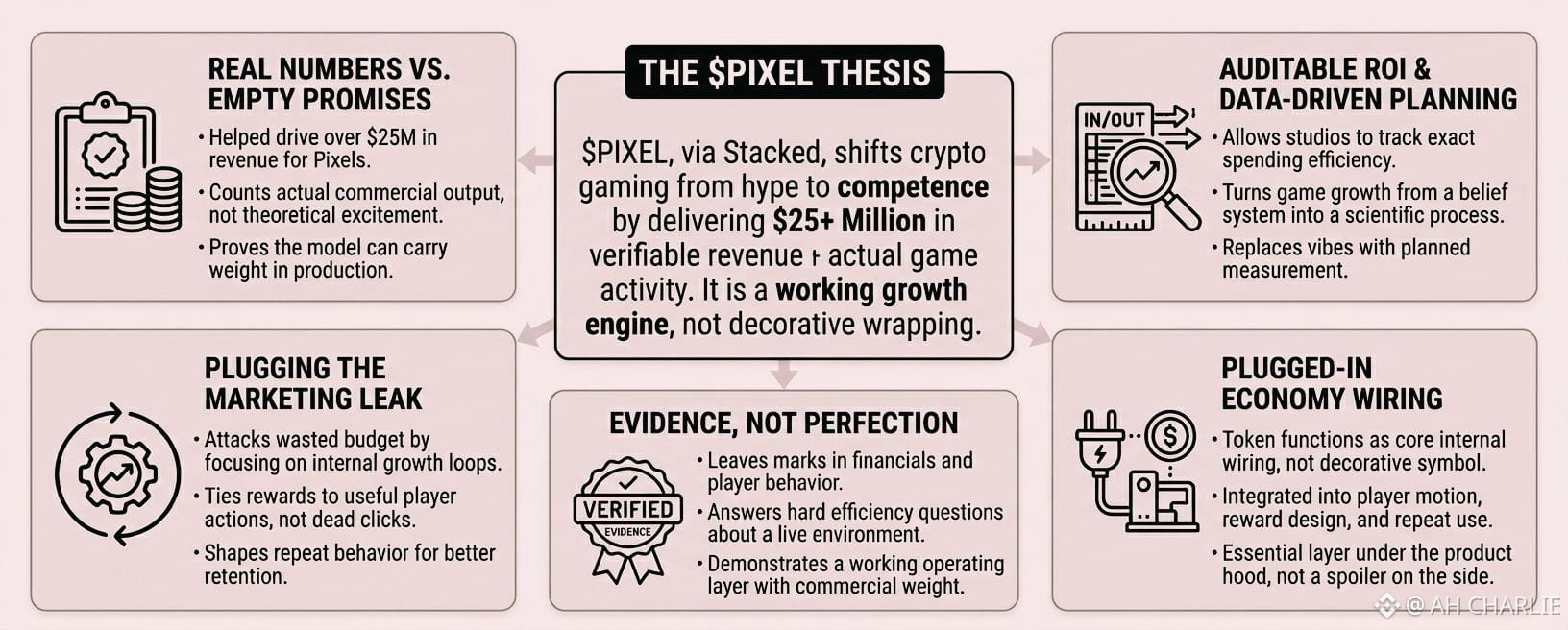
Not because it sounds futuristic. Not because the branding is slick. Because the system behind it, Stacked, has already helped drive more than $25 million in revenue for Pixels. That changes the conversation. Fast. We are not looking at a theory anymore. We are looking at a working engine that touched the bottom line. In plain English, it helped bring in money that can be counted, checked, and matched to actual game activity. In this sector, that alone is rare enough to feel suspicious.
The first thing studios should notice is this: Stacked is not selling a vague promise. It is solving a brutal old problem. Game studios usually burn huge amounts of money trying to get players in the door, keep them active, and bring them back. Most of that budget leaks out through ad networks, middlemen, and broad campaigns that hit a lot of people who do not care. It is like trying to fill a cracked bucket with a fire hose. Loud effort. Weak result.
Stacked seems to attack that waste directly.
Instead of spraying budget into outside channels and hoping some of it turns into real play, it turns rewards into a more targeted growth loop inside the game itself. That matters. A lot. Because if rewards are tied to useful player actions, not dead clicks, then the studio is not just buying noise. It is shaping behavior. Better retention. Better repeat activity. Better spending flow. Cleaner data. Less blind spending. That is operational value, not story time.
And PIXEL sits right in the middle of that loop.
That is the second part people miss. When a game economy works, it does not work because the token exists. Tokens are cheap to launch. Any bored team with a logo can do that before lunch. A real game economy works when the token is plugged into player motion, reward design, and repeat use across a live system. PIXEL starts to matter more when it stops being a symbol and starts acting like wiring.
That is what this revenue number hints at.
If Stacked helped push over $25 million into Pixels, then we are not talking about cosmetic support. We are talking about a core growth layer. The engine is not hanging off the side of the product like some decorative spoiler. It is under the hood. Fuel in, motion out. Studios should pay attention to that because this is the part most crypto gaming teams fake. They talk about community. They talk about loyalty. They talk about ecosystem. Fine. Cute words. But if none of that leads to measurable player action and measurable revenue, it is just a campfire story in a pitch deck.
The third point is where this gets serious for builders.
Auditable ROI changes how studios make decisions. ROI just means return on what you spent. Simple. If a studio can track what went in and what came back out, it can plan with less guessing. That is huge. It means growth stops being a belief system and becomes a process. Spend here. Measure this. Keep what works. Cut what does not. Again, very normal in mature industries. Weirdly rare in crypto, where half the sector still behaves like vibes are a treasury strategy.
For game studios, this is not just about one title doing well. It is about proof that the model can carry weight in production. Live users. Live rewards. Live revenue. Not “coming soon.” Not “testnet excitement.” Not “strong community response.” Actual commercial output. The kind that forces harder questions. Can this lower user acquisition waste? Can this improve retention efficiency? Can this make reward spending less dumb? Can this turn game growth from a leaky funnel into a closed loop?
With PIXEL, the early answer looks less theoretical now.
This is what a proof of concept is supposed to look like. Not a whitepaper. Not a founder thread. Not a dashboard screenshot with no context. A real proof of concept leaves marks in the financials. It shows up in player behavior and in revenue. Stacked doing that for Pixels is important because it gives studios something rare in Web3 gaming: evidence.
Not perfection. Evidence.
And honestly, that is enough to get my attention. I do not care about grand claims anymore. I care about whether the machine works when real users hit it, when budgets get stressed, when the novelty fades. PIXEL, through Stacked, has at least shown one thing clearly: this system is not just decorative crypto wrapping around a weak game loop. It appears to be an actual operating layer with measurable commercial weight.
In this market, that is not magic.
It is just competence. Which, sadly, makes it stand out.
