

Something about premium currencies in Web3 games has always felt a bit too clean to me. You earn them, maybe buy more, spend them to move faster, and that’s kind of the whole story. It’s efficient, predictable and strangely empty after a while. The more you engage with it, the more it feels like you’re just accelerating your exit. Not playing, just getting through it faster.
I felt that again while playing @Pixels . At first, everything looked familiar. Farming loops, crafting cycles, small upgrades stacking over time. I assumed the premium layer would behave the same way, earn, spend, optimize, repeat. That quiet shift where the game slowly turns into a system you operate instead of something you experience.
But after a bit, something didn’t sit right. The usual logic wasn’t holding. Spending didn’t always translate into clean advantage, and earning didn’t feel linear. It wasn’t random either. It just felt like the system wasn’t treating every action equally, even when they looked identical on the surface.
 At one point, I caught myself thinking something I hadn’t really considered before in a game like this, what if I’m being rewarded more than I should be and the system knows it? It sounds strange, but there were moments where outcomes felt slightly out of sync with effort. Not enough to complain about, just enough to feel like something was being quietly adjusted.
It didn’t feel static either. More like the system was remembering patterns, then slowly getting better at judging them over time. Not in big visible changes, but in small shifts that compound. The kind you only notice if you keep playing long enough. That’s when it stopped feeling like a reward system and started feeling like something that evaluates.
You can still optimize, but it doesn’t hold. The more predictable the loop becomes, the less reliable it feels. Almost like the system is pushing back against anything that looks too extractive. Not aggressively, just enough to make sure no single pattern dominates for too long. It’s subtle, but it changes how you approach the game.
And it’s not just about giving less, it also feels like the system takes things back. Not in a direct way, but in how value flows. Some of what you generate doesn’t hold the same impact, depending on how it was created. Which makes it feel less like a one way reward system and more like something that’s constantly balancing and correcting itself.
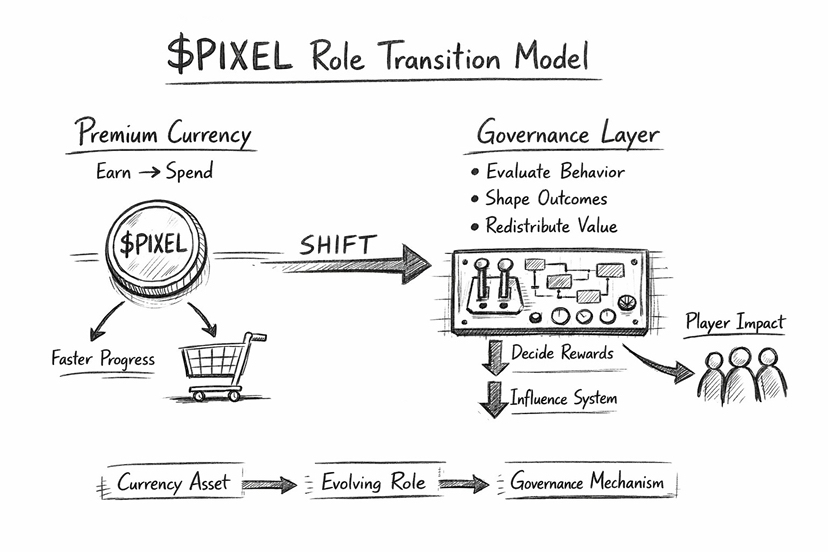
That’s where $PIXEL started to feel different to me. Not just something I earn or spend, but something that exists inside this balancing layer. It doesn’t just move through the economy, it feels tied to how outcomes are decided across the system. Not just influencing my experience, but quietly participating in how value gets distributed and corrected over time.
From the outside, though, the market doesn’t really treat it that way. Price moves, supply unlocks, sentiment shifts. Last I checked, it’s still sitting in that mid-range zone, active, but not dominant. It’s being traded like any other GameFi token, which makes me wonder if people are missing what it’s actually trying to become.
Because if $PIXEL is part of how the system decides what behavior deserves to persist, then it’s not just a currency, it’s closer to a steering layer. Not governance in the traditional sense, where you vote and wait, but something more continuous. Something that shapes outcomes in real time, based on how players collectively behave.
That’s where things get complicated. Can a system really reward meaningful behavior without players eventually figuring out how to simulate it? Optimization doesn’t disappear, it just adapts. And if players start mimicking “good behavior” at scale, does the system keep learning or does it fall behind?
It reminds me of environments where value isn’t fixed, but constantly recalibrated. Where small behavioral differences compound over time, and the system quietly separates users based on alignment. Not through hard rules, but through continuous adjustment. Some players stay in sync. Others drift, even if they’re doing the same things.
And in Pixels, that drift doesn’t just affect individuals. It feels like it affects the system as a whole. If too many players lean into extraction, the overall quality of rewards seems to weaken. If behavior aligns more naturally with the game, things stabilize. It’s not something you can measure directly, but you can feel it over time.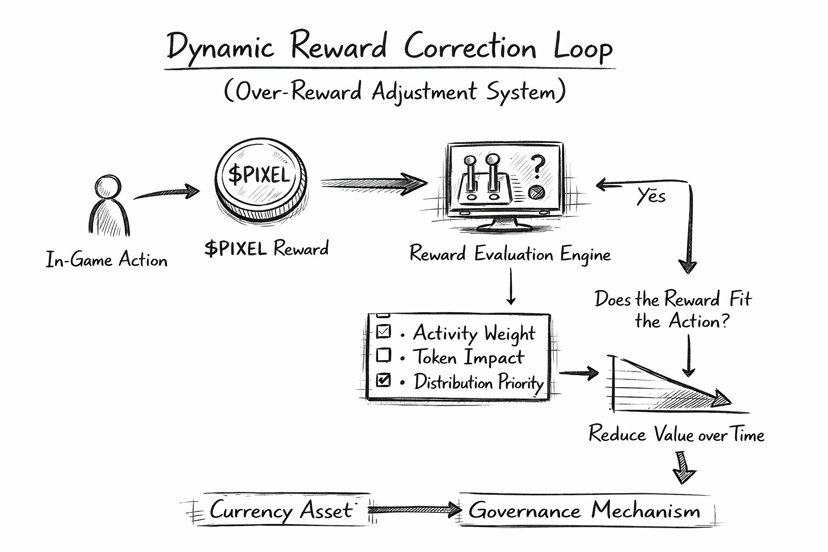
That changes the loop entirely. It’s no longer just about farming efficiently and leaving at the right moment. Because if everyone does that, the system adapts, value shifts, and the strategy loses its edge. The usual pattern, farm, sell, leave, starts breaking down when the system actively resists it.
What replaces it isn’t perfectly clear yet. But it feels closer to something where staying matters. Where coming back tomorrow isn’t just habit, it’s part of how the system continues to learn, refine, and redistribute value more accurately. Because without that continuity, there’s nothing to evaluate, nothing to correct, nothing to improve.
I don’t think #pixel is fully there yet. Systems like this need scale before they become precise. Early on, behavior is messy, signals are weak, and even a well designed system is still figuring things out. Sometimes distribution matters more than design at that stage, which makes everything harder to judge.
But I also don’t see $PIXEL as just another premium currency anymore. It feels like it’s trying to sit at a deeper layer, somewhere between economy and governance, where it helps decide not just how players progress, but what kind of behavior the system is built to sustain.
That’s not an easy thing to pull off. And it’s definitely not guaranteed to work.
But it’s different enough to notice.
The idea makes sense. The rest depends on execution.