
I’ve been spending real time inside Pixels these past days, and one subtle tension refuses to leave my mind.
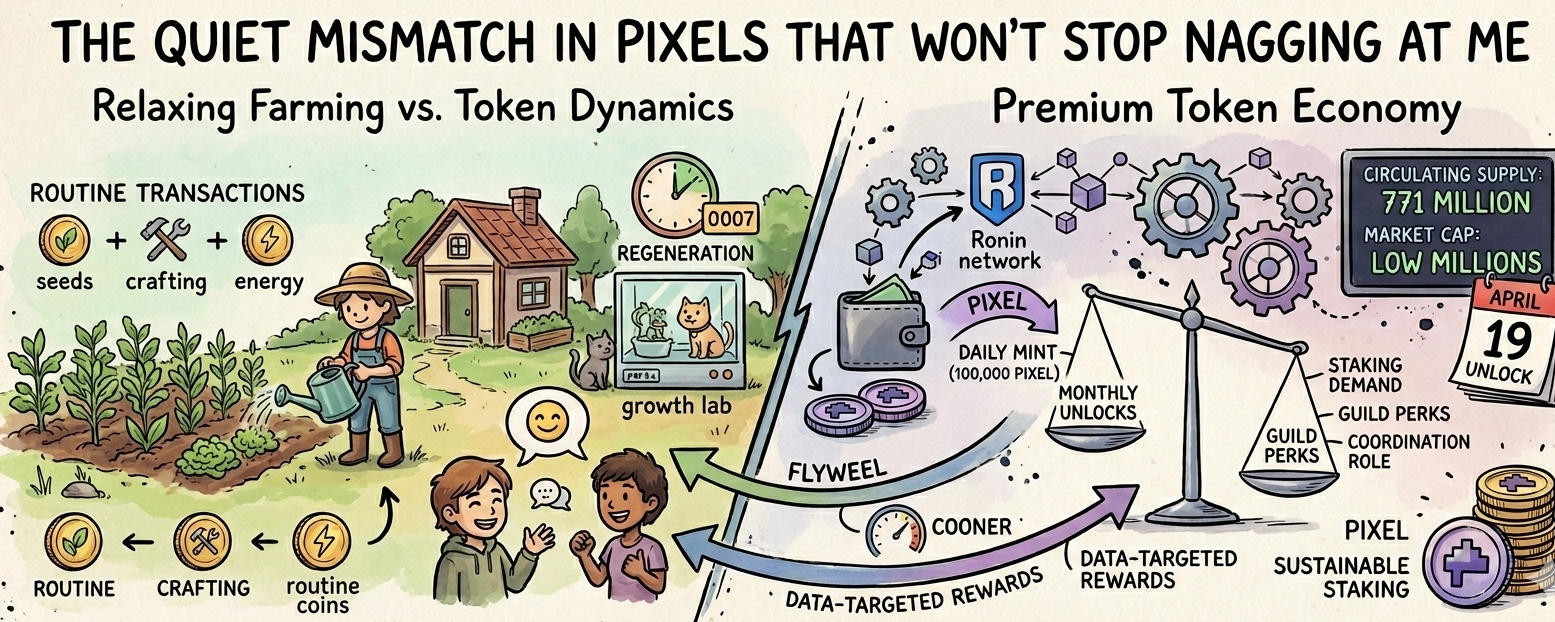
The game itself is quietly impressive and relaxing in a way that feels rare. You sign up with nothing more than an email, watch energy regenerate steadily at around 19.8 per hour, tend crops on your owned farmland NFT or rent a simple Speck plot, hatch pets in the growth lab, customize your avatar, and drop by the carnival or invite friends over to your farm. It creates a daily loop that actually feels enjoyable and brings you back naturally, without the usual heavy grind pressure. Yet the token side introduces a more complex layer. Circulating supply has reached substantial levels (with current trackers showing roughly 771 million while broader absorption sits higher), the market cap lingers in the low millions while FDV stays near 40 million, and the system continues minting a fixed 100,000 PIXEL daily for data-targeted rewards. Tomorrow, April 19, an unlock will release approximately 89–91 million tokens across advisors, ecosystem rewards and related categories worth several hundred thousand dollars at prices hovering near $0.008. The supply flow is steady, even as the core gameplay remains light, owned, and centered on fun.
What keeps bothering me most is the thoughtful separation they built between the two economies. Everyday in-game coins handle the routine flow buying seeds, crafting at the kiln or textile mill, trading with NPCs, and restoring energy at the sauna. PIXEL serves as the premium coordination layer above it: staking for passive rewards, accelerating builds, unlocking cosmetics and guild perks, minting extra pets, or helping guide funding toward new games in the expanding platform. The architecture is smart a centralized backend quietly evaluates quests, social interactions and meaningful contributions to decide daily reward distribution, while the on-chain Ronin layer securely manages true ownership through land NFTs, pet transfers and seamless wallet connections. This creates an exceptionally smooth user experience where blockchain stays in the background, but it also puts quiet, ongoing responsibility on the incentive structure. Factors like certain wallet concentration and relatively thin liquidity on Katana pools (alongside major exchanges) add sensitivity, particularly when daily trading volumes often climb to 20–30 million a striking ratio relative to the current market cap.
If this observation holds, the real long-term test for Pixels will be how steadily its publishing flywheel absorbs these daily mints and monthly unlocks. The flywheel is built to attract more games, gather richer player data, sharpen reward targeting toward genuine value creation, and gradually lower user acquisition costs over time. Right now on-chain activity holds up well, supported by resource timers, guild systems, land rentals that let owners share real yields, and pets that bring tangible utility. User growth feels more authentic than many past play-to-earn attempts, thanks to free entry and social features that encourage regular returns. The market seems to price PIXEL’s coordination role as reasonably established, even though the hybrid architecture still leaves the team some flexibility to fine-tune the targeting behind the scenes. Should engagement levels ease or the data model prove less precise than hoped, those high volumes could turn toward sell pressure fairly quickly especially with the remaining locked supply continuing to vest in the years ahead.
I’m not entirely settled on the final picture yet, but what stands out most clearly to me is that Pixels has put together something structurally more solid than many projects in the space. The hybrid design delivers practical, lasting advantages: gameplay that never forces blockchain into the spotlight, land you can truly own and monetize through rentals, pets that add real depth, and an evolving world that grows with new chapters and features while staying loyal to its “fun first” foundation. PIXEL rarely acts as the main driver for casual daily play; it functions more as an optional but meaningful deeper layer for those who want to stake, enhance their experience, or help shape the broader ecosystem. The most important factor going forward will be whether this clean division between everyday coins and premium PIXEL utility remains stable through the unlock cycles, showing if demand for staking and high-value features is genuinely organic and sustainable.
The live idea I’m carrying forward is this: if on-chain metrics and liquidity patterns begin to diverge noticeably from headline player counts right around these supply events while the core farming loops and social interactions stay consistently strong it won’t automatically signal that the game is losing its edge. It may simply reveal that the token design placed its bet on the flywheel reaching full self-sustainability a little earlier than the complete architecture was fully ready to support in practice. I’ll be watching closely how tomorrow’s April 19 unlock plays out in the market.
