
It wasn’t the reward that stood out. It was how quickly I stopped caring about it. I finished a loop, collected what I earned, and instead of chasing the next optimization, I slowed down. Not intentionally. It just didn’t feel urgent. Around me, other players were still active, some efficient, some clearly not but no one seemed locked into that familiar race to extract and exit. That’s usually where things fall apart.
At first, I thought Pixels was just another well-designed farming loop. The structure was familiar. Time in, rewards out, optimize the gap. I’ve seen that pattern enough to know how it ends. Efficiency takes over, behavior compresses, and eventually progress starts to feel disconnected from effort. But here, it didn’t collapse on schedule.
The repetition was still there, but it didn’t feel hollow. More importantly, players weren’t behaving like pure extractors. That’s where the assumption started to shift. Because most GameFi systems don’t fail due to lack of gameplay. They fail because incentives quietly teach players to treat the system like something to drain. They reward activity, but not value.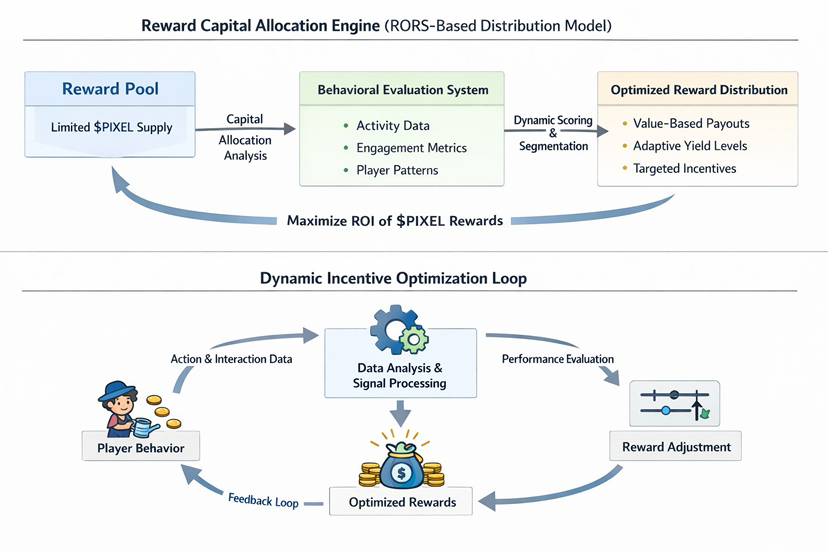
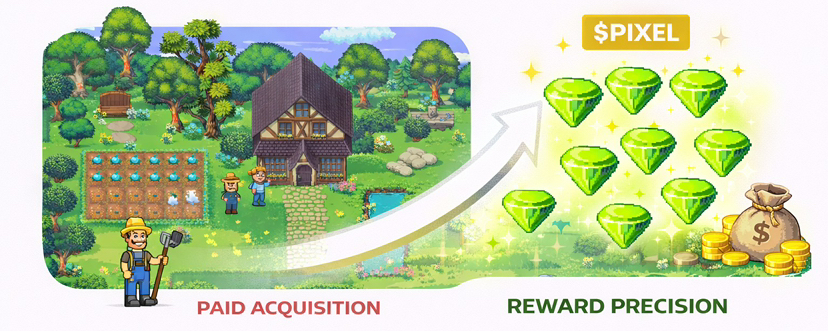
Once players figure that out, everything becomes about efficiency. Traditional user acquisition just accelerates the problem. You bring users in, pay them to engage, and hope enough stick around. Most don’t. They extract what they can and move on. Growth becomes replacement.
What @Pixels seems to be exploring is something closer to reward precision. Not increasing rewards, but allocating them better. Over time, outcomes don’t feel perfectly consistent. The same action doesn’t always lead to the same result. At first it feels off. Then it starts to make sense.
The system appears to be working with a limited reward pool, distributing it based on signals gathered from how players behave, not just what they do. Efficiency still matters, but it’s no longer the whole game. Some forms of efficiency start to feel less valuable over time. Highly optimized, repetitive behavior doesn’t scale rewards the same way. Not because it’s blocked, but because it’s deprioritized.
That’s where the product starts to reflect the idea. Chapter 3 introduces Exploration Realms, procedurally generated islands accessed through Voyage Contracts purchased with $PIXEL. Progression now involves spending back into the system, not just extracting from it. The token becomes part of access, not just output.
The LiveOps layer pushes this further. On the surface, it looks like rotating events, Fishing Frenzy, Harvest Rush but it behaves like a continuous control system. It redirects attention, reshapes activity, and creates new behavioral signals. The environment keeps shifting, and in that movement, reward allocation becomes more precise.
The social layer ties it together. Proximity chat, referrals, share to earn, these aren’t just features. They function as low cost acquisition and retention reinforcement. Players bring in other players, but more importantly, they stay because interaction itself carries value. Growth starts compounding inside the system.
That’s when monetization starts to look different. It’s no longer driven purely by how many users you bring in, but by how well you keep the right ones. $PIXEL sits at the center of that loop. It’s not just earned and sold. It’s used to access progression layers, cycling value back into gameplay instead of letting it exit immediately.
Still, there’s real tension. If rewards are based on behavior, what stops players from optimizing toward whatever the system favors? At some point, optimization starts to mimic engagement. And early on, with limited data, the system may misread patterns and reward the wrong things. That risk is real.
But the system doesn’t need to be perfect. It just needs to make extractive behavior less optimal than meaningful participation. Over time, that difference compounds. Players who align with the system gain small advantages, better rewards, better access, better positioning. No hard barriers. Just divergence.
You see this outside gaming too. Marketplaces reward reliable sellers. Platforms surface consistent creators. No one is excluded, but outcomes shift based on behavior. Slowly at first, then more clearly. You’re not buying access. You’re building alignment.
That’s where retention overtakes rewards. Because rewards only matter if players come back. Most GameFi systems create activity, not continuity. And without continuity, no economy holds. The loop here is simple, players generate data, data improves rewards, rewards improve experience, experience retains players.
Compare that to the default loop. Users come in, farm, sell, and leave. Price drops, incentives weaken, and the system spends again to refill the top. One loop compounds. The other leaks.
Chapter 3 feels like a move toward the first. Exploration creates meaningful sinks. LiveOps continuously reshapes incentives. Social systems reduce acquisition cost while strengthening retention. Together, they form a system trying to place rewards where they create long term value.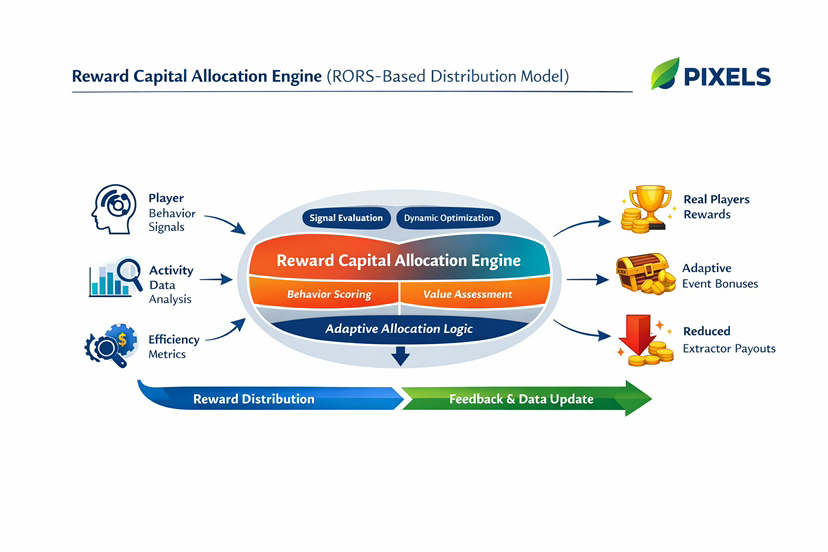
That doesn’t guarantee success. Early signals are noisy. Data is incomplete. The system may misprice behavior before it learns. And without enough players, even good design lacks feedback. That’s why distribution matters more than design at the start.
Still, the direction is clear. #pixel doesn’t feel like a game trying to outspend others on rewards. Or a token trying to hold attention through emissions. It feels like a live economy trying to reduce wasted incentives and reward the behaviors that actually sustain it.
Not perfectly. But intentionally.
And if that direction holds, monetization stops being about who you bring in. It becomes about who you keep.
If behavior holds, everything else follows.