
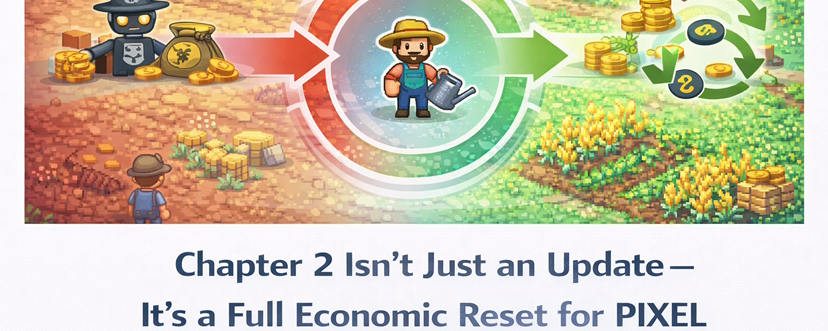
Something felt off after Chapter 2 went live. Not broken, just recalibrated. The land looked the same, the crops grew the same, the loop was still familiar. But the way people moved through it had changed. Less urgency, fewer obvious grind paths. Some players were still optimizing, but it didn’t look as clean anymore. Almost like the system had shifted just enough to make old habits unreliable.
At first, I thought @Pixels was doing what every GameFi project eventually does, tweak rewards, stretch emissions, buy time. A typical “new chapter” that’s really just a softer version of the same loop. I’ve seen enough of those to recognize the pattern early.
But this didn’t feel like a tweak.
It felt like the system stopped agreeing with the players.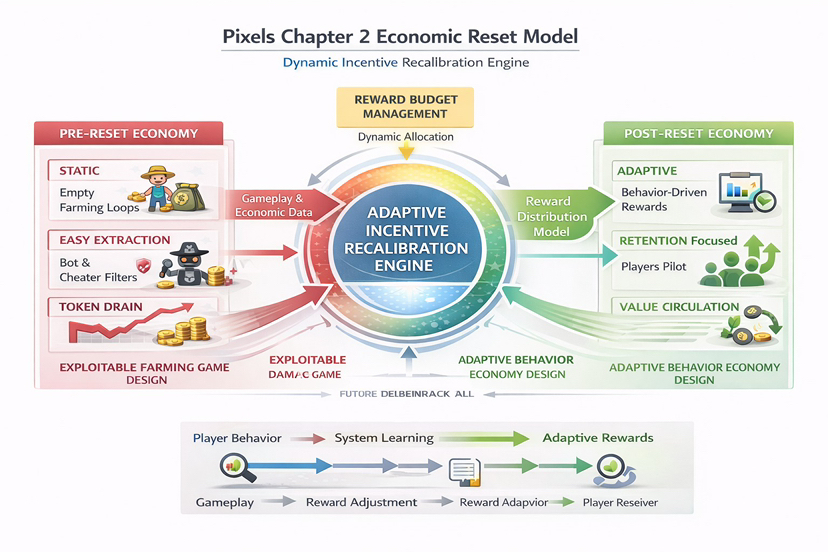
The strategies that used to work didn’t disappear, they just stopped working consistently. Actions that once guaranteed returns became conditional. Not random, not nerfed outright, just less predictable. And that kind of friction does something interesting. It forces you to stop thinking in routines and start thinking in terms of alignment.
That’s where the shift really begins. Most GameFi economies reward actions. Do something, get paid. Simple, transparent, and easy to optimize. But that simplicity is exactly what breaks them. Once the optimal path is clear, the system gets solved. And once it’s solved, it gets drained.
Chapter 2 seems to be pushing against that failure mode.
The game still presents itself as simple. You farm, craft, trade, interact. There’s progression, a light social layer, a sense that your time compounds into something persistent. But underneath, the reward system doesn’t feel fixed anymore. It feels selective. Like it’s constantly deciding what behavior is actually worth reinforcing.
And that implies something important.
The system can’t reward everything.
There’s a limit, a budget, whether explicit or not and that budget has to be spent carefully. Not every action deserves the same outcome, and not every player gets the same share over time. The system isn’t trying to be fair in the short term. It’s trying to be efficient in the long term.
That’s a different kind of economy.
Instead of distributing tokens evenly, it’s allocating them where they generate the most value. And value, in this context, doesn’t just mean activity. It means retention. Contribution. Signal over noise. The kind of behavior that keeps the system stable rather than extracting from it.
You don’t see it directly. You feel it over time.
And that’s where things get more complicated. Because if rewards are being allocated based on behavior, players will naturally try to adjust their behavior to match what the system prefers. Optimization doesn’t go away, it evolves. The risk is that “high value behavior” becomes just another pattern to mimic.
So the system has to keep adapting faster than the players.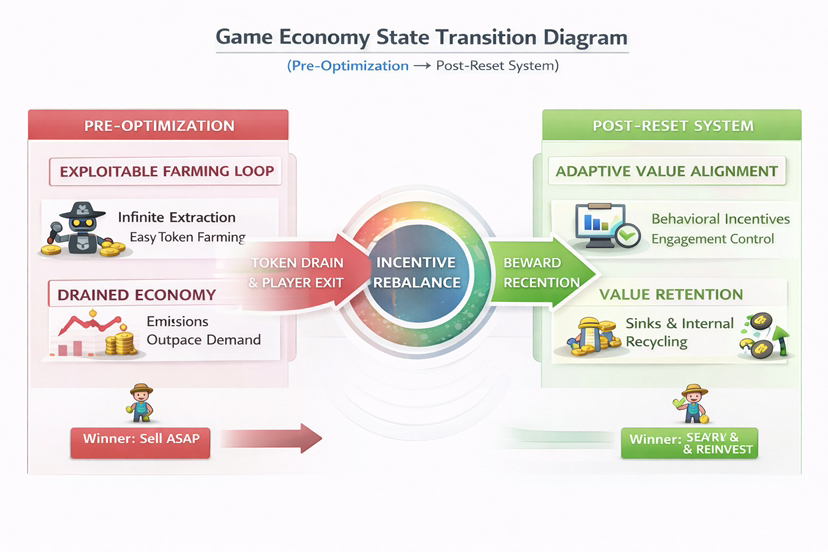
That’s not easy, especially early on. The system is still learning, and the data it relies on is limited. Signals are weak. Some behaviors will be mispriced. Some rewards will go to the wrong places. And those early decisions matter, because they shape how players behave later.
In a way, the system is training players at the same time players are trying to decode the system.
That tension doesn’t disappear.
From a token perspective, this adds another layer. Supply continues regardless of how smart the design is. Unlocks don’t wait for the system to mature. So the real question isn’t just whether Chapter 2 improves the economy, it’s whether the system can generate enough meaningful engagement to absorb that supply over time.
Because demand here isn’t just about buying.
It’s about staying.
Pixels seems to be leaning into that by trying to slow down how value leaves the system. Not by forcing it, but by creating reasons to keep it circulating internally. Progression systems, in-game sinks, and participation loops all quietly encourage players to reinvest rather than extract immediately. Value doesn’t just flow out, it gets reused, redirected, and, ideally, compounded inside the ecosystem.
And that’s where the system starts to extend beyond just players. There are early signs of a broader layer forming, creators, contributors, referral-driven growth. Value isn’t only generated through gameplay anymore. It’s starting to emerge from the network itself. That adds complexity, but also resilience, if it scales.
Still, none of this removes the core constraint.
If players don’t stay, the system has nothing to optimize.
No data, no feedback, no refinement. Everything depends on whether people come back, not because rewards are high, but because the experience keeps adjusting in ways that feel worth returning to. That’s the real shift here. Rewards are no longer the product. Behavior is.
Utility only works if someone comes back tomorrow.
And if it works, the loop becomes something more stable. Players interact with the system, their behavior generates data, that data reshapes how rewards are allocated, and those rewards influence how players behave next. Over time, the experience improves, retention strengthens, and the system has more signal to work with.
If it fails, it falls back into something familiar.
Users optimize quickly, extract what they can, sell, and leave. Price weakens, activity drops, and the system loses relevance. That loop is easy to fall into, and hard to escape.
Chapter 2 is clearly trying to break it.
But breaking a loop is easier than replacing it.
For this to work, the system needs scale. Enough players, enough variation, enough time to learn what actually creates value. Without that, even a well-designed economy struggles to calibrate itself. And early on, distribution might matter more than design. You need participants before you can optimize participation.
So this doesn’t feel like a content update.
It doesn’t even feel like a normal economic rebalance.
It feels like Pixels is rebuilding its core around a system that can adjust itself, one that doesn’t stay static long enough to be solved.
Concept makes sense.
Execution is hard.
Direction feels right.
Outcome is uncertain.
Don’t watch the token. Watch the players.
