
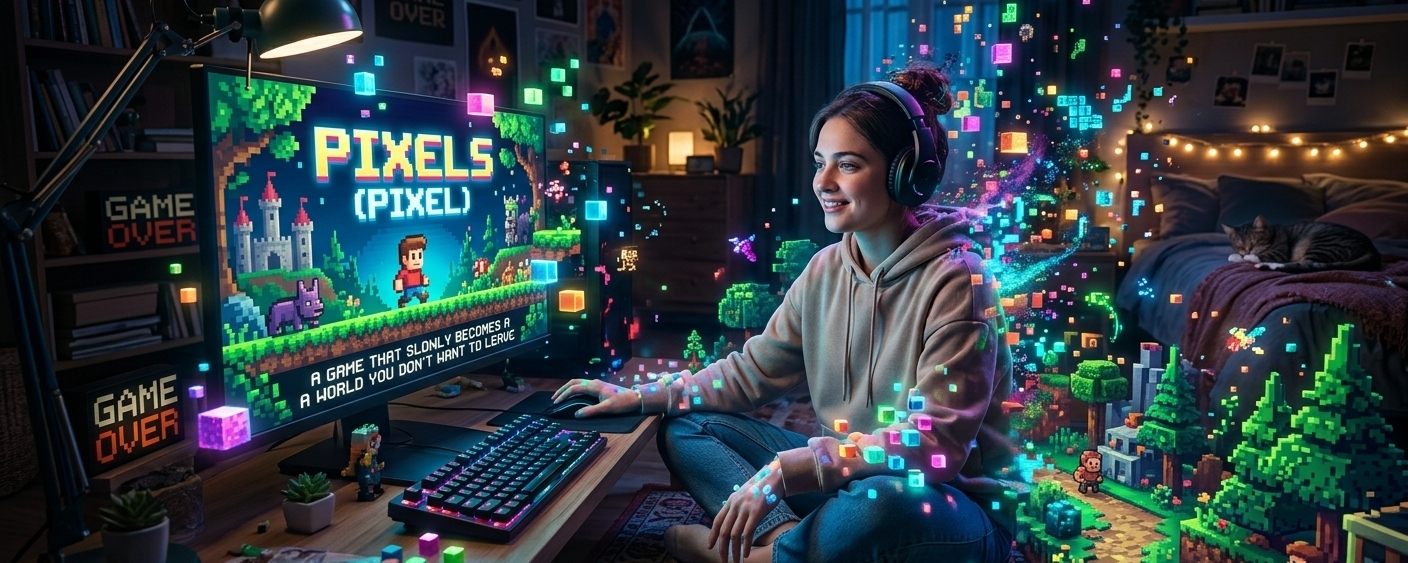
Most projects in this space arrive with noise, urgency, and a feeling that if you don’t act now you might miss everything, but Pixels never really felt like that to me. It felt quiet, almost like it was growing somewhere in the background while everyone else was chasing attention. And strangely, that’s what made it stand out more. Because when something doesn’t try too hard to convince you, it usually means it’s focused on building something real. As I spent more time understanding it, it became clear that Pixels wasn’t trying to be another short-term “play-to-earn” story. It felt like they were building a place where people could actually stay, not just log in for rewards and disappear. That one shift in mindset changes everything, because when a system is built for staying, every decision inside it becomes more thoughtful, more patient, and more sustainable.
At the beginning, it feels simple in a way that almost lowers your guard. You farm, you explore, you collect resources, and it reminds you of older games that didn’t try to overwhelm you. For a while, you don’t think too deeply about it, you just play. But slowly, something starts to change. The things you do begin to matter in ways you didn’t expect. The crops you grow aren’t just for you, they connect to other players, to markets, to systems that depend on activity. Without realizing it, you move from just playing to participating. I found myself going from casual actions to actually thinking about efficiency, planning, and positioning inside the game. And the interesting part is that no one forces that shift on you. It happens naturally. They don’t push complexity, they let you grow into it, and that’s why it feels more real than most systems that try to impress you too quickly.
A big part of why the experience feels smooth comes from the technology quietly stepping out of the way. In many blockchain games, you feel the system constantly, through delays, fees, and interruptions that break immersion. Here, that friction is almost invisible. By building on an infrastructure designed for gaming, interactions feel fast and natural, and you don’t stop every few minutes to think about what’s happening behind the scenes. You just keep going. And when you reach that point where you stop noticing the technology entirely, something important happens. The game becomes the focus again. That’s a small detail on the surface, but it’s actually one of the biggest steps toward making Web3 usable for everyday people.
The economy inside Pixels doesn’t feel forced, and that’s what makes it interesting. You earn through your actions, but you also spend, trade, and reinvest in ways that keep everything moving. It’s not just about extracting value as fast as possible, it’s about being part of a loop that continues over time. Land changes the way you think about everything. It’s not just an asset you hold and wait for price movement, it’s something you use, something that produces, something that connects you deeper into the system. When you own land, you stop thinking short term. You start thinking about sustainability, about how your presence fits into the bigger picture. And when enough players start thinking like that, the entire economy becomes more stable.
What Pixels is really trying to do feels like a response to everything that went wrong before. The first wave of Web3 games was built around speed and extraction. People came in for rewards, and when those rewards slowed down, they left just as quickly. That cycle repeated again and again. Pixels seems to be asking a different question, not how much you can earn today, but why you would come back tomorrow. That shift leads to better systems, deeper engagement, and a stronger foundation. It’s not about removing earning, it’s about making it part of something larger instead of the only reason to stay.
At the same time, it’s not perfect, and it’s important to see that clearly. The balance of the economy still matters, because if rewards grow faster than demand, pressure builds over time. Player behavior is unpredictable, and even strong systems depend on people choosing to stay and participate. There’s also reliance on the surrounding ecosystem, and like everything in crypto, external conditions can influence how the project is perceived and used. These risks don’t disappear just because the design is better, they just become more manageable.
Looking ahead, Pixels feels like it’s moving toward something bigger than just being a successful game. It feels like an early version of a persistent digital world, where people don’t just visit, they build, interact, and stay connected over time. We’re slowly seeing a shift from temporary engagement to long-term participation, from speculation to experience. It’s not fully there yet, but the direction is clear, and sometimes direction matters more than speed.
What stands out the most is how calm the whole approach feels. There’s no rush, no pressure to prove everything overnight. It just keeps growing, layer by layer, player by player. And in a space where most things try to move too fast and collapse under their own weight, that kind of steady progress feels different. Maybe that’s why it works. Maybe that’s what this space needed all along.
And if it continues like this, then Pixels won’t just be remembered as another Web3 game. It might be remembered as one of the moments where things started to change, where digital worlds began to feel a little more real, a little more human, and a lot more worth staying in.
