
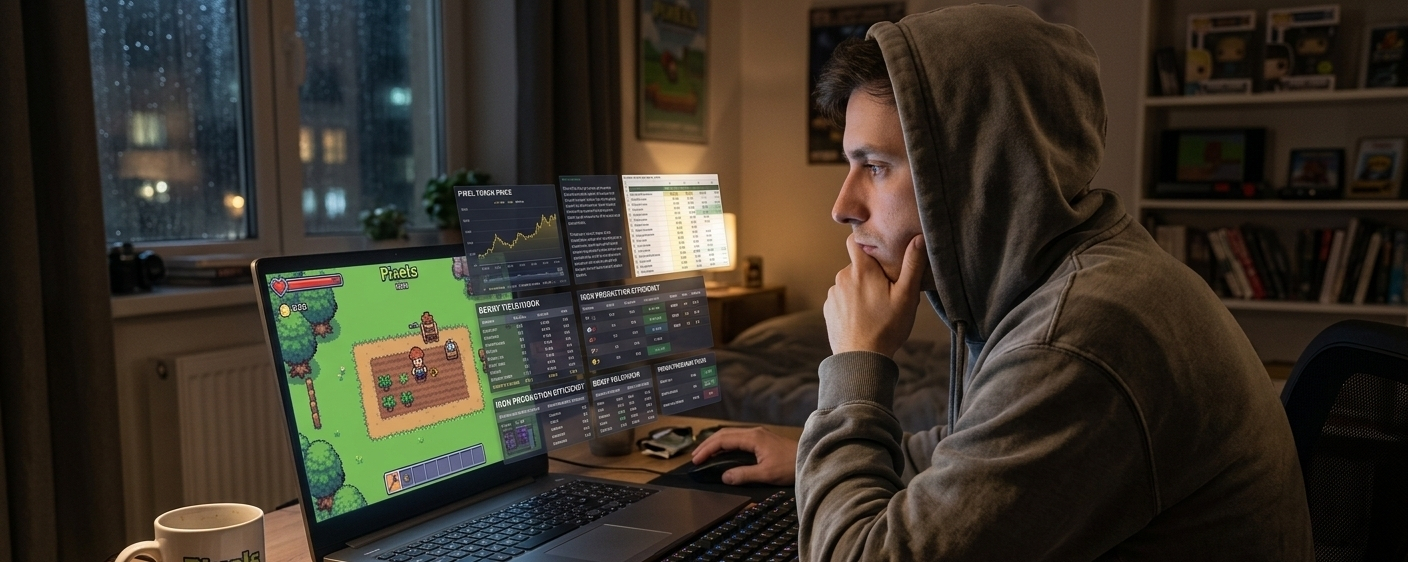

I’ve been thinking about this for a while now.
At what point does a game stop being a game?
Not in an obvious way. Nothing breaks. Nothing feels “wrong” at first.
But slowly, the feeling changes.
You log in, do your usual stuff, check what’s worth doing… and somehow it starts to feel less like playing and more like managing something.
That’s kind of where I’m at with Pixels right now.
From the outside, it looks like everything is working.
More players, more activity, more attention—especially after the move to Ronin. And honestly, that move made sense. Lower fees, faster transactions, built-in audience… it’s almost the perfect setup for growth.
And yeah, growth happened.
But I keep coming back to this one thing:
Did people come because the game got better… or because it just became easier to be there?
Because those are not the same.
When Pixels was on Polygon, it felt simple. You’d log in, farm a bit, maybe explore, maybe not. It wasn’t deep, but it was easy to enjoy.
Now it feels different.
Not worse, just… different.
Everything has a purpose now. Land isn’t just something you have—it’s something that generates. Resources aren’t just part of gameplay—they’re something you think about in terms of output.
And you start noticing your own behavior changing.
You’re not just playing anymore.
You’re thinking in terms of efficiency.
“What should I do next?”
“What gives me the best return?”
That shift is subtle, but once it happens, it’s hard to ignore.
Then there’s the token side of it.
PIXEL is basically everywhere. Progression, upgrades, access—it all connects back to it.
Which makes sense. But at the same time, it creates this dependency where the whole experience starts feeling tied to something outside the game itself.
Like… if the token moves, the feeling of the game kind of moves with it.
And that’s a bit strange if you think about it.
Because now you’re not just playing—you’re indirectly part of a system that behaves like a market.
I’ve seen people get excited about the upcoming updates—more depth, production chains, all that.
And yeah, that’s probably needed. Simple loops don’t last forever.
But there’s always this risk that adding more systems doesn’t actually make things more fun… it just makes things more complicated.
There’s a point where you stop relaxing in a game and start keeping track of it.
And I’m not sure that’s always a good trade.
To be fair, Ronin helped a lot.
It removed friction. It brought in people. It gave Pixels a real push.
But bringing people in is one thing.
Giving them a reason to stay is something else entirely.
If rewards slow down tomorrow… do people still show up?
I don’t think there’s a clear answer to that yet.
And maybe that’s the part we don’t talk about enough in Web3.
We look at numbers all the time—users, volume, activity.
But we don’t really talk about whether people are just… enjoying themselves.
Not optimizing. Not earning.
Just playing because they feel like it.
That kind of “quiet fun” is hard to measure, but it’s probably the most important thing.
I don’t think Pixels is doing anything wrong, by the way.
If anything, it’s doing something really interesting.
It’s trying to mix a game and an economy into one thing.
But maybe that’s exactly why it feels a bit uncertain too.
