

At first glance, Pixels doesn’t feel like what we’ve come to expect from Web3 games. There’s no immediate surge of excitement, no aggressive onboarding funnel, no loud promise of “the next big thing.” In fact, it feels almost understated—intentionally minimal. And paradoxically, that restraint is exactly what makes it compelling.
When I first opened Pixels, I didn’t expect to stay long. The mechanics seemed familiar: farming, gathering resources, exploring land, interacting with other players. These are loops we’ve seen countless times in traditional gaming. But the longer I stayed, the more it became clear that Pixels isn’t trying to reinvent gameplay—it’s trying to reframe how value is experienced within it.
Most blockchain games over the past few years have followed a predictable trajectory. They launch with strong token incentives, attract a surge of users motivated by short-term rewards, and then struggle with retention once those incentives weaken. This isn’t necessarily due to flawed intent—it’s structural. When systems are designed around extraction, user behavior inevitably aligns with it. Players become participants in an economy first, and only secondarily participants in a game.
Pixels appears to be testing a different model.
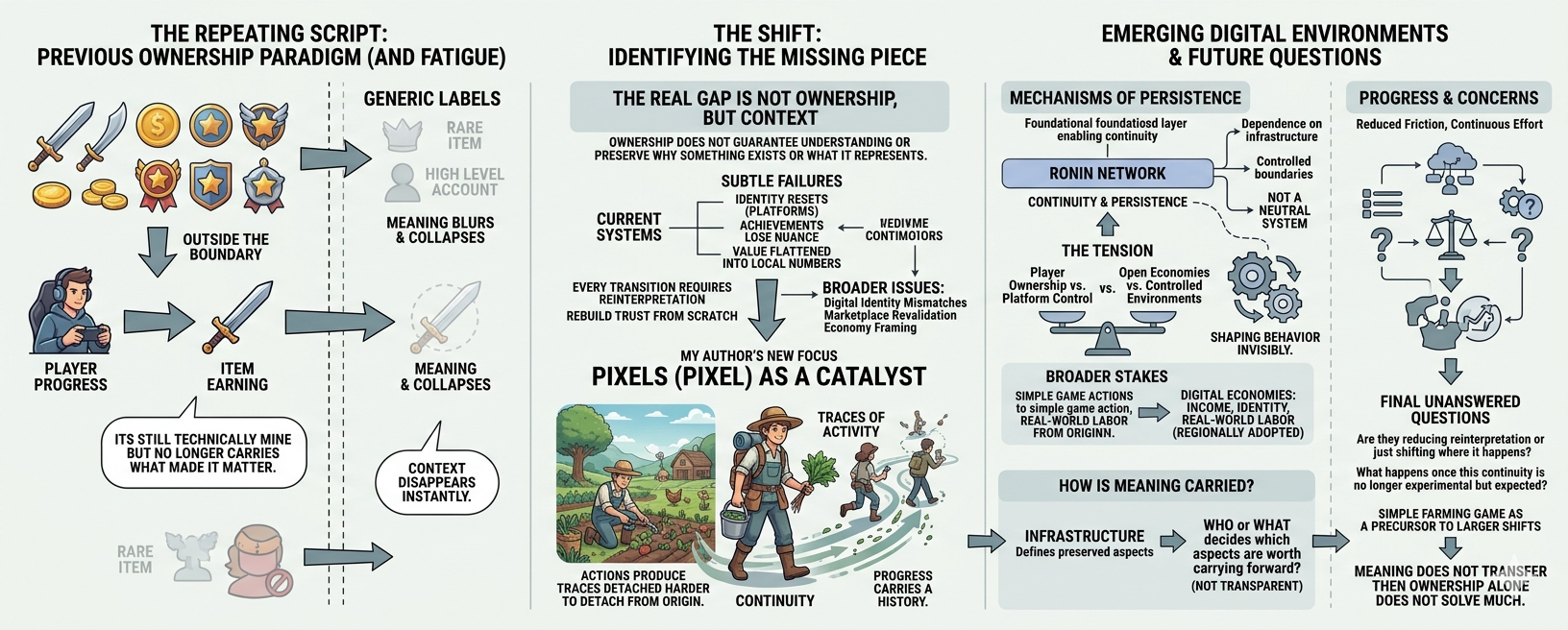
Instead of building around the token layer, it prioritizes the experience and embeds ownership more subtly into the environment. You’re not constantly reminded that you’re “earning.” There’s no pressure to optimize every action for maximum return. That absence of friction changes behavior in a meaningful way. You don’t log in with the mindset of extracting value—you log in to build, to explore, to gradually expand your presence within the world.
That distinction matters.
The pacing plays a critical role here. Progression in Pixels is deliberately slower, which can initially feel unfamiliar—especially for users conditioned by fast reward cycles. But over time, that slower rhythm creates a different kind of engagement. It’s not driven by urgency or scarcity, but by consistency. The game doesn’t demand your attention; it earns it gradually.
Equally important is how blockchain integration is handled. Ownership exists, but it’s not intrusive. You can interact with the system—trade, build, participate—without constantly thinking about wallets, gas fees, or on-chain complexity. This reduces cognitive overhead and makes the experience feel more natural, particularly for players who are not deeply embedded in crypto.
However, the economic layer is still present, quietly shaping the system. Rewards are tied to activity rather than passive holding, which is a more sustainable design in theory. But this introduces a delicate balancing problem. If rewards are too accessible, inflation erodes their value. If they are too restrictive, engagement declines. This is not a static challenge—it requires continuous calibration as user behavior evolves.
The broader context also reinforces why this approach matters. The market today is fundamentally different from earlier Web3 cycles. Users are more selective, more skeptical, and less responsive to purely incentive-driven models. Attention is no longer captured by rewards alone—it must be retained through experience. Pixels is operating within this transition, where long-term engagement is more valuable than short-term spikes.
That said, a critical question remains: if you remove the earning layer entirely, does the game still hold up?
At present, Pixels sits in an interesting middle ground. Its simplicity can be calming and accessible, but it may not yet offer the depth that some players seek over extended periods. The challenge moving forward will be expansion—adding complexity and new layers of engagement without losing the simplicity that makes it approachable.
The social dimension adds another layer of potential. Interactions between players—visiting spaces, trading, collaborating—transform otherwise repetitive actions into shared experiences. Unlike rigid guild structures in traditional games, this social layer feels more organic. But that flexibility also requires careful evolution to ensure it remains engaging rather than diffuse.
Stepping back, Pixels doesn’t feel like a project trying to dominate through hype. It feels more like a controlled experiment—an attempt to answer a difficult question: can a Web3 game sustain engagement without constantly emphasizing financial incentives?
This is a far more complex challenge than simply attracting users. It requires aligning design, economy, and player psychology in a way that doesn’t rely on constant external motivation.
There are, of course, risks. Token volatility can quickly shift user behavior. Network dependencies introduce technical vulnerabilities. And like any evolving system, long-term sustainability is uncertain.
But ultimately, the defining question is simple: will players continue to return when the novelty fades?
If they do—not because of rewards, but because the experience itself is meaningful—then Pixels may be quietly achieving something that most Web3 games have struggled to deliver: a system where value isn’t extracted from time, but built through it.
