
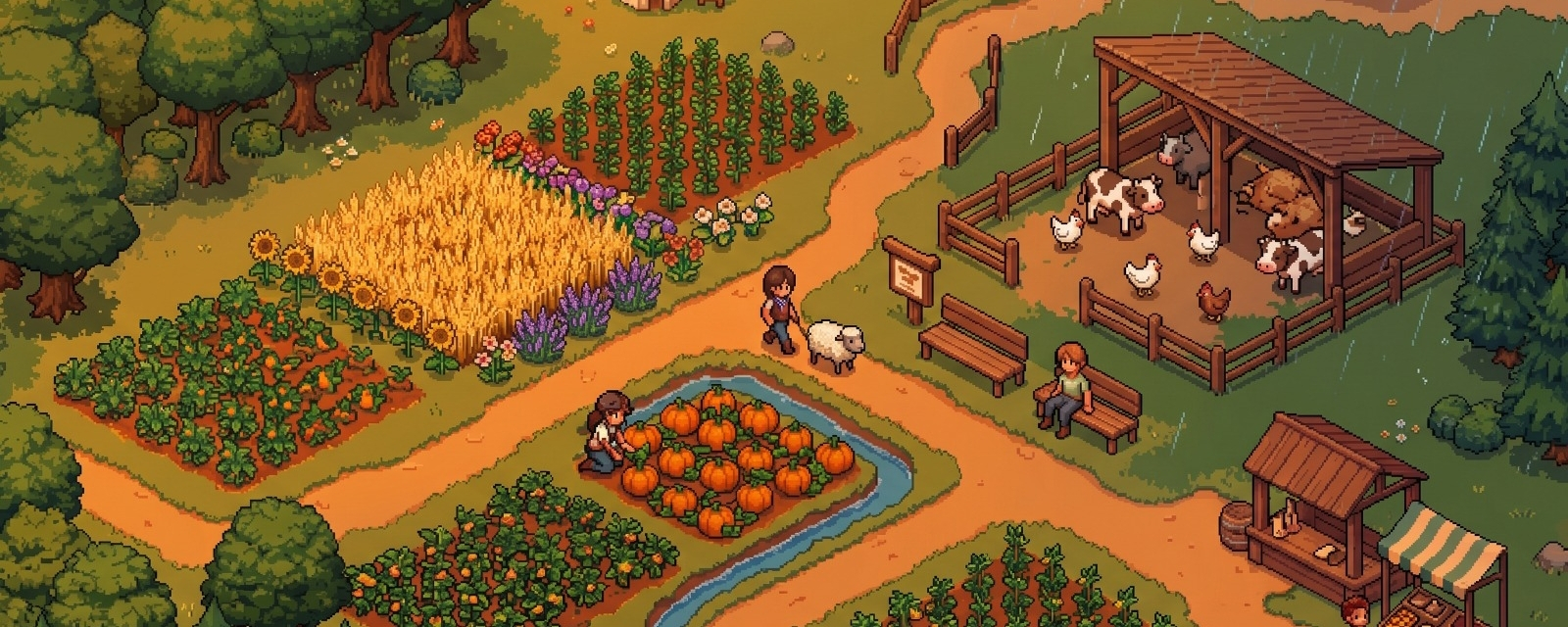
The game’s new warm open‑world farming update doesn’t reinvent its pixelated island. It deepens it. It makes staying feel natural.
Before the update, Pixels had momentum. Players farmed, gathered resources, completed quests, flipped items in a player‑driven economy. The loop worked, but it was transactional. You logged in to optimize. You plotted efficient routes between wheat fields and lumber stands. You checked the marketplace. You logged off. It was functional and, at times, addictive in the way any system built on accumulation can be.
But tone shapes behavior. When a space feels lived in, players treat it differently.
The map feels less like a collection of zones and more like contiguous land. That continuity matters in a farming game, where routine defines the experience. The walk to water your distant crop plot becomes part of the day, not a loading screen to skip.
Farming itself hasn’t been overhauled so much as grounded. Crop growth feels more deliberate. Soil quality and proximity to water sources carry visible impact, nudging players to think about placement instead of maximizing pure density. There’s a tradeoff between clustering everything in one hyper-efficient square and spreading out to take advantage of environmental bonuses.
Livestock mechanics lean into that same balance. Animals require slightly more attention—feed timing, shelter conditions, spacing—but the systems stop short of becoming punishing. It’s not a survival sim. It’s closer to stewardship. When you build a proper enclosure and see your animals cluster under a roof during an in-game rain, it feels earned in a quiet way. The game doesn’t announce your success with fireworks. It just lets the scene sit.
What’s changed socially may be more important than any mechanical tweak. The warmer framing of the world has subtly shifted how players gather. Communal farming hubs, once optimized for output, are starting to look idiosyncratic. Someone plants decorative flowers along the edge of a shared wheat field. Another leaves a bench near a trading post. These are inefficient uses of space. They are also invitations.
In the past, most player interaction orbited around transactions—buy low, sell high, coordinate resource runs. That layer still exists. The economy remains central, and scarcity still shapes behavior. But there’s more ambient presence now. Players idle together. They compare layouts. They walk each other through farm designs that aren’t built for maximum yield but for coherence. It’s the difference between showing someone your spreadsheet and showing them your kitchen.
The update doesn’t ignore progression. There are new craftables, expanded building options, and subtle recalibrations to resource rarity that prevent inflation from spiraling. The developers appear aware that a player‑driven economy can collapse under its own abundance. Some materials take longer to refine. Certain high‑value crops demand more thoughtful inputs. These constraints are not dramatic, but they slow the race just enough to make room for texture.
And that may be the real achievement here: restraint.
Open‑world farming games often fall into one of two traps. They either gamify everything into a treadmill of optimization, or they lean so heavily into coziness that friction disappears and engagement thins out. Pixels is attempting a narrower path. It keeps the underlying systems intact—resource management, trade, progression—but wraps them in an environment that encourages attachment rather than extraction.
Attachment is harder to design. It depends on accumulation of small, credible details. A crop that sways differently depending on time of day. A shoreline that curves imperfectly. A market stall that looks slightly rearranged after a server reset, as if someone had been there before you. None of these elements demand attention. Together, they change how long you stay logged in after you’ve technically finished your tasks.
There’s also something timely about the shift. Digital spaces increasingly compete on spectacle—bigger maps, louder events, sharper hooks. Pixels goes in the opposite direction. You feel the distance between places because you travel it.
That travel creates memory. You start to recognize a bend in the path where you once ran out of stamina. A clearing where you first tested a new seed type. A neighbor’s farm that added a windmill last week. These are minor landmarks, but they accumulate into something steadier than novelty. They create familiarity.
Home, in games, is often reduced to a spawn point or storage chest. Here, it feels closer to maintenance and choice. Do you widen the path for easier movement, or leave it narrow because it looks right? Do you clear every tree for profit, or keep a small grove because the shade softens the edge of your fields? The systems allow either. The update gently suggests the latter might be worth considering.
Nothing about this transformation is loud. There’s no dramatic overhaul to point at and declare revolutionary. Instead, the world feels warmer at the edges, less hurried, more cohesive. It trusts players to notice.
And they do. Not all at once.