
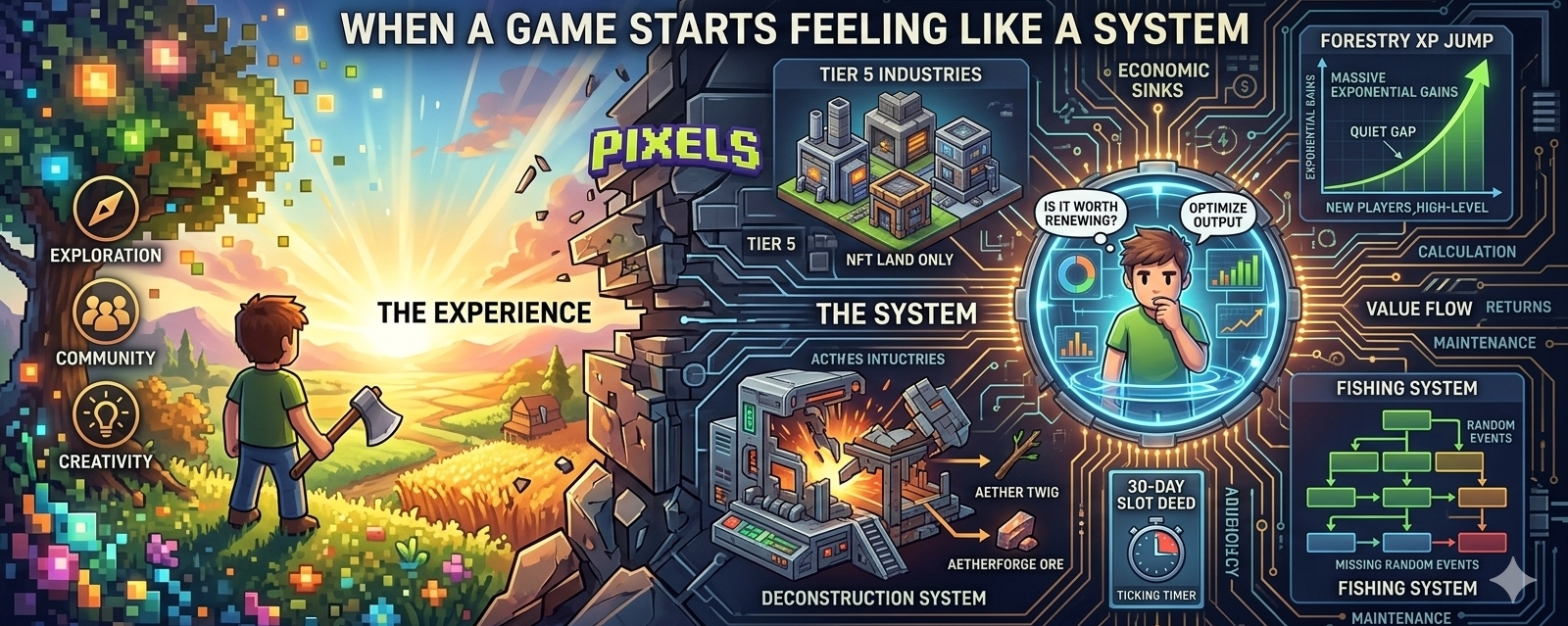
When a Game Starts Feeling Like a System
There’s a thought that keeps circling in my head lately, and I can’t really shake it off. When a game keeps adding more layers, more systems, more mechanics tied to economy and progression… does it actually become stronger, or does it slowly start carrying its own weight? Not in an obvious way, not where everything breaks—but in a subtle way, where the feeling of “playing” quietly shifts into something else.
That’s exactly the space I found myself in after looking closely at the Pixels Tier 5 update. At first, it felt straightforward—new tier, new materials, new crafting paths. Nothing surprising on the surface. But the more I sat with it, the more it started to feel like something deeper was happening. This isn’t just extra content being added. It feels like the system itself is evolving, almost redefining how players are meant to exist inside it.
One of the first things that stood out to me was how Tier 5 industries are limited to NFT land. It doesn’t shout at you, it doesn’t force anything—but it quietly creates distance between players. Suddenly, not everyone is on the same level anymore, and progression isn’t just about effort—it’s also about access. Then comes the slot deed system, with that 30-day expiration. Again, no hard pressure, but there’s a constant reminder in the background: if you want to keep things running, you have to stay involved. It introduces this loop of commitment where playing isn’t just optional—it becomes something you maintain over time.
But what really stayed with me is the deconstruction system. Before this, the loop was simple and familiar—build something, upgrade it, hold onto it. Now, there’s this shift where breaking things down becomes just as important as creating them. You build… so you can dismantle… so you can move forward. It’s a very different mindset. And it made me wonder—when the system asks you to destroy what you’ve built for better efficiency, does that change how you feel about your own progress? It almost turns everything into a resource decision instead of something you’re attached to.
At the same time, I can see why this exists. It actually makes the economy feel more alive. Materials like Aether Twig or Aetherforge Ore don’t just appear out of nowhere—they come from this cycle of deconstruction. Nothing is wasted, everything moves. That’s smart design. It avoids artificial scarcity and instead creates circulation. But with that comes a different kind of experience—one where you’re constantly thinking about value, about output, about what makes the most sense rather than what feels good to do.
The fishing system reflects that same direction. It’s clean, structured, and predictable. Five tiers, durability tied to progression, access depending on your tools—it all makes sense. You can see exactly where you’re going and what you need to get there. But there’s less randomness, less of that unexpected moment that just happens. It feels designed, almost too perfectly. Something you understand more than something you discover.
Then there’s the forestry XP jump at Tier 5, which is honestly massive. It clearly pushes players toward higher tiers, encouraging efficiency and scaling. But it also creates this quiet gap. When rewards at the top become so strong, everything below it starts to feel like a stepping stone rather than an experience on its own. It raises a simple question—are new players enjoying the journey, or are they just grinding through it to reach the “real” part of the game?
And the slot expiration… that part is interesting in a different way. On paper, it works perfectly as an economic sink. It keeps value flowing out, prevents buildup, keeps the system balanced. But beyond that, it introduces something psychological—a timer. A rhythm that doesn’t fully depend on you. Over time, that can shift how you engage with the game. You’re not just logging in because you want to—you’re logging in because something needs to be maintained.
None of this is accidental. That’s the impressive part. The design clearly shows intention. Everything connects—resources, progression, player behavior. It’s not random feature stacking. It’s a system being carefully shaped. And compared to most play-to-earn models, that level of thought really stands out.
But at the same time, complexity always brings a certain risk. The more systems you add, the more decisions turn into calculations. You start thinking in terms of efficiency, returns, optimization. “What do I gain from this?” “Should I break this instead?” “Is it worth renewing?” And slowly, without realizing it, the experience can start to feel less like a world and more like something you’re managing.
That’s where the balance becomes important. Because not everyone is here to optimize everything. Some players just want to explore, to relax, to exist inside the game without constantly thinking about numbers. And if that space becomes too small, something valuable might quietly fade away.
Right now, the Tier 5 update feels strong in direction, no doubt about it. Mechanically, it’s solid. Economically, it’s thoughtful. But emotionally… it still feels like it’s finding its place. Maybe that comes with time. Maybe players themselves will shape how it feels in the long run. Or maybe the system will keep growing until it becomes the main thing, with the game following behind it.
And honestly, that’s what makes this moment so interesting. It’s not about whether the update is good or bad. It’s about what it slowly turns the experience into—and whether, in the process, it still feels like a game.