I will be honest, It is the way it turns ordinary digital behavior into something that feels a little more visible.
When I first heard about it, I almost dismissed it for the opposite reason people usually praise these projects. It sounded too gentle. A social casual game built around farming, exploration, and creation. Open world. Soft language. Relaxed mood. I have learned to be careful with that kind of framing, because sometimes “casual” just means shallow, and sometimes “social” means there are other avatars on the screen but not much real feeling underneath. A lot of projects know how to describe comfort. Fewer know how to build it.
So my first instinct was to assume @Pixels was mostly presentation.
A nice surface. A friendly world. Familiar loops. Probably enough to attract people for a while, but not enough to leave much of a mark. That was more or less where my head was at the start.
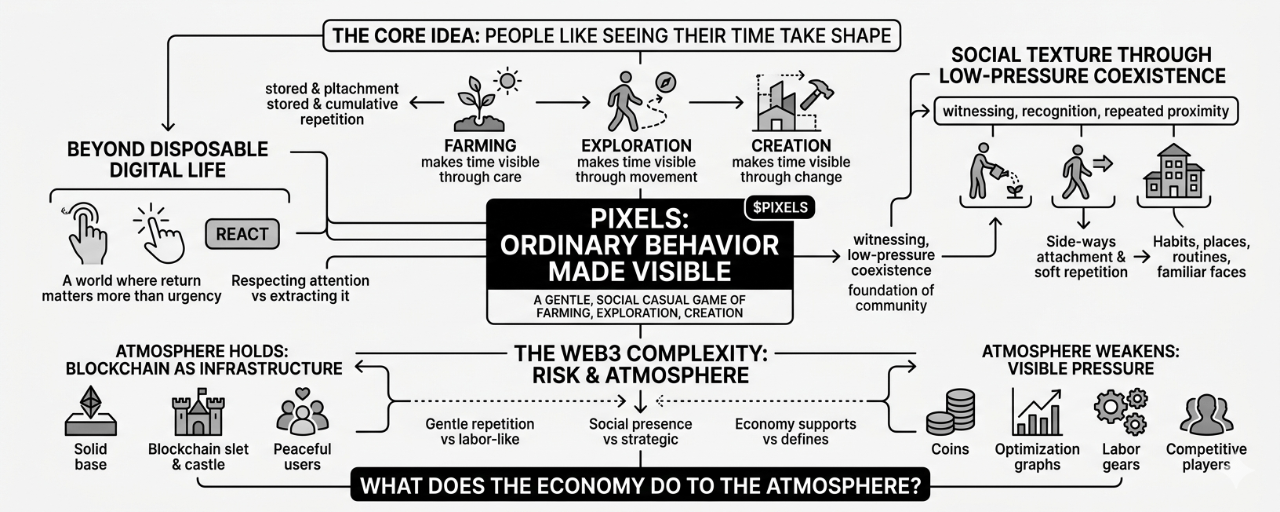
But after thinking about it more, the part that began to stand out was something smaller. #pixel seems built around the idea that people like seeing their time take shape. Not in some dramatic way. Not necessarily through huge achievements. Just through signs. A crop growing because you planted it. A place changing because you spent time there. A world that reflects your return, even in quiet ways. That does something to the experience.
Because a lot of digital life has the opposite quality.
You scroll, click, react, maybe enjoy yourself for a few minutes, and then the whole thing disappears behind the next thing. Even entertainment has become strangely disposable. You spend time, but the time does not settle anywhere. It does not leave behind much weight. That is one reason games still matter differently from a lot of other online spaces. Games can make time feel stored. They can make repetition feel cumulative. And when a game leans into farming, creation, and exploration, it is really leaning into three different ways of making time visible.
Farming makes time visible through care.
Exploration makes time visible through movement.
Creation makes time visible through change.
That is a simple structure, but I think it explains a lot. People do not always want intensity. Often they want to feel that their attention had shape. That their actions were not lost the second they happened. You can usually tell when a game understands this. It stops chasing constant stimulation and starts building a world where return matters more than urgency.
That is where things get interesting.
Because once you see Pixels that way, it stops looking like a farming game in the narrow sense. It starts looking more like an environment for light commitment. A place where you can spend a little effort and then come back later to find that effort still legible. That idea sounds modest, but it is not easy to get right. Most online products are much better at extracting attention than at respecting it. They know how to keep you busy. They do not always know how to make that busyness feel meaningful.
Pixels seems to be aiming at something softer than that.
Not meaning in the grand sense. Nothing so heavy. More like continuity. The feeling that you and the world are in a small ongoing relationship with each other. You do something. The world holds it. You return. Something has moved. That loop is old, but it keeps working because it mirrors something very basic in how people live. Most of life is not a sequence of dramatic moments. It is maintenance, repetition, small progress, wandering, adjusting, trying again. A game built around those rhythms can feel oddly natural even when the setting is stylized and artificial.
I think that is one reason farming keeps coming back across generations of games.
It gives form to patience.
That may be the least flashy way to describe it, but probably the most honest one. You plant, wait, tend, collect, repeat. The pleasure is not only in the reward. It is in watching the interval between actions start to matter. The world is no longer just reacting instantly to you. It is unfolding with you, a little. That changes how a player relates to time inside the game. It slows things down without making them empty.
Exploration adds another layer to that because it interrupts pure routine. If farming anchors the player, exploration loosens them again. It gives curiosity somewhere to go. And creation, maybe most importantly, gives the player a way to convert activity into expression. Even if the expression is small, even if it is just arrangement, design, or preference, it matters. People want to feel that their world does not look exactly the same with or without them in it.
That instinct is stronger than people admit.
A lot of online spaces flatten individual presence. Everyone passes through the same interfaces, the same feeds, the same shapes. Creation-based games push back against that a little. They let users leave traces. Not permanent in any ultimate sense, maybe, but enough to feel like a mark. And once people can leave marks, they begin to care differently. Not always more intensely, but more specifically.
That shift also changes the meaning of the social layer.
I do not think social worlds become social through constant direct interaction. That is the mistake many games make. They build systems for communication but forget that social feeling often starts before conversation. It starts with witnessing. With recognition. With repeated proximity. Someone else watering their crops. Someone else passing through the same area often enough to become familiar. Someone else building differently from how you build. It becomes obvious after a while that low-pressure coexistence is one of the real foundations of online community.
Pixels seems well suited to that kind of social texture.
A calmer world gives people room to notice each other without forcing every moment into competition or coordination. And that matters, because real attachment in digital spaces often grows sideways, not head-on. Not through giant shared events, but through soft repetition. The same names. The same places. The same rhythms. That kind of familiarity is easy to underestimate because it does not look dramatic from the outside. But it is often what makes a world feel inhabited rather than merely populated.
Of course, this is also where the Web3 part complicates things.
Because the moment a game touches ownership, token logic, or economic visibility, the meaning of ordinary actions begins to shift. A routine can remain a routine, but it can also become an optimization problem. A farm can remain a farm, but it can also become an asset structure. Exploration can become resource routing. Creation can become signaling. None of that is automatically bad. But it does put pressure on the softer parts of the experience.
And softer experiences are easier to damage than people think.
If players begin to feel that every action should be measured, compared, or monetized, then the emotional center of the world moves. Quiet play becomes labor-like. Social presence becomes strategic. Gentle repetition becomes productivity. I do not think that always happens, and I do not think Pixels has to fall into that pattern. But the risk is real enough that it shapes how I look at games like this.
The question changes from “is there an economy here?” to “what does the economy do to the atmosphere?”
That feels like the more honest question.
Because a game like Pixels depends so much on mood. On softness. On the sense that time can be spent here without immediately being converted into pressure. If that atmosphere holds, then the blockchain layer may feel secondary, almost infrastructural. Something supporting the world without defining every moment inside it. But if that atmosphere weakens, then the infrastructure becomes much more visible, and usually not in a flattering way.
You can usually tell the difference by how people describe their time in the game.
If they talk about habits, places, little routines, familiar faces, small projects, then the world is probably doing something right. If they mostly talk about maximizing, extracting, timing, and calculating, then something narrower has taken over. That does not mean the game has failed. It just means it may be functioning more as a system than as a place.
And I think $PIXEL is most interesting right at that edge.
Not because it has solved the tension, but because it shows how much online worlds still depend on very old human needs. The need to care for something small. The need to wander a little. The need to leave some trace. The need to be around other people without always having to perform. Those needs are not new. The technology around them may be new, or newer, but the deeper pattern is not.
Maybe that is why Pixels feels more worth thinking about than it first appears.
Not as some grand statement. Just as a reminder that digital spaces still succeed or fail on basic things. Whether time feels respected. Whether repetition feels alive. Whether a world can hold your attention without squeezing it too hard.
That is quieter than most Web3 conversations. But probably closer to the truth.

Artikel
What makes Pixels interesting to me is not ownership, or even Ronin.
Haftungsausschluss: Die hier bereitgestellten Informationen enthalten Meinungen Dritter und/oder gesponserte Inhalte und stellen keine Finanzberatung dar. Siehe AGB.