

Most people skip governance when researching a new L1. But governance decisions are the red thread connecting architecture to long-term outcomes. The choices @Fogo Official community and team make in the next 12 months will determine whether technical advantages translate into lasting ecosystem health.
A Misconception to Clear Up
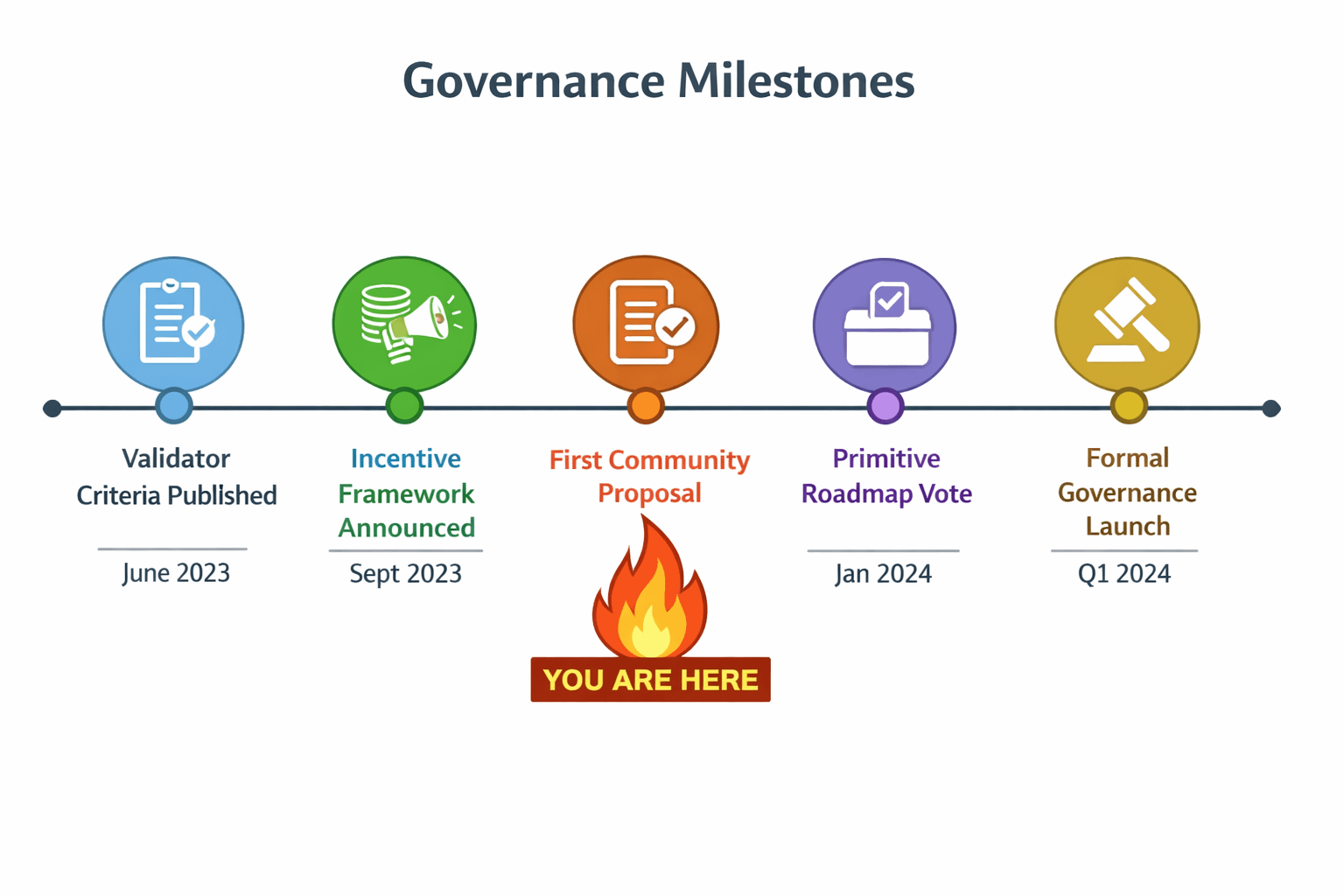
"Governance doesn't matter until there's a DAO." Wrong. Governance is happening now — who joins the validator set, how incentives are allocated, what primitives get enshrined. The real question isn't whether governance exists but whether the transition to community-led coordination happens transparently.
Decision 1: Validator Set Expansion Criteria
Most consequential. Fogo launched with a curated set for sub-40ms consistency. But every curated system faces the question: how do you open the box without breaking what's inside?
Expansion criteria will define decentralization trajectory. If transparent and performance-based, trust grows. If opaque, centralization concerns compound. I'm watching for a published framework the community can Learn from independently.
Decision 2: Incentive Program Structure
Fogo allocated 6% of $FOGO genesis to community distribution, with 4.5% reserved. How that gets deployed is a major choice. The reward structure for LPs, builders, and early adopters shapes who stays.
The best approach is phased allocation tied to milestones — not blanket distributions that Earn short-term activity but no loyalty. Milestone-based incentive governance would be a strong positive signal.
Decision 3: Enshrined Primitive Roadmap
Fogo already enshrines batch auctions and MEV mitigation. Future candidates: on-chain limit order books, oracle integrations, cross-chain settlement. Each addition expands capability but increases complexity. The governance process needs to balance ambition with engineering rigor — two well-audited primitives per year beats six rushed ones.
Decision 4: Fee Structure and Economic Model
Fee economics need to balance competitiveness (traders are fee-sensitive) with sustainability. The claim that "low fees attract volume" is true but incomplete — unsustainably low fees funded by inflation create fragile economics. Fogo's Sessions model adds complexity: who bears the abstracted gas cost, and how is that negotiated between dApps and the protocol?
Decision 5: Transparency Standards
Not a technical decision, but perhaps the most important. Every packet of information shared or withheld shapes community trust. #Fogo's team has strong credentials, but credentials don't substitute for ongoing transparency. Regular substantive updates — not just marketing — are the foundation of healthy governance culture.
My Governance Health Checklist
Are validator expansion criteria published and followed? Transparency over outcomes.
Are incentive allocations tied to measurable milestones? Structure over generosity.
Is the primitive roadmap discussed publicly before implementation? Input over surprise.
Are post-mortems published after any incident or major decision? Accountability over image management.
If all four trend positively, governance is maturing. If two or more go silent, I'd re-examine my conviction.
The Nuance I Hold
Governance is Fogo's most underdeveloped area — expected for a chain six weeks post-mainnet. I'm not alarmed by the current team-led model. What I'm watching is the pace and transparency of the transition toward community participation. The architecture gives #fogo a strong foundation. Governance determines whether it gets built on wisely.

Risks I'm Watching
Governance delay. If formal mechanisms take too long, the community disengages from coordination.
Validator politics. Expansion decisions that appear favoritism-driven undermine decentralization narrative.
Incentive misallocation. Poorly structured programs attract mercenary capital that exits when dry.
Communication gaps. Irregular or marketing-heavy updates erode trust faster than technical setbacks.
Practical Takeaways
Governance matters now, not just when a DAO launches. Track team decisions as early governance signals.
Watch validator expansion criteria as the clearest indicator of decentralization intent.
Demand substance in communication. Honest updates are worth more than polished announcements.
