Binance Square
#pixeltokens

pixeltokens

93,188 Aufrufe
213 Kommentare
FareedNasar
·
--
Übersetzung ansehen
The Rise of @Pixels and the Power of the Stacked EcosystemThe evolution of Web3 gaming is becoming more practical, and @pixels is a strong example of how this space is maturing. Instead of focusing only on hype, the project is building a structured and sustainable environment through its Stacked ecosystem. This system allows players to engage in multiple layers of gameplay, where farming, resource management, and trading are all interconnected in a meaningful way. What makes this approach interesting is how $PIXEL is integrated directly into the player experience. It’s not just a reward token—it acts as a utility layer that supports progression, upgrades, and economic interactions within the game. This creates a loop where players are not only participating for entertainment but are also contributing to a functioning digital economy. The Stacked ecosystem also encourages long-term engagement. Players can gradually build their assets, optimize strategies, and explore different ways to maximize their returns. This adds depth compared to traditional games, where progress is often linear and limited. Another key factor is accessibility. @pixels ls keeps the gameplay simple enough for new users while still offering complexity for experienced players who want to dive deeper into strategy and optimization. This balance is essential for onboarding more users into Web3 gaming. Overall, @pixels is moving in a direction where gameplay and blockchain utility actually complement each other. If this model continues to develop, $PIXEL L could play an even bigger role in shaping sustainable gaming economies. The future of #pixel looks promising as more users begin to understand and explore its ecosystem. #pixel #PIXEL/USDT #PIXEL📈 #PixelTokens

The Rise of @Pixels and the Power of the Stacked Ecosystem

The evolution of Web3 gaming is becoming more practical, and @Pixels is a strong example of how this space is maturing. Instead of focusing only on hype, the project is building a structured and sustainable environment through its Stacked ecosystem. This system allows players to engage in multiple layers of gameplay, where farming, resource management, and trading are all interconnected in a meaningful way.

What makes this approach interesting is how $PIXEL is integrated directly into the player experience. It’s not just a reward token—it acts as a utility layer that supports progression, upgrades, and economic interactions within the game. This creates a loop where players are not only participating for entertainment but are also contributing to a functioning digital economy.

The Stacked ecosystem also encourages long-term engagement. Players can gradually build their assets, optimize strategies, and explore different ways to maximize their returns. This adds depth compared to traditional games, where progress is often linear and limited.

Another key factor is accessibility. @Pixels ls keeps the gameplay simple enough for new users while still offering complexity for experienced players who want to dive deeper into strategy and optimization. This balance is essential for onboarding more users into Web3 gaming.

Overall, @Pixels is moving in a direction where gameplay and blockchain utility actually complement each other. If this model continues to develop, $PIXEL L could play an even bigger role in shaping sustainable gaming economies. The future of #pixel looks promising as more users begin to understand and explore its ecosystem. #pixel #PIXEL/USDT #PIXEL📈 #PixelTokens
Übersetzung ansehen
The growth of @pixels els is honestly impressive. The Stacked ecosystem is creating a real player-driven economy where time, strategy, and creativity actually matter. $PIXEL isn’t just a token—it’s becoming the backbone of in-game ownership and rewards. Excited to see how #pixel evolves 🚀#pixel $PIXEL #PIXEL/USDT #PIXEL📈 #PixelTokens
The growth of @Pixels els is honestly impressive. The Stacked ecosystem is creating a real player-driven economy where time, strategy, and creativity actually matter. $PIXEL isn’t just a token—it’s becoming the backbone of in-game ownership and rewards. Excited to see how #pixel evolves 🚀#pixel $PIXEL #PIXEL/USDT #PIXEL📈 #PixelTokens
Übersetzung ansehen
pixel campaignExploring the Growth of @Pixels and the Power of the $PIXEL Ecosystem 🚀 The evolution of blockchain gaming has reached an exciting stage, and one of the most promising projects leading this transformation is @Pixels. Built with a vision to merge immersive gameplay with real economic value, Pixels is not just another GameFi project—it’s a full ecosystem powered by creativity, ownership, and community. At the heart of this ecosystem lies the $PIXEL token, which acts as both a utility and governance asset. Unlike many projects that struggle to create real use cases, Pixels integrates $PIXEL deeply into gameplay mechanics. Players can earn, spend, and reinvest tokens within the game world, creating a loop that encourages both engagement and sustainability. What makes Pixels stand out is its “stacked ecosystem” approach. Instead of relying on a single layer of interaction, it combines multiple elements—farming, resource management, land ownership, and social collaboration. This layered design ensures that players are not just participants but contributors to a growing digital economy. One key strength of Pixels is accessibility. The game lowers the barrier for entry, allowing new users to experience blockchain gaming without needing deep technical knowledge. This is crucial for mass adoption. By focusing on fun and simplicity first, and blockchain second, Pixels successfully attracts both Web2 and Web3 audiences. Another major highlight is land ownership. In Pixels, land isn’t just cosmetic—it’s productive. Players can use land to farm, build, and generate resources that hold real value. This creates a sense of digital ownership that goes beyond speculation. It’s about participation in a living economy. The community aspect also plays a vital role. Pixels encourages collaboration, trading, and interaction between players. This social layer strengthens the ecosystem and keeps it active. A strong community is often the backbone of successful Web3 projects, and Pixels clearly understands this. From an investment perspective, $PIXEL has strong potential due to its real utility. Many tokens fail because they lack demand beyond speculation, but Pixels continuously creates demand through gameplay. As more users join and engage, the ecosystem naturally expands, increasing the importance of the token. Moreover, the integration with major platforms like Binance adds credibility and exposure. Being featured on such platforms helps Pixels reach a broader audience and build trust among users and investors alike. Looking ahead, the future of Pixels seems promising. With ongoing development, new features, and expanding gameplay mechanics, the ecosystem is set to grow even further. If the team continues to focus on user experience and utility, Pixels could become a benchmark in blockchain gaming. In conclusion, Pixels is more than just a game—it’s a dynamic ecosystem where players can truly own, earn, and grow. The combination of engaging gameplay, strong token utility, and community-driven development makes it a project worth watching closely. #pixel #PIXEL/USDT #pixel #PIXEL📈 #PixelToTheMoon #PixelTokens

pixel campaign

Exploring the Growth of @Pixels and the Power of the $PIXEL Ecosystem 🚀
The evolution of blockchain gaming has reached an exciting stage, and one of the most promising projects leading this transformation is @Pixels. Built with a vision to merge immersive gameplay with real economic value, Pixels is not just another GameFi project—it’s a full ecosystem powered by creativity, ownership, and community.
At the heart of this ecosystem lies the $PIXEL token, which acts as both a utility and governance asset. Unlike many projects that struggle to create real use cases, Pixels integrates $PIXEL deeply into gameplay mechanics. Players can earn, spend, and reinvest tokens within the game world, creating a loop that encourages both engagement and sustainability.
What makes Pixels stand out is its “stacked ecosystem” approach. Instead of relying on a single layer of interaction, it combines multiple elements—farming, resource management, land ownership, and social collaboration. This layered design ensures that players are not just participants but contributors to a growing digital economy.
One key strength of Pixels is accessibility. The game lowers the barrier for entry, allowing new users to experience blockchain gaming without needing deep technical knowledge. This is crucial for mass adoption. By focusing on fun and simplicity first, and blockchain second, Pixels successfully attracts both Web2 and Web3 audiences.
Another major highlight is land ownership. In Pixels, land isn’t just cosmetic—it’s productive. Players can use land to farm, build, and generate resources that hold real value. This creates a sense of digital ownership that goes beyond speculation. It’s about participation in a living economy.
The community aspect also plays a vital role. Pixels encourages collaboration, trading, and interaction between players. This social layer strengthens the ecosystem and keeps it active. A strong community is often the backbone of successful Web3 projects, and Pixels clearly understands this.
From an investment perspective, $PIXEL has strong potential due to its real utility. Many tokens fail because they lack demand beyond speculation, but Pixels continuously creates demand through gameplay. As more users join and engage, the ecosystem naturally expands, increasing the importance of the token.
Moreover, the integration with major platforms like Binance adds credibility and exposure. Being featured on such platforms helps Pixels reach a broader audience and build trust among users and investors alike.
Looking ahead, the future of Pixels seems promising. With ongoing development, new features, and expanding gameplay mechanics, the ecosystem is set to grow even further. If the team continues to focus on user experience and utility, Pixels could become a benchmark in blockchain gaming.
In conclusion, Pixels is more than just a game—it’s a dynamic ecosystem where players can truly own, earn, and grow. The combination of engaging gameplay, strong token utility, and community-driven development makes it a project worth watching closely.
#pixel
#PIXEL/USDT #pixel #PIXEL📈 #PixelToTheMoon #PixelTokens
Übersetzung ansehen
#PIXEL Global Leaderboard is live and it’s the perfect reminder that in Web3 gaming, consistency beats hype. If you’re grinding PIXEL, the leaderboard isn’t just a “who’s #1” flex—it’s a scoreboard of strategy: Efficient daily routines > random long sessions Smart resource management > chasing every quest Staying active through market noise > emotional play My approach: 1) Set a clear daily target (time + tasks) so you don’t burn out 2) Track what actually moves your rank (points/hour, not vibes) 3) Don’t overextend—leaderboard pushes can tempt you into bad trades or overspending in-game If you’re participating: what’s your current rank goal—Top 10, Top 100, or just steady progress? And are you focusing on time efficiency or max points per session?#pixel $PIXEL #PixelTokens
#PIXEL Global Leaderboard is live and it’s the perfect reminder that in Web3 gaming, consistency beats hype.

If you’re grinding PIXEL, the leaderboard isn’t just a “who’s #1” flex—it’s a scoreboard of strategy:
Efficient daily routines > random long sessions
Smart resource management > chasing every quest
Staying active through market noise > emotional play

My approach:
1) Set a clear daily target (time + tasks) so you don’t burn out
2) Track what actually moves your rank (points/hour, not vibes)
3) Don’t overextend—leaderboard pushes can tempt you into bad trades or overspending in-game

If you’re participating: what’s your current rank goal—Top 10, Top 100, or just steady progress? And are you focusing on time efficiency or max points per session?#pixel $PIXEL #PixelTokens
Artikel
Übersetzung ansehen
#pixelHere’s an original article (500+ characters) you can post on Binance Square: The growing ecosystem around @Pixels is becoming one of the most exciting developments in Web3 gaming. Built with a strong focus on community and player ownership, Pixels is not just a game—it’s a digital economy powered by the $PIXEL token. Players can earn, trade, and build within a vibrant world that continues to expand through the Stacked ecosystem. What makes Pixels unique is its seamless integration of gameplay and blockchain rewards. Instead of traditional pay-to-win models, it encourages participation, creativity, and long-term engagement. The Stacked ecosystem further enhances this by connecting multiple experiences, allowing users to benefit from shared liquidity and utility across platforms. As Web3 adoption grows, projects like Pixels are setting new standards for how games can deliver value to users. With continuous updates, strong community backing, and real utility for $PIXEL, the future looks promising. Keep an eye on @Pixels as it continues to shape the next generation of blockchain gaming. #PixelTokens

#pixel

Here’s an original article (500+ characters) you can post on Binance Square:

The growing ecosystem around @Pixels is becoming one of the most exciting developments in Web3 gaming. Built with a strong focus on community and player ownership, Pixels is not just a game—it’s a digital economy powered by the $PIXEL token. Players can earn, trade, and build within a vibrant world that continues to expand through the Stacked ecosystem.

What makes Pixels unique is its seamless integration of gameplay and blockchain rewards. Instead of traditional pay-to-win models, it encourages participation, creativity, and long-term engagement. The Stacked ecosystem further enhances this by connecting multiple experiences, allowing users to benefit from shared liquidity and utility across platforms.

As Web3 adoption grows, projects like Pixels are setting new standards for how games can deliver value to users. With continuous updates, strong community backing, and real utility for $PIXEL, the future looks promising. Keep an eye on @Pixels as it continues to shape the next generation of blockchain gaming.

#PixelTokens
Übersetzung ansehen
#pixel $PIXEL A pixel is the smallest unit of a digital image or display screen. The word “pixel” comes from “picture element,” which means it is a tiny part of a bigger picture. Every image you see on a phone, computer, or television screen is made up of thousands or even millions of pixels. Each pixel is like a small dot that shows a specific color, and when all these colored dots come together, they create a complete image. Pixels are very important in digital technology. The quality of an image depends on the number of pixels it has. This is called resolution. A higher resolution means more pixels, which results in a clearer and sharper image. For example, a high-resolution photo looks more detailed than a low-resolution one. Pixels are used in many devices such as smartphones, cameras, and monitors. They play a key role in graphics design, gaming, and video production. Without pixels, digital images would not exist. Understanding pixels helps us better understand how digital screens and images work in our daily life.@Pixels (https://www.binance.com/en/square/profile/pixels),#Kalshi’sDisputewithNevada #PixelTokens #PIXEL📈 #PİXEL
#pixel $PIXEL A pixel is the smallest unit of a digital image or display screen. The word “pixel” comes from “picture element,” which means it is a tiny part of a bigger picture. Every image you see on a phone, computer, or television screen is made up of thousands or even millions of pixels. Each pixel is like a small dot that shows a specific color, and when all these colored dots come together, they create a complete image.
Pixels are very important in digital technology. The quality of an image depends on the number of pixels it has. This is called resolution. A higher resolution means more pixels, which results in a clearer and sharper image. For example, a high-resolution photo looks more detailed than a low-resolution one.
Pixels are used in many devices such as smartphones, cameras, and monitors. They play a key role in graphics design, gaming, and video production. Without pixels, digital images would not exist. Understanding pixels helps us better understand how digital screens and images work in our daily life.@Pixels (https://www.binance.com/en/square/profile/pixels),#Kalshi’sDisputewithNevada #PixelTokens #PIXEL📈 #PİXEL
P--R--N--A:
Pixels introduces a realistic spending environment that may encourage responsible in-game decisions. Sustained user activity will be critical to maintaining its economic loop.
Artikel
Übersetzung ansehen
From Game to Economy: How Pixels Is Redefining Play into a Full-Scale Engagement Ecosystem#PixelTokens @pixels #pixel If I'm honest... it's like this - before a movie was just a story. Now if it is a whole platform where content, data, ads, user behavior - everything works together, then it is not just a movie anymore. @Pixelsis also trying to stand in that same place - at that very level but thing is... The first layer is the smart -reward system. The idea here sounds very simple but the inside is a little different. On today's internet, you use a free service and in return your attention is sold to an ad network. Here they are says - this value will go directly to player without going through the middle. That is, if you enter the game, finish tutorial or play regularly - you will get token directly. It's like you are not only getting a reward for working but also for being at work. For a normal user, it is very simple - I played, I got something. But inside, game design is gradually becoming engagement-economy. That is, the time you spend is your value. A mental thing works here. People like incentives at the beginning but over time, if incentives become the main objective, then the experience is no longer pure game - it becomes a loop. The second layer is data engine. Pixels Events API can actually be called the "brain" of the entire system. I will say that if we look at big picture now - they are actualy trying to create a Google/Facebook style ad network but here the ad is replaced by gameplay, and the data is replaced by player action. For a normal user, this means - play, get samething. For a developer - you can understand the user, grow quickly. And for a trader - it is not just a token, it is an engagement signal. But the real question comes here - trust. People usually get scared when their behavior and value come together. The volatility of token increases that fear. If reward is unpredictable, how stable will the engagement be ? On the other hand, if it works, then gaming will not only become entertainment but also a distribution layer - where intermediaries will be reduced and value flow will be direct. If a game gradually moves to a place where it is not just a game but also creates entire economy - then do we really still call it a game or does it become something else? It tracks user behavior, spend patterns, retention - everything. From the outside it's analytics, but inside it's a prediction system. Think of it simply - game is not just letting you play, it's learning to understand you - I am really obak..... watching this. Even though this is a physics formula, there is a metaphor here - value, engagement and activity together create behaviores of the entire system. This is very powerful for developers. Because they not only know what the user is doing, they can predict what the user will do next . This means that rewards and economies are no longer random - they become predictable. But this is where a subtle problem arises. When everything can predicted, connects the player's identity - wallet, device, behavior - all together. As a result, a user is no longer just a user of a game, but becomes part of the entire network. This is an advantage for developers. Because user acquisition and analyticsis become pretty much ready-made. But at the same time, a dependency is created - once you're in, it becomes difficult to get out. Now, if we look at the update from 11 months ago, we can see that they have gradually structured it more. The RORS dashboard is actually a reality check - seeing live how much return you get when you spend rewards. This is very important for developers because biggest problem in Web3 is - it's difficult to understand ROI. Then comes the staking + emission model. It's a way to control liquidity. This means that reward pool is not just a cost, but a managed economy. The cross-game model is actually the biggest shift. Because then a game became part of the entire ecosystem instead of being a separate entity. And the $BERRY to $PIXEL transition was actually narrative consolidation - bringing entire economy into one place. Honestly speaking.... $PIXEL

From Game to Economy: How Pixels Is Redefining Play into a Full-Scale Engagement Ecosystem

#PixelTokens @Pixels #pixel
If I'm honest... it's like this - before a movie was just a story. Now if it is a whole platform where content, data, ads, user behavior - everything works together, then it is not just a movie anymore. @Pixelsis also trying to stand in that same place - at that very level but thing is... The first layer is the smart -reward system. The idea here sounds very simple but the inside is a little different. On today's internet, you use a free service and in return your attention is sold to an ad network. Here they are says - this value will go directly to player without going through the middle. That is, if you enter the game, finish tutorial or play regularly - you will get token directly. It's like you are not only getting a reward for working but also for being at work. For a normal user, it is very simple - I played, I got something. But inside, game design is gradually becoming engagement-economy. That is, the time you spend is your value. A mental thing works here. People like incentives at the beginning but over time, if incentives become the main objective, then the experience is no longer pure game - it becomes a loop. The second layer is data engine. Pixels Events API can actually be called the "brain" of the entire system.

I will say that if we look at big picture now - they are actualy trying to create a Google/Facebook style ad network but here the ad is replaced by gameplay, and the data is replaced by player action. For a normal user, this means - play, get samething. For a developer - you can understand the user, grow quickly. And for a trader - it is not just a token, it is an engagement signal. But the real question comes here - trust. People usually get scared when their behavior and value come together. The volatility of token increases that fear. If reward is unpredictable, how stable will the engagement be ? On the other hand, if it works, then gaming will not only become entertainment but also a distribution layer - where intermediaries will be reduced and value flow will be direct.
If a game gradually moves to a place where it is not just a game but also creates entire economy - then do we really still call it a game or does it become something else?

It tracks user behavior, spend patterns, retention - everything. From the outside it's analytics, but inside it's a prediction system. Think of it simply - game is not just letting you play, it's learning to understand you - I am really obak..... watching this. Even though this is a physics formula, there is a metaphor here - value, engagement and activity together create behaviores of the entire system. This is very powerful for developers. Because they not only know what the user is doing, they can predict what the user will do next

. This means that rewards and economies are no longer random - they become predictable. But this is where a subtle problem arises. When everything can predicted, connects the player's identity - wallet, device, behavior - all together. As a result, a user is no longer just a user of a game, but becomes part of the entire network. This is an advantage for developers. Because user acquisition and analyticsis become pretty much ready-made. But at the same time, a dependency is created - once you're in, it becomes difficult to get out. Now, if we look at the update from 11 months ago, we can see that they have gradually structured it more.
The RORS dashboard is actually a reality check - seeing live how much return you get when you spend rewards. This is very important for developers because biggest problem in Web3 is - it's difficult to understand ROI. Then comes the staking + emission model. It's a way to control liquidity. This means that reward pool is not just a cost, but a managed economy. The cross-game model is actually the biggest shift. Because then a game became part of the entire ecosystem instead of being a separate entity. And the $BERRY to $PIXEL transition was actually narrative consolidation - bringing entire economy into one place.
Honestly speaking....
$PIXEL
J U N I A:
The volatility of token increases that fear. If reward is unpredictable, how stable will the engagement be ?
Artikel
Übersetzung ansehen
PİXELS. First Time Breeding Pets in Pixels A Structured Analytical Experience.The more I look at @Pixels the less I think the farming side is the main story. That part is just easy to understand. You plant - $craft - decorate - hang out itz soft familiar almost intentionally simple. Anyone can look at it and get the idea in seconds. But that surface doesn0t really explain what the system is trying to do. What stands out more is how it handles incentives. Most P2E models did not fail because they could n0t attract users they failed because they gave users too many ways to extract value without creating anything meaningful in return. Once that happens everything shifts. Players stop behaving like players &start behaving like optimizers. The game becomes a loop to farm not a place to stay. Pixels does not seem blind to that problem. Instead of rewarding everything it feels more selective. Not every action is treated equally & every player behavior gets the same outcome. There is a clear attempt to push rewards toward things that actually support the ecosystem participation - coordination - contribution. That already changes the tone. Because now rewards are not just payouts they start acting more like signals. The system is basically saying do more of this less of that. And honestly thatz where it gets interesting. It stops looking like a simple play → earn loop and starts looking more like an incentive system thatz trying to shape behavior over time. Even the way the game is presented supports that. Ownership land progression social layers all of that builds a sense that value is tied to staying inside the system not just extracting from it. But I would not call it solved. If anything it feels like something thatis still being tuned in real time. You can usually tell when a system is adjusting small shifts in how rewards feel how players react where activity moves. That is normal for something like this. Probably necessary too. Because once real rewards are involved players do not sit still. They test everything. They find shortcuts. They turn side mechanics into main strategies. Every system eventually gets pushed to its limits. And thatz where the real pressure shows up. The idea sounds great rewards that reinforce meaningful behaviour instead of draining the system. But the hard part is keeping that balance once optimization kicks in. Because eventually players will try to bend the system toward extraction again. Thatz just how GameFi works. So the real question isnot whether $PIXEL 's can attract players or even keep them active. It’s whether it can keep the experience feeling like a game while still running an economy underneath it. Thats a much harder problem than it sounds. And maybe thatz the actual ambition here. Not building another farming game with a token attached but building a system where incentives do not slowly erase the reason people showed up in the first place. If it doesn0t it ends up looking like the same loop with better design. If that works it changes how P2E is usually perceived. What do you think about it? feel free to share your experience and ideas. Note Binance AI [https://www.binance.com/en/square/profile/pixels](https://www.binance.com/en/square/profile/pixels) #pixel @Pixels$PIXEL $PIXEL #PixelTokens {future}(PIXELUSDT)

PİXELS. First Time Breeding Pets in Pixels A Structured Analytical Experience.

The more I look at @Pixels the less I think the farming side is the main story.
That part is just easy to understand. You plant - $craft - decorate - hang out itz soft familiar almost intentionally simple. Anyone can look at it and get the idea in seconds.
But that surface doesn0t really explain what the system is trying to do.
What stands out more is how it handles incentives. Most P2E models did not fail because they could n0t attract users they failed because they gave users too many ways to extract value without creating anything meaningful in return.
Once that happens everything shifts. Players stop behaving like players &start behaving like optimizers. The game becomes a loop to farm not a place to stay.
Pixels does not seem blind to that problem.
Instead of rewarding everything it feels more selective. Not every action is treated equally & every player behavior gets the same outcome. There is a clear attempt to push rewards toward things that actually support the ecosystem participation - coordination - contribution.
That already changes the tone.
Because now rewards are not just payouts they start acting more like signals. The system is basically saying do more of this less of that.
And honestly thatz where it gets interesting.
It stops looking like a simple play → earn loop and starts looking more like an incentive system thatz trying to shape behavior over time.
Even the way the game is presented supports that. Ownership land progression social layers all of that builds a sense that value is tied to staying inside the system not just extracting from it.
But I would not call it solved.
If anything it feels like something thatis still being tuned in real time. You can usually tell when a system is adjusting small shifts in how rewards feel how players react where activity moves.
That is normal for something like this. Probably necessary too.
Because once real rewards are involved players do not sit still. They test everything. They find shortcuts. They turn side mechanics into main strategies. Every system eventually gets pushed to its limits.
And thatz where the real pressure shows up.
The idea sounds great rewards that reinforce meaningful behaviour instead of draining the system. But the hard part is keeping that balance once optimization kicks in.
Because eventually players will try to bend the system toward extraction again. Thatz just how GameFi works.
So the real question isnot whether $PIXEL 's can attract players or even keep them active.
It’s whether it can keep the experience feeling like a game while still running an economy underneath it.
Thats a much harder problem than it sounds.
And maybe thatz the actual ambition here.
Not building another farming game with a token attached but building a system where incentives do not slowly erase the reason people showed up in the first place.
If it doesn0t it ends up looking like the same loop with better design.
If that works it changes how P2E is usually perceived.
What do you think about it? feel free to share your experience and ideas.
Note Binance AI
https://www.binance.com/en/square/profile/pixels

#pixel @Pixels$PIXEL
$PIXEL #PixelTokens
Alpha Byte:
Fast and cheap transactions definitely help active farming economies scale better.l
Artikel
Übersetzung ansehen
Pixel is not magic. it's just a smart gamePixels (PIXEL) is a social casual web3 game powered by the Ronin Network, offering a captivating open-world experience centered around farming, exploration, and creation. PIXEL serves as the native utility and governance token within the Pixels ecosystem, facilitating a variety of real-world applications. One of the primary uses of PIXEL is as an in-game currency. Players can use PIXEL to purchase items, upgrades, and cosmetic enhancements, enriching their gaming experience. For instance, PIXEL can speed up build times, temporarily boost energy, and unlock new skins and crafting recipes. This utility makes PIXEL integral to the gameplay, providing players with tangible benefits and enhancing their overall engagement. Beyond in-game purchases, PIXEL plays a crucial role in NFT minting. All future NFT mints within the Pixels ecosystem will be conducted using PIXEL, allowing players to create and trade unique digital assets. This feature not only adds a layer of personalization to the game but also introduces players to the broader world of NFTs and blockchain technology. PIXEL also offers a VIP membership option, known as the Pixels VIP membership. By purchasing this membership with PIXEL, users gain access to exclusive areas and perks within the game. This includes the ability to withdraw $BERRY to a Ronin wallet, providing additional value and utility to dedicated players. The introduction of Guilds, a new social-fi feature, further expands the use of PIXEL. Players can join these guilds by using PIXEL, fostering a sense of community and collaboration within the game. This social aspect enhances the gaming experience, making it more interactive and engaging. Quality of life upgrades within the game are another application of PIXEL. Premium in-game features, designed to improve the overall gameplay experience, are available for purchase with PIXEL. This ensures that players who invest in the token can enjoy a more seamless and enjoyable gaming journey. Finally, PIXEL is set to play a role in governance within the Pixels ecosystem. The token will eventually be used to govern a community treasury, allowing players to have a say in the future development and direction of the game. This democratic approach empowers players, giving them a stake in the ecosystem they are Pixels (PIXEL) is a premier Web3 social farming and adventure game operating on the Ronin network, acting as a "titan" in the 2026 GameFi sector. The PIXEL token is the premium in-game currency used for land acquisition, high-tier crafting, pet minting, and VIP membership. Its ecosystem supports over 10 million players, focusing on sustainable, utility-driven Web3 mechanics. #PIXEL/USDT #PIXEL📈 CoinGecko +3 Key Aspects of the PIXEL Token & Ecosystem: Utility: PIXEL is used for speeding up build times, energy boosts, unlocking new skins, and accessing special in-game items.Game Mechanics: The game uses a two-token system: $PIXEL for premium on-chain actions and "Coins" for routine in-game farming.Recent Performance (April 2026): PIXEL saw a surge in interest after founder Luke Barwikowski teased technology intended to improve player retention. It is ranked as a top NFT game by engagement.Tokenomics: The maximum supply is 5 billion, with approximately 3.18 billion in circulation.Where to Buy: The token is heavily traded on [Binance](https://www.binance.com/en/price/pixels), among other exchanges.CoinMarketCap +5 As of April 2026, the project has matured beyond its initial hype, with a focus on long-term engagement and sustainability. Binance +1 If you would like, I can: Show you the live PIXEL price chartFind the latest price predictionsProvide a tutorial on how to start playing and earn#PIXEL/USDT #PIXEL📈 #PixelTokens

Pixel is not magic. it's just a smart game

Pixels (PIXEL) is a social casual web3 game powered by the Ronin Network, offering a captivating open-world experience centered around farming, exploration, and creation. PIXEL serves as the native utility and governance token within the Pixels ecosystem, facilitating a variety of real-world applications.

One of the primary uses of PIXEL is as an in-game currency. Players can use PIXEL to purchase items, upgrades, and cosmetic enhancements, enriching their gaming experience. For instance, PIXEL can speed up build times, temporarily boost energy, and unlock new skins and crafting recipes. This utility makes PIXEL integral to the gameplay, providing players with tangible benefits and enhancing their overall engagement.

Beyond in-game purchases, PIXEL plays a crucial role in NFT minting. All future NFT mints within the Pixels ecosystem will be conducted using PIXEL, allowing players to create and trade unique digital assets. This feature not only adds a layer of personalization to the game but also introduces players to the broader world of NFTs and blockchain technology.

PIXEL also offers a VIP membership option, known as the Pixels VIP membership. By purchasing this membership with PIXEL, users gain access to exclusive areas and perks within the game. This includes the ability to withdraw $BERRY to a Ronin wallet, providing additional value and utility to dedicated players.

The introduction of Guilds, a new social-fi feature, further expands the use of PIXEL. Players can join these guilds by using PIXEL, fostering a sense of community and collaboration within the game. This social aspect enhances the gaming experience, making it more interactive and engaging.

Quality of life upgrades within the game are another application of PIXEL. Premium in-game features, designed to improve the overall gameplay experience, are available for purchase with PIXEL. This ensures that players who invest in the token can enjoy a more seamless and enjoyable gaming journey.

Finally, PIXEL is set to play a role in governance within the Pixels ecosystem. The token will eventually be used to govern a community treasury, allowing players to have a say in the future development and direction of the game. This democratic approach empowers players, giving them a stake in the ecosystem they are
Pixels (PIXEL) is a premier Web3 social farming and adventure game operating on the Ronin network, acting as a "titan" in the 2026 GameFi sector. The PIXEL token is the premium in-game currency used for land acquisition, high-tier crafting, pet minting, and VIP membership. Its ecosystem supports over 10 million players, focusing on sustainable, utility-driven Web3 mechanics.
#PIXEL/USDT #PIXEL📈 CoinGecko +3
Key Aspects of the PIXEL Token & Ecosystem:
Utility: PIXEL is used for speeding up build times, energy boosts, unlocking new skins, and accessing special in-game items.Game Mechanics: The game uses a two-token system: $PIXEL for premium on-chain actions and "Coins" for routine in-game farming.Recent Performance (April 2026): PIXEL saw a surge in interest after founder Luke Barwikowski teased technology intended to improve player retention. It is ranked as a top NFT game by engagement.Tokenomics: The maximum supply is 5 billion, with approximately 3.18 billion in circulation.Where to Buy: The token is heavily traded on Binance, among other exchanges.CoinMarketCap +5
As of April 2026, the project has matured beyond its initial hype, with a focus on long-term engagement and sustainability.
Binance +1
If you would like, I can:
Show you the live PIXEL price chartFind the latest price predictionsProvide a tutorial on how to start playing and earn#PIXEL/USDT #PIXEL📈 #PixelTokens
Artikel
Übersetzung ansehen
#PIXEL#PIXEL📈 l $PIXEL @pixels Meet Stacked. The App That Makes Play-to-Earn Actually Work. Pixels Following A lot of people think of Pixels as just a game. That was never the full picture. As we built Pixels, we realized that most Web3 games share the same problem: how to add ownership to games without breaking their economies or attracting the wrong users. The hard part was never putting assets on-chain. The hard part is managing incentive alignment. And that is the biggest reason so many Web3 games have struggled. Over the last year, we’ve materially improved the economics within Pixels and gotten much closer to what the market has been chasing for a long time: sustainable play-to-earn. That problem became our obsession. That problem is what led to Stacked. Stacked is a rewards app for players and a rewarded LiveOps engine for games - built from everything we learned scaling Pixels. So What Is Stacked? For players, it is one place to: play games, complete missions, build streaks, earn rewards, and cash out across a growing ecosystem. For studios, it is the system underneath that experience: event tracking, targeting, reward logic, fraud controls, payouts, testing, attribution, and, increasingly, an AI game economist that helps teams figure out what to reward and why. What Stacked means for players For players, the experience is meant to be simple. You download one app, play real games, get tasks matched to how you play, earn rewards, and you claim them in one place. That’s the experience. What makes it different is what happens underneath. Not every player should see the same task. Not every action deserves the same reward. And importantly: we do not sell personal data to third parties. Gameplay signals stay inside the Stacked system and are used to improve reward matching. The first wave: Stacked is launching first across our own first-party ecosystem: 🧑‍🌾 Pixels ⛏️ Pixel Dungeons 🦖 Sleepagotchi 🥰 Chubkins in early access Players should think about this as a soft launch. We’re starting with the games we know best, where we control the loops and understand the economics, so we can tighten the system before scaling. For the first few weeks, the rewards feed will focus on $PIXEL ecosystem games. Over time, more games, more reward types, and more experiences will appear as the network grows. The slow start is intentional. As confidence in the system builds, we’ll accelerate user acquisition, grow Stacked more aggressively, and open the doors to more B2B partners. The first chapter is focused. The latter ones get much bigger. What Stacked Means for Studios On the studio side, Stacked is the system we wish we had from day one. At its core, Stacked is a rewarded LiveOps engine. A studio integrates, sends gameplay events into the system, and Stacked helps decide: Who should get rewarded For what When And with what kind of reward The goal is to reward the right behavior, for the right user, at the right moment, and then measure whether it actually improved retention, revenue, or LTV. That is where Stacked becomes more than a quest board. It becomes a system for running reward-driven LiveOps with actual controls around targeting, pricing, attribution, and abuse. [https://www.binance.com/en/square/profile/pixels](https://www.binance.com/en/square/profile/pixels) #bianace #bullrun #BinanceSquare #PixelTokens

#PIXEL

#PIXEL📈 l $PIXEL @Pixels
Meet Stacked. The App That Makes Play-to-Earn Actually Work.
Pixels
Following
A lot of people think of Pixels as just a game. That was never the full picture.
As we built Pixels, we realized that most Web3 games share the same problem: how to add ownership to games without breaking their economies or attracting the wrong users.
The hard part was never putting assets on-chain. The hard part is managing incentive alignment. And that is the biggest reason so many Web3 games have struggled.
Over the last year, we’ve materially improved the economics within Pixels and gotten much closer to what the market has been chasing for a long time: sustainable play-to-earn.
That problem became our obsession. That problem is what led to Stacked.
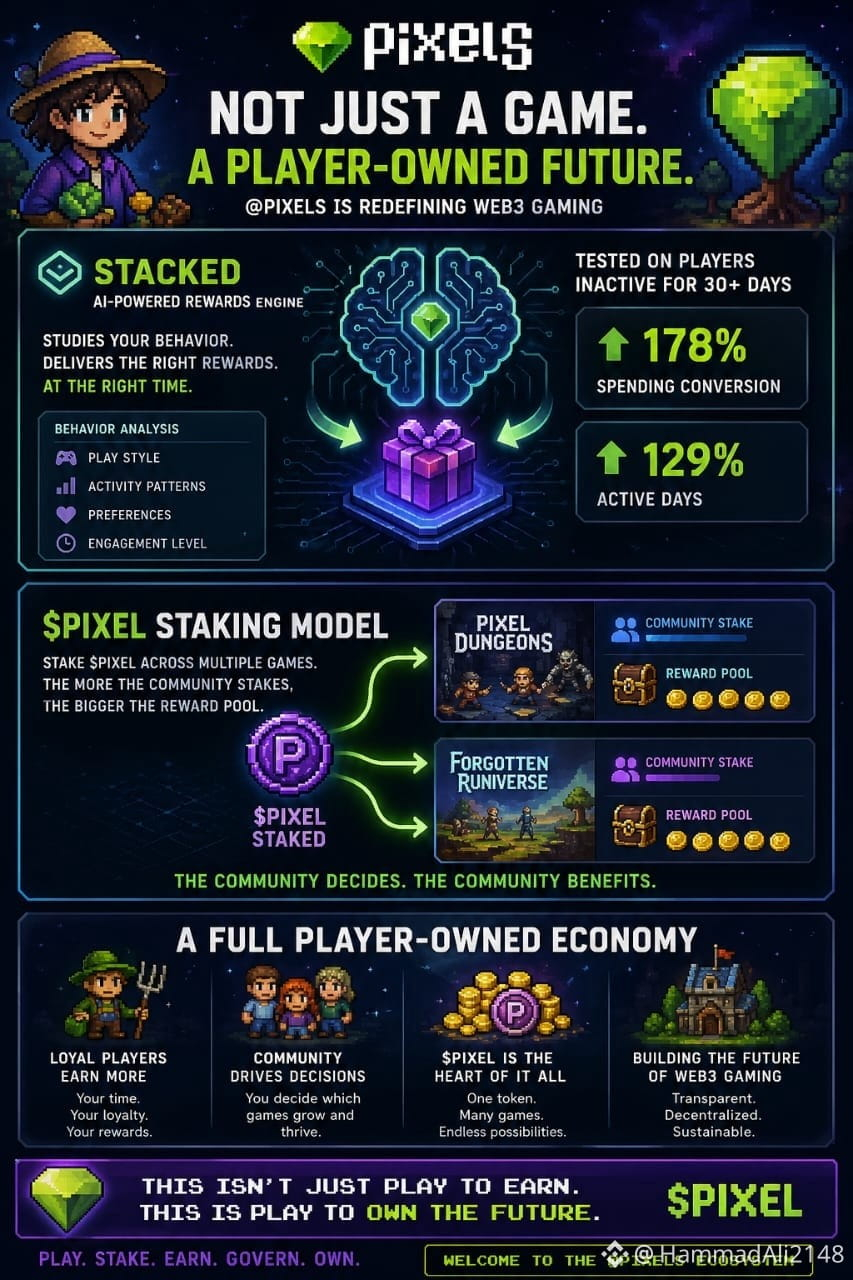
Stacked is a rewards app for players and a rewarded LiveOps engine for games - built from everything we learned scaling Pixels.
So What Is Stacked?
For players, it is one place to: play games, complete missions, build streaks, earn rewards, and cash out across a growing ecosystem.
For studios, it is the system underneath that experience: event tracking, targeting, reward logic, fraud controls, payouts, testing, attribution, and, increasingly, an AI game economist that helps teams figure out what to reward and why.
What Stacked means for players
For players, the experience is meant to be simple. You download one app, play real games, get tasks matched to how you play, earn rewards, and you claim them in one place. That’s the experience.
What makes it different is what happens underneath.
Not every player should see the same task. Not every action deserves the same reward.
And importantly: we do not sell personal data to third parties. Gameplay signals stay inside the Stacked system and are used to improve reward matching.
The first wave:
Stacked is launching first across our own first-party ecosystem:
🧑‍🌾 Pixels
⛏️ Pixel Dungeons
🦖 Sleepagotchi
🥰 Chubkins in early access
Players should think about this as a soft launch. We’re starting with the games we know best, where we control the loops and understand the economics, so we can tighten the system before scaling.
For the first few weeks, the rewards feed will focus on $PIXEL ecosystem games. Over time, more games, more reward types, and more experiences will appear as the network grows.
The slow start is intentional. As confidence in the system builds, we’ll accelerate user acquisition, grow Stacked more aggressively, and open the doors to more B2B partners. The first chapter is focused. The latter ones get much bigger.
What Stacked Means for Studios
On the studio side, Stacked is the system we wish we had from day one. At its core, Stacked is a rewarded LiveOps engine.
A studio integrates, sends gameplay events into the system, and Stacked helps decide:
Who should get rewarded
For what
When
And with what kind of reward
The goal is to reward the right behavior, for the right user, at the right moment, and then measure whether it actually improved retention, revenue, or LTV.
That is where Stacked becomes more than a quest board. It becomes a system for running reward-driven LiveOps with actual controls around targeting, pricing, attribution, and abuse.
https://www.binance.com/en/square/profile/pixels
#bianace #bullrun #BinanceSquare #PixelTokens
Artikel
Übersetzung ansehen
PixelPixels & The "Stacked" Revolution: More Than Just a Game The Web3 gaming landscape is undergoing a massive transformation, moving away from simple "click-to-earn" mechanics toward complex, sustainable digital economies. At the forefront of this shift is @pixels Pixels (https://www.binance.com/en/square/profile/pixels), which has evolved from a popular farming simulator on the Ronin network into a robust, multi-game ecosystem powered by the $PIXEL token. Introducing the "Stacked" Ecosystem The most significant development recently is the public launch of Stacked. Originally an internal tool developed by the Pixels team to manage their massive economy (which now boasts over 1 million daily active users), Stacked is now being offered to the wider Web3 world. Stacked isn't just a reward system; it is a sophisticated AI-driven engine designed to solve the "inflation trap" that many blockchain games fall into. Instead of handing out blanket rewards, Stacked uses an SDK to track real player behavior. It identifies true contributors—players who engage, spend, and build—and delivers personalized rewards that sustain the game’s health. By integrating this into the broader ecosystem, #pixel is transitioning from a standalone game into a decentralized publishing platform. Utility and Chapter 3: Bountyfall With the release of Chapter 3 – Bountyfall, the utility of $PIXEL has reached new heights. The introduction of Unions (Wildgroves, Seedwrights, and Reapers) has added a competitive social layer to the game. Players now use $PIXEL not just for seeds and land upgrades, but as a strategic asset to switch unions, participate in high-stakes competitive seasons, and influence the "Yieldstone" economy. The Future of $PIXEL As a "Gaming Index" token, $PIXEL PIXEL is no longer tied to the success of a single title. Through Multi-Game Staking, the community can use their tokens to vote on which new indie games should be featured within the Pixels hub. This decentralizes the publishing process and ensures that value flows back to the players who keep the ecosystem alive. Whether you are a long-time farmer or a new explorer, the integration of the Stacked ecosystem ensures that your time spent in @pixels translates into real, sustainable value. How the Pixels Ecosystem is Changing Web3 Gaming This video provides an excellent deep dive into the recent ecosystem updates and the strategic vision behind the token's utility. #pixel #PIXEL/USDT #PIXEL📈 #PixelTokens #PixelToTheMoon

Pixel

Pixels & The "Stacked" Revolution: More Than Just a Game
The Web3 gaming landscape is undergoing a massive transformation, moving away from simple "click-to-earn" mechanics toward complex, sustainable digital economies. At the forefront of this shift is @Pixels Pixels (https://www.binance.com/en/square/profile/pixels), which has evolved from a popular farming simulator on the Ronin network into a robust, multi-game ecosystem powered by the $PIXEL token.
Introducing the "Stacked" Ecosystem
The most significant development recently is the public launch of Stacked. Originally an internal tool developed by the Pixels team to manage their massive economy (which now boasts over 1 million daily active users), Stacked is now being offered to the wider Web3 world.
Stacked isn't just a reward system; it is a sophisticated AI-driven engine designed to solve the "inflation trap" that many blockchain games fall into. Instead of handing out blanket rewards, Stacked uses an SDK to track real player behavior. It identifies true contributors—players who engage, spend, and build—and delivers personalized rewards that sustain the game’s health. By integrating this into the broader ecosystem, #pixel is transitioning from a standalone game into a decentralized publishing platform.
Utility and Chapter 3: Bountyfall
With the release of Chapter 3 – Bountyfall, the utility of $PIXEL has reached new heights. The introduction of Unions (Wildgroves, Seedwrights, and Reapers) has added a competitive social layer to the game. Players now use $PIXEL not just for seeds and land upgrades, but as a strategic asset to switch unions, participate in high-stakes competitive seasons, and influence the "Yieldstone" economy.
The Future of $PIXEL
As a "Gaming Index" token, $PIXEL PIXEL is no longer tied to the success of a single title. Through Multi-Game Staking, the community can use their tokens to vote on which new indie games should be featured within the Pixels hub. This decentralizes the publishing process and ensures that value flows back to the players who keep the ecosystem alive.
Whether you are a long-time farmer or a new explorer, the integration of the Stacked ecosystem ensures that your time spent in @Pixels translates into real, sustainable value.
How the Pixels Ecosystem is Changing Web3 Gaming
This video provides an excellent deep dive into the recent ecosystem updates and the strategic vision behind the token's utility.
#pixel #PIXEL/USDT #PIXEL📈 #PixelTokens #PixelToTheMoon
Artikel
Übersetzung ansehen
How Bear Markets Crush Meme & Gaming Coins Like PIXELWhat’s a Bear Market? A *bear market* is when prices trend down 20%+ from recent highs and stay there for months. It’s not just a dip — it’s a full shift in psychology. *Bear market signs:* - *Investor sentiment*: Fear, apathy, crypto is dead headlines - *Liquidity*: Trading volume dries up, venture funding stops - *Time*: Lasts 6-24 months, not days - *Price action*: Lower highs, lower lows. Rallies get sold fast Bitcoin led the last bear from Nov 2021 to Nov 2022, dropping 77%. Most altcoins fell 85-99%. *How Bear Markets Crush Meme & Gaming Coins Like PIXEL* PIXEL isn’t technically a meme coin — it’s a gaming token for http://Pixels.xyz. But it trades like one: high-beta, narrative-driven, retail-heavy. Here’s what happens in a bear: *1. Liquidity Evaporates First* In bulls, traders rotate profits: BTC → ETH → Large caps → Gaming/NFTs → Memes. In bears, that flow reverses. Gaming tokens and memes are last in, first out. When BTC drops 10%, PIXEL can drop 30% because buyers disappear but sellers don’t. *2. No Narrative = No Bid* Meme coins run on hype, community, and attention. Bear markets kill attention. No influencers shill, no YouTube thumbnails, no trending tweets. PIXEL relies on game updates and player growth. If the game stagnates AND crypto is bearish, there are two headwinds. Token price decouples from fundamentals and just follows BTC x3. *3. Tokenomics Get Tested* Most gaming tokens have inflation — play-to-earn rewards, team unlocks, treasury spending. In bulls, demand absorbs it. In bears, there’s no demand. Unlocks that were fine at $1 kill price at $0.10. PIXEL has vested emissions and staking. If new players aren’t joining due to bear sentiment, sell pressure overwhelms buyers. *4. USDT Dominance Spikes* We covered this earlier. Bear markets = USDT.D ripping from 5% to 9%+. All that capital is hiding. For PIXEL/USDT on Binance, that means every bounce is capped. Traders sell into strength to get back to USDT safety. *5. Death Spiral Risk* Worst case: Price drops → players earn less USD → they quit → less demand for PIXEL → price drops more. Meme/gaming tokens can hit 99% drawdowns in bears. Only projects that keep building survive. *PIXEL vs Pure Meme Coins in a Bear* Factor Pure Meme Coin ,Gaming Token Like PIXEL **Utility** None, just vibes In-game currency, land, NFTs **Revenue** Zero Game fees, marketplace cuts **Survival odds** Relies 100% on community Can survive if game retains users **Bear drawdown** 95-99% typical 90-98% but with fundamental floor PIXEL has an advantage: Pixels game had 1M+ DAU at peak. If it keeps even 100K players in a bear, there’s real PIXEL sinks — buying land, speeding up tasks, guilds. Pure memes don’t have that. *How to Handle PIXEL in a Bear Market* 1. *Watch BTC first*: If BTC is in a downtrend, don’t catch PIXEL knives. Wait for BTC to bottom. 2. *Track unlocks*: Check vesting schedules. Avoid buying right before large token releases. 3. *Player metrics > price*: If DAU and in-game spending hold steady while price nukes, that’s accumulation zone. 4. *USDT.D is king*: Don’t deploy size until USDT.D tops out and reverses. That signals fear is maxed. 5. *Size smaller*: Volatility is higher. A 20% PIXEL move in a bull is normal. In a bear it can happen in 1 hour. *The Bottom Line* Bear markets are where weak memes die and real gaming ecosystems prove themselves. PIXEL will bleed hard — every alt does. But unlike a pure meme, it has a shot at surviving if the game keeps users engaged. The rule: *In bulls you buy narratives. In bears you buy survivors.* If PIXEL is still updating, retaining players, and burning tokens 12 months into a bear, that’s when the next bull’s 50x entries appear. For now on Binance: respect the trend. If BTC.D is up and USDT.D is up, PIXEL/USDT is guilty until proven innocent.$PIXEL {future}(PIXELUSDT) #pixel #PIXEL/USDT #PixelTokens @pixels

How Bear Markets Crush Meme & Gaming Coins Like PIXEL

What’s a Bear Market?
A *bear market* is when prices trend down 20%+ from recent highs and stay there for months. It’s not just a dip — it’s a full shift in psychology.
*Bear market signs:*
- *Investor sentiment*: Fear, apathy, crypto is dead headlines
- *Liquidity*: Trading volume dries up, venture funding stops
- *Time*: Lasts 6-24 months, not days
- *Price action*: Lower highs, lower lows. Rallies get sold fast
Bitcoin led the last bear from Nov 2021 to Nov 2022, dropping 77%. Most altcoins fell 85-99%.
*How Bear Markets Crush Meme & Gaming Coins Like PIXEL*
PIXEL isn’t technically a meme coin — it’s a gaming token for http://Pixels.xyz. But it trades like one: high-beta, narrative-driven, retail-heavy. Here’s what happens in a bear:
*1. Liquidity Evaporates First*
In bulls, traders rotate profits: BTC → ETH → Large caps → Gaming/NFTs → Memes. In bears, that flow reverses. Gaming tokens and memes are last in, first out. When BTC drops 10%, PIXEL can drop 30% because buyers disappear but sellers don’t.
*2. No Narrative = No Bid*
Meme coins run on hype, community, and attention. Bear markets kill attention. No influencers shill, no YouTube thumbnails, no trending tweets. PIXEL relies on game updates and player growth. If the game stagnates AND crypto is bearish, there are two headwinds. Token price decouples from fundamentals and just follows BTC x3.
*3. Tokenomics Get Tested*
Most gaming tokens have inflation — play-to-earn rewards, team unlocks, treasury spending. In bulls, demand absorbs it. In bears, there’s no demand. Unlocks that were fine at $1 kill price at $0.10. PIXEL has vested emissions and staking. If new players aren’t joining due to bear sentiment, sell pressure overwhelms buyers.
*4. USDT Dominance Spikes*
We covered this earlier. Bear markets = USDT.D ripping from 5% to 9%+. All that capital is hiding. For PIXEL/USDT on Binance, that means every bounce is capped. Traders sell into strength to get back to USDT safety.
*5. Death Spiral Risk*
Worst case: Price drops → players earn less USD → they quit → less demand for PIXEL → price drops more. Meme/gaming tokens can hit 99% drawdowns in bears. Only projects that keep building survive.
*PIXEL vs Pure Meme Coins in a Bear*
Factor Pure Meme Coin ,Gaming Token Like PIXEL
**Utility** None, just vibes In-game currency, land, NFTs
**Revenue** Zero Game fees, marketplace cuts
**Survival odds** Relies 100% on community Can survive if game retains users
**Bear drawdown** 95-99% typical 90-98% but with fundamental floor
PIXEL has an advantage: Pixels game had 1M+ DAU at peak. If it keeps even 100K players in a bear, there’s real PIXEL sinks — buying land, speeding up tasks, guilds. Pure memes don’t have that.
*How to Handle PIXEL in a Bear Market*
1. *Watch BTC first*: If BTC is in a downtrend, don’t catch PIXEL knives. Wait for BTC to bottom.
2. *Track unlocks*: Check vesting schedules. Avoid buying right before large token releases.
3. *Player metrics > price*: If DAU and in-game spending hold steady while price nukes, that’s accumulation zone.
4. *USDT.D is king*: Don’t deploy size until USDT.D tops out and reverses. That signals fear is maxed.
5. *Size smaller*: Volatility is higher. A 20% PIXEL move in a bull is normal. In a bear it can happen in 1 hour.
*The Bottom Line*
Bear markets are where weak memes die and real gaming ecosystems prove themselves. PIXEL will bleed hard — every alt does. But unlike a pure meme, it has a shot at surviving if the game keeps users engaged.
The rule: *In bulls you buy narratives. In bears you buy survivors.* If PIXEL is still updating, retaining players, and burning tokens 12 months into a bear, that’s when the next bull’s 50x entries appear.
For now on Binance: respect the trend. If BTC.D is up and USDT.D is up, PIXEL/USDT is guilty until proven innocent.$PIXEL
#pixel #PIXEL/USDT #PixelTokens @pixels
Syeda Abida Batool :
😱
Übersetzung ansehen
Why @Pixels and the Stacked Ecosystem Are Changing Web3 GamingThe Web3 gaming space is evolving rapidly, and @pixels s is emerging as a standout project by combining creativity, ownership, and real economic value. At the center of this ecosystem is $PIXEL, a token designed not only for transactions but also to reward active participation. Players are no longer just users—they are contributors who help shape the in-game economy. What makes Pixels unique is its Stacked ecosystem. Instead of relying on a single earning mechanism, it builds multiple layers of interaction such as farming, crafting, trading, and collaboration. This structure creates a more balanced and sustainable environment where users can explore different strategies to grow their assets. The more engaged the community becomes, the stronger the ecosystem grows. On Binance Square, discussions around $PIXEL EL are increasing as more users recognize its long-term potential. The integration of NFTs and decentralized systems ensures that players truly own their progress and rewards. As blockchain gaming continues to expand, @pixels is setting an example of how to build a project that is not only fun but also economically meaningful. Keeping an eye on $PIXEL and the #pixel ecosystem could be a smart move for anyone interested in the future of digital gaming. #pixel #PIXEL/USDT #PIXEL📈 #PixelTokens #PixelToTheMoon

Why @Pixels and the Stacked Ecosystem Are Changing Web3 Gaming

The Web3 gaming space is evolving rapidly, and @Pixels s is emerging as a standout project by combining creativity, ownership, and real economic value. At the center of this ecosystem is $PIXEL , a token designed not only for transactions but also to reward active participation. Players are no longer just users—they are contributors who help shape the in-game economy.
What makes Pixels unique is its Stacked ecosystem. Instead of relying on a single earning mechanism, it builds multiple layers of interaction such as farming, crafting, trading, and collaboration. This structure creates a more balanced and sustainable environment where users can explore different strategies to grow their assets. The more engaged the community becomes, the stronger the ecosystem grows.
On Binance Square, discussions around $PIXEL EL are increasing as more users recognize its long-term potential. The integration of NFTs and decentralized systems ensures that players truly own their progress and rewards.
As blockchain gaming continues to expand, @Pixels is setting an example of how to build a project that is not only fun but also economically meaningful. Keeping an eye on $PIXEL and the #pixel ecosystem could be a smart move for anyone interested in the future of digital gaming. #pixel #PIXEL/USDT #PIXEL📈 #PixelTokens #PixelToTheMoon
Artikel
Übersetzung ansehen
Pixels and The Stacked Ecosystem: The Future of Sustainable Web3 GameingThe evolution of blockchain gaming is entering a new phase, and @pixels is at the center of this transformation with its innovative Stacked ecosystem. Unlike traditional play-to-earn models that often struggle with sustainability, Pixels introduces a more balanced approach where game play, economy, and community all reinforce each other. At its core, the Pixels ecosystem allows players to truly own their in-game assets while actively participating in a dynamic economy powered by $PIXEL X EL. This token is not just a reward mechanism—it acts as the backbone of the ecosystem, enabling transactions, upgrades, governance elements, and deeper engagement across multiple layers of game play. What makes the Stacked ecosystem particularly exciting is how it connects different mechanics into a unified experience. Farming, crafting, trading, and social interactions are not isolated features—they are stacked together to create long-term value for players. This design encourages consistent participation rather than short-term speculation, which is a major step forward for Web3 gaming. Another key strength of @pixels Pixels is its focus on accessibility. The game lowers entry barriers, making it easy for both crypto-native users and newcomers to join, play, and earn without complex on boarding. This approach is crucial for mass adoption and helps expand the reach of blockchain gaming beyond niche communities. As the ecosystem continues to grow, the role of $PIXEL EL will likely expand even further, integrating new utilities and strengthening the overall economic loop. With continuous development and strong community involvement, Pixels is positioning itself as a leading example of how blockchain games can be both fun and economically sustainable. #PixelTokens

Pixels and The Stacked Ecosystem: The Future of Sustainable Web3 Gameing

The evolution of blockchain gaming is entering a new phase, and @Pixels is at the center of this transformation with its innovative Stacked ecosystem. Unlike traditional play-to-earn models that often struggle with sustainability, Pixels introduces a more balanced approach where game play, economy, and community all reinforce each other.
At its core, the Pixels ecosystem allows players to truly own their in-game assets while actively participating in a dynamic economy powered by $PIXEL X

EL. This token is not just a reward mechanism—it acts as the backbone of the ecosystem, enabling transactions, upgrades, governance elements, and deeper engagement across multiple layers of game play.
What makes the Stacked ecosystem particularly exciting is how it connects different mechanics into a unified experience. Farming, crafting, trading, and social interactions are not isolated features—they are stacked together to create long-term value for players. This design encourages consistent participation rather than short-term speculation, which is a major step forward for Web3 gaming.
Another key strength of @Pixels Pixels is its focus on accessibility. The game lowers entry barriers, making it easy for both crypto-native users and newcomers to join, play, and earn without complex on boarding. This approach is crucial for mass adoption and helps expand the reach of blockchain gaming beyond niche communities.
As the ecosystem continues to grow, the role of $PIXEL EL will likely expand even further, integrating new utilities and strengthening the overall economic loop. With continuous development and strong community involvement, Pixels is positioning itself as a leading example of how blockchain games can be both fun and economically sustainable.
#PixelTokens
Artikel
Übersetzung ansehen
🎮 Pixels Global Leaderboard: 15M $PIXEL Rewards – Join Now!$PIXEL {future}(PIXELUSDT) The Pixels ecosystem is on fire! 🔥 @Pixels has just launched an epic Global Leaderboard Campaign with a massive 15,000,000 $PIXEL token reward pool. And yes — you can be part of it. So how does it work? It's simple: Follow, post, and trade to climb the leaderboard. But remember — only original, high-quality content counts. No Red Packets, no giveaways, no bots. Just real engagement from real players. Why does this matter for the Stacked ecosystem? Because Pixels isn't just a game anymore — it's the gateway to a connected Web3 gaming universe. Stacked allows multiple dApps to share assets, rewards, and economies. The more people actively participate (like in this leaderboard campaign), the stronger the entire ecosystem becomes. Your mission: ✅ Post original content about Pixels & Stacked ✅ Tag @Pixels ✅ Use $PIXEL and #pixel ✅ Avoid copy-paste or spam With over 35,000 participants already, don't get left behind. Jump in, earn your spot, and claim your share of 15 million $PIXEL. The farm is waiting. 🌾 #PIXEL📈 #PixelTokens #BinanceSquareFamily

🎮 Pixels Global Leaderboard: 15M $PIXEL Rewards – Join Now!

$PIXEL
The Pixels ecosystem is on fire! 🔥 @Pixels has just launched an epic Global Leaderboard Campaign with a massive 15,000,000 $PIXEL token reward pool. And yes — you can be part of it.
So how does it work? It's simple: Follow, post, and trade to climb the leaderboard. But remember — only original, high-quality content counts. No Red Packets, no giveaways, no bots. Just real engagement from real players.
Why does this matter for the Stacked ecosystem? Because Pixels isn't just a game anymore — it's the gateway to a connected Web3 gaming universe. Stacked allows multiple dApps to share assets, rewards, and economies. The more people actively participate (like in this leaderboard campaign), the stronger the entire ecosystem becomes.
Your mission:
✅ Post original content about Pixels & Stacked
✅ Tag @Pixels
✅ Use $PIXEL and #pixel
✅ Avoid copy-paste or spam
With over 35,000 participants already, don't get left behind. Jump in, earn your spot, and claim your share of 15 million $PIXEL . The farm is waiting. 🌾
#PIXEL📈 #PixelTokens #BinanceSquareFamily
Artikel
Übersetzung ansehen
🔥 Why Everyone’s Watching Pixels Right Now (And You Should Too) 🔥The gaming + crypto space is crowded… but let’s be real — most projects are just noise. ⚠️ Pixels is NOT one of them. This isn’t just another play-to-earn experiment. Pixels is building a stacked ecosystem where gameplay, economy, and ownership actually make sense. And that’s rare. 🎮 You’re not just playing — you’re participating in a living economy 💰 $PIXEL isn’t just a token — it’s the fuel behind progression, rewards, and governance 🌱 The ecosystem keeps expanding, creating real depth instead of short-term hype Most GameFi projects fail because they focus on quick rewards over sustainability. Pixels flips that. It focuses on: ✔️ Player retention over hype ✔️ Utility over speculation ✔️ Community-driven growth over artificial pumps And here’s the strategic angle most people miss 👇 The stacked ecosystem model means Pixels isn’t relying on ONE feature to survive. It’s layering systems — farming, crafting, social gameplay, token utility — all interconnected. That’s how you build longevity. 📈 Translation: If adoption grows, EVERYTHING in the ecosystem compounds. But don’t get blinded by hype — ask yourself: 👉 Are users actually staying? 👉 Is the economy sustainable? 👉 Does $PIXEL have real demand drivers? Right now, Pixels is one of the few projects where the answer is leaning toward yes. 🚀 Keep your eyes on @pixels 💎 Watch how $PIXEL evolves 🔥 This is where smart attention is going #pixel #Binance #TrendingTopic #BinanceSquareTalks #PixelTokens

🔥 Why Everyone’s Watching Pixels Right Now (And You Should Too) 🔥

The gaming + crypto space is crowded… but let’s be real — most projects are just noise. ⚠️
Pixels is NOT one of them.
This isn’t just another play-to-earn experiment. Pixels is building a stacked ecosystem where gameplay, economy, and ownership actually make sense. And that’s rare.
🎮 You’re not just playing — you’re participating in a living economy
💰 $PIXEL isn’t just a token — it’s the fuel behind progression, rewards, and governance
🌱 The ecosystem keeps expanding, creating real depth instead of short-term hype
Most GameFi projects fail because they focus on quick rewards over sustainability. Pixels flips that. It focuses on:
✔️ Player retention over hype
✔️ Utility over speculation
✔️ Community-driven growth over artificial pumps
And here’s the strategic angle most people miss 👇
The stacked ecosystem model means Pixels isn’t relying on ONE feature to survive. It’s layering systems — farming, crafting, social gameplay, token utility — all interconnected. That’s how you build longevity.
📈 Translation:
If adoption grows, EVERYTHING in the ecosystem compounds.
But don’t get blinded by hype — ask yourself:
👉 Are users actually staying?
👉 Is the economy sustainable?
👉 Does $PIXEL have real demand drivers?
Right now, Pixels is one of the few projects where the answer is leaning toward yes.
🚀 Keep your eyes on @Pixels
💎 Watch how $PIXEL evolves
🔥 This is where smart attention is going
#pixel #Binance #TrendingTopic #BinanceSquareTalks #PixelTokens
Artikel
Übersetzung ansehen
What makes Pixels feel different to me is not the world, token, or farming alone.$PIXEL #PixelTokens I will be honest, It is the fact that the game seems built around maintenance. That is not a glamorous word. Most projects would avoid it. They would rather say creativity, ownership, exploration, freedom, community. Those words are easier to sell. Maintenance sounds dull. It sounds like chores. It sounds like the kind of thing people do because they have to, not because they want to. But the more I think about Pixels, the more I feel that maintenance is exactly the right word. And maybe that is why it stayed in my head longer than I expected. When I first saw it, I treated it the way I treat a lot of Web3 games. I looked at the surface, understood the category, and moved on too quickly. Social. Casual. Open world. Ronin. Farming, exploration, creation. Fine. I had seen enough combinations of those ideas already. My assumption was that it would probably work as a mood board before it worked as a lived space. That happens often. The description sounds calm and inviting, but the actual experience ends up feeling like a thin set of loops trying very hard to look alive. So I did not dismiss @Pixelsaggressively. I just did not trust it much. Then I started thinking about what kind of person a game like this is really made for. Not the idealized player in a trailer. A real player. Someone who logs in tired. Someone with twenty minutes, maybe less. Someone who does not want intensity every time. Someone who likes a bit of order, a bit of progress, a bit of visible change. Someone who does not need every session to feel important, but still wants it to feel like it counted for something. Once I looked at it from that angle, the whole thing started to make more sense. Because maintenance is one of the most common ways people create attachment. Not excitement. Attachment. That difference matters. Excitement is easy to understand. It spikes quickly. It shows itself clearly. Games know how to create it. But attachment grows in slower ways. It grows when a place starts depending on your return just enough that you notice your own absence from it. It grows when small tasks stop feeling like interruptions and start feeling like part of the relationship you have with the world. That is where things get interesting. Farming games have always understood this better than people give them credit for. The appeal is not simply planting and harvesting. It is the feeling that the world keeps time with you. You do something. You leave. You come back. Something has changed because you were here earlier. That is a very specific emotional structure. It turns effort into continuity. It makes care visible. Pixels seems to take that logic and stretch it across a broader social world. And I think that is why the game feels more revealing than it first appears. Because once maintenance becomes social, it stops being just a private loop. It becomes a shared condition of the world. Other people are also tending, arranging, collecting, updating, returning. Their presence is not only visible through interaction. It is visible through upkeep. Through the fact that the world around you also shows signs of being looked after by others. That matters more than the word “community” usually captures. A lot of online spaces talk about community when what they really mean is reaction. Posts, comments, messages, events, bursts of attention. That can create activity, but it does not always create trust or familiarity. Familiarity often comes from watching other people take care of things over time. It comes from repeated signs that they are still here, still involved, still participating in the slow life of the place. In that sense, a farming world can sometimes feel more social than much louder platforms do. Because care is legible. You can see it. You can see it in repetition. In changes that happened gradually. In routines that are not dramatic enough to announce themselves, but still leave evidence behind. A space starts to feel inhabited when effort settles into it. Not just when people pass through it. That is one reason I think Pixels is better understood as a game about stewardship than a game about escape. Escape suggests leaving life behind. Stewardship suggests bringing some part of real life’s habits with you. Showing up. Managing small things. Taking responsibility for an area, a task, a rhythm. That sounds almost uncomfortably ordinary, but ordinary is not necessarily a weakness in game design. Sometimes it is the thing that gives a world durability. You can usually tell when a game has no real relationship with ordinary life. It needs constant novelty to stay upright. Constant events, constant rewards, constant stimulation. The moment the noise drops, the emptiness underneath becomes obvious. But a maintenance-based world can survive quieter periods because quiet is part of its structure. It is not waiting to impress you all the time. It is waiting for you to return. That is a very different kind of promise. And honestly, it may be a more realistic one. Most people do not build a long-term relationship with a game because it amazed them every day. They build it because the game found a stable place in their schedule and mood. It became somewhere they could re-enter without friction. Somewhere they knew how to be. Pixels seems designed around that kind of repeatable presence. Of course, that does not automatically make it good. It just makes the design intention more interesting. Because maintenance can be comforting, but it can also become a trap. That is the risk with any system built on repetition. If the player begins to feel that they are no longer caring for a world but merely servicing it, the whole emotional balance changes. The same loop that once felt grounding can start to feel draining. The same return that once felt natural can start to feel compulsory. And this is where the Web3 part makes me more cautious. Because when a game contains visible economic logic, even a soft world can become hard around the edges. Care starts getting translated into output. Routine starts getting measured. Time starts feeling priced. A task that might otherwise feel gentle can suddenly carry a second weight. Not just “do I want to do this,” but “am I using this system correctly,” or “am I missing value by not doing this now.” That shift is subtle, but it matters. A world like Pixels depends heavily on tone. If players feel they are tending a place, that tone holds. If they begin feeling they are managing a set of optimizations, the tone starts to thin out. The actions may look identical from the outside. Planting is still planting. Gathering is still gathering. Building is still building. But inwardly, the player is no longer relating to those actions in the same way. The question changes from “what am I taking care of here?” to “what is this loop extracting from me?” That is a much sharper question, and it is the one slower online worlds always have to answer eventually. I do not think Pixels has an easy way around that. Probably no game of this type does. But I think it is still useful to name the tension clearly. Especially because so much of the project’s appeal seems to come from the softness of its world. The low-pressure feel. The repetitive calm. The sense that you can spend time here without being pushed into constant performance. That softness is not decorative. It is structural. If it breaks, a lot breaks with it. And maybe that is why I find Pixels more interesting now than when I first saw it. Not because I suddenly think it represents some huge future. More because it seems to sit on a very human edge. The edge between care and labor. Between routine and obligation. Between tending a place and working a system. That edge is not unique to games, really. It shows up in a lot of digital life now. Platforms want regularity from us. Apps want maintenance from us. Systems want us checking, updating, returning, staying in rhythm with their logic. What a game like Pixels does, at its best, is make that pattern feel gentler and more visible. It turns maintenance into something you can actually see, inhabit, and maybe even enjoy for a while. That does not make it innocent. But it does make it worth looking at more carefully. Because if a world can make people feel that small repeated acts of care are meaningful, without turning those acts into pure pressure, then it has probably understood something real about how attachment works online. And if it cannot, that becomes visible too. Either way, the interesting part is not just that Pixels lets people build, farm, and explore. It is that it asks what happens when a digital world is held together less by spectacle than by the quiet willingness of people to keep showing up and take care of it. #pixel $PIXEL

What makes Pixels feel different to me is not the world, token, or farming alone.

$PIXEL
#PixelTokens
I will be honest, It is the fact that the game seems built around maintenance.
That is not a glamorous word. Most projects would avoid it. They would rather say creativity, ownership, exploration, freedom, community. Those words are easier to sell. Maintenance sounds dull. It sounds like chores. It sounds like the kind of thing people do because they have to, not because they want to.
But the more I think about Pixels, the more I feel that maintenance is exactly the right word.
And maybe that is why it stayed in my head longer than I expected.
When I first saw it, I treated it the way I treat a lot of Web3 games. I looked at the surface, understood the category, and moved on too quickly. Social. Casual. Open world. Ronin. Farming, exploration, creation. Fine. I had seen enough combinations of those ideas already. My assumption was that it would probably work as a mood board before it worked as a lived space. That happens often. The description sounds calm and inviting, but the actual experience ends up feeling like a thin set of loops trying very hard to look alive.
So I did not dismiss @Pixelsaggressively. I just did not trust it much.
Then I started thinking about what kind of person a game like this is really made for.
Not the idealized player in a trailer. A real player. Someone who logs in tired. Someone with twenty minutes, maybe less. Someone who does not want intensity every time. Someone who likes a bit of order, a bit of progress, a bit of visible change. Someone who does not need every session to feel important, but still wants it to feel like it counted for something. Once I looked at it from that angle, the whole thing started to make more sense.
Because maintenance is one of the most common ways people create attachment.
Not excitement. Attachment.
That difference matters. Excitement is easy to understand. It spikes quickly. It shows itself clearly. Games know how to create it. But attachment grows in slower ways. It grows when a place starts depending on your return just enough that you notice your own absence from it. It grows when small tasks stop feeling like interruptions and start feeling like part of the relationship you have with the world.
That is where things get interesting.
Farming games have always understood this better than people give them credit for. The appeal is not simply planting and harvesting. It is the feeling that the world keeps time with you. You do something. You leave. You come back. Something has changed because you were here earlier. That is a very specific emotional structure. It turns effort into continuity. It makes care visible.
Pixels seems to take that logic and stretch it across a broader social world.
And I think that is why the game feels more revealing than it first appears. Because once maintenance becomes social, it stops being just a private loop. It becomes a shared condition of the world. Other people are also tending, arranging, collecting, updating, returning. Their presence is not only visible through interaction. It is visible through upkeep. Through the fact that the world around you also shows signs of being looked after by others.
That matters more than the word “community” usually captures.
A lot of online spaces talk about community when what they really mean is reaction. Posts, comments, messages, events, bursts of attention. That can create activity, but it does not always create trust or familiarity. Familiarity often comes from watching other people take care of things over time. It comes from repeated signs that they are still here, still involved, still participating in the slow life of the place. In that sense, a farming world can sometimes feel more social than much louder platforms do.
Because care is legible.
You can see it.
You can see it in repetition. In changes that happened gradually. In routines that are not dramatic enough to announce themselves, but still leave evidence behind. A space starts to feel inhabited when effort settles into it. Not just when people pass through it.
That is one reason I think Pixels is better understood as a game about stewardship than a game about escape.
Escape suggests leaving life behind. Stewardship suggests bringing some part of real life’s habits with you. Showing up. Managing small things. Taking responsibility for an area, a task, a rhythm. That sounds almost uncomfortably ordinary, but ordinary is not necessarily a weakness in game design. Sometimes it is the thing that gives a world durability.
You can usually tell when a game has no real relationship with ordinary life. It needs constant novelty to stay upright. Constant events, constant rewards, constant stimulation. The moment the noise drops, the emptiness underneath becomes obvious. But a maintenance-based world can survive quieter periods because quiet is part of its structure. It is not waiting to impress you all the time. It is waiting for you to return.
That is a very different kind of promise.
And honestly, it may be a more realistic one. Most people do not build a long-term relationship with a game because it amazed them every day. They build it because the game found a stable place in their schedule and mood. It became somewhere they could re-enter without friction. Somewhere they knew how to be. Pixels seems designed around that kind of repeatable presence.
Of course, that does not automatically make it good. It just makes the design intention more interesting.
Because maintenance can be comforting, but it can also become a trap. That is the risk with any system built on repetition. If the player begins to feel that they are no longer caring for a world but merely servicing it, the whole emotional balance changes. The same loop that once felt grounding can start to feel draining. The same return that once felt natural can start to feel compulsory.
And this is where the Web3 part makes me more cautious.
Because when a game contains visible economic logic, even a soft world can become hard around the edges. Care starts getting translated into output. Routine starts getting measured. Time starts feeling priced. A task that might otherwise feel gentle can suddenly carry a second weight. Not just “do I want to do this,” but “am I using this system correctly,” or “am I missing value by not doing this now.”
That shift is subtle, but it matters.
A world like Pixels depends heavily on tone. If players feel they are tending a place, that tone holds. If they begin feeling they are managing a set of optimizations, the tone starts to thin out. The actions may look identical from the outside. Planting is still planting. Gathering is still gathering. Building is still building. But inwardly, the player is no longer relating to those actions in the same way.
The question changes from “what am I taking care of here?” to “what is this loop extracting from me?”
That is a much sharper question, and it is the one slower online worlds always have to answer eventually.
I do not think Pixels has an easy way around that. Probably no game of this type does. But I think it is still useful to name the tension clearly. Especially because so much of the project’s appeal seems to come from the softness of its world. The low-pressure feel. The repetitive calm. The sense that you can spend time here without being pushed into constant performance.
That softness is not decorative. It is structural.
If it breaks, a lot breaks with it.
And maybe that is why I find Pixels more interesting now than when I first saw it. Not because I suddenly think it represents some huge future. More because it seems to sit on a very human edge. The edge between care and labor. Between routine and obligation. Between tending a place and working a system.
That edge is not unique to games, really. It shows up in a lot of digital life now. Platforms want regularity from us. Apps want maintenance from us. Systems want us checking, updating, returning, staying in rhythm with their logic. What a game like Pixels does, at its best, is make that pattern feel gentler and more visible. It turns maintenance into something you can actually see, inhabit, and maybe even enjoy for a while.
That does not make it innocent. But it does make it worth looking at more carefully.
Because if a world can make people feel that small repeated acts of care are meaningful, without turning those acts into pure pressure, then it has probably understood something real about how attachment works online.
And if it cannot, that becomes visible too.
Either way, the interesting part is not just that Pixels lets people build, farm, and explore.
It is that it asks what happens when a digital world is held together less by spectacle than by the quiet willingness of people to keep showing up and take care of it.

#pixel $PIXEL
Übersetzung ansehen
#pixel $PIXEL PIXEL coin is gaining strong attention in the Web3 gaming space, mainly through its connection with the Pixels ecosystem. It acts as a utility token used for in-game purchases, NFTs, and governance features. As play-to-earn and metaverse gaming continue to grow, PIXEL has solid future potential. Increasing user adoption and regular game updates are helping build a stronger in-game economy. Recent activity shows rising interest from both players and investors. However, like all cryptocurrencies, PIXEL remains highly volatile and influenced by overall market trends. If the ecosystem expands successfully, its demand and value could increase over time. #$PIXEL #PIXEL/USDT #PixelTokens #Binance #PixelToTheMoon
#pixel $PIXEL PIXEL coin is gaining strong attention in the Web3 gaming space, mainly through its connection with the Pixels ecosystem. It acts as a utility token used for in-game purchases, NFTs, and governance features. As play-to-earn and metaverse gaming continue to grow, PIXEL has solid future potential. Increasing user adoption and regular game updates are helping build a stronger in-game economy. Recent activity shows rising interest from both players and investors. However, like all cryptocurrencies, PIXEL remains highly volatile and influenced by overall market trends. If the ecosystem expands successfully, its demand and value could increase over time.
#$PIXEL #PIXEL/USDT #PixelTokens #Binance #PixelToTheMoon
Nadia Al-Shammari:
هدية مني لك تجدها مثبت في اول منشور 🌹
Übersetzung ansehen
#pixel $PIXEL A pixel is the smallest unit of a digital image or display. It is a tiny square or dot that combines with many other pixels to form a complete picture on screens such as smartphones, computers, and televisions. Each pixel holds a specific color value, and when thousands or millions of pixels are arranged together, they create detailed and clear images. Pixels usually work with three main colors: red, green, and blue (RGB). By adjusting the intensity of these colors, a pixel can display a wide range of colors. This is how digital screens show realistic images and videos. The quality of an image depends on its resolution, which refers to the number of pixels it contains. Higher resolution means more pixels and better image clarity. Pixels are very important in digital technology, especially in graphic design, photography, and video games. Pixel art is also a popular style where images are created using visible pixels for a retro look. In simple terms, pixels are the building blocks of all digital visuals.Pixels (https://www.binance.com/en/square/profile/pixels), tag token $PIXEL {spot}(PIXELUSDT) #PIXEL/USDT #PixelTokens #PİXEL
#pixel $PIXEL A pixel is the smallest unit of a digital image or display. It is a tiny square or dot that combines with many other pixels to form a complete picture on screens such as smartphones, computers, and televisions. Each pixel holds a specific color value, and when thousands or millions of pixels are arranged together, they create detailed and clear images.
Pixels usually work with three main colors: red, green, and blue (RGB). By adjusting the intensity of these colors, a pixel can display a wide range of colors. This is how digital screens show realistic images and videos. The quality of an image depends on its resolution, which refers to the number of pixels it contains. Higher resolution means more pixels and better image clarity.
Pixels are very important in digital technology, especially in graphic design, photography, and video games. Pixel art is also a popular style where images are created using visible pixels for a retro look. In simple terms, pixels are the building blocks of all digital visuals.Pixels (https://www.binance.com/en/square/profile/pixels), tag token $PIXEL
#PIXEL/USDT #PixelTokens #PİXEL
Melde dich an, um weitere Inhalte zu entdecken
Krypto-Nutzer weltweit auf Binance Square kennenlernen
⚡️ Bleib in Sachen Krypto stets am Puls.
💬 Die weltgrößte Kryptobörse vertraut darauf.
👍 Erhalte verlässliche Einblicke von verifizierten Creators.
E-Mail-Adresse/Telefonnummer