
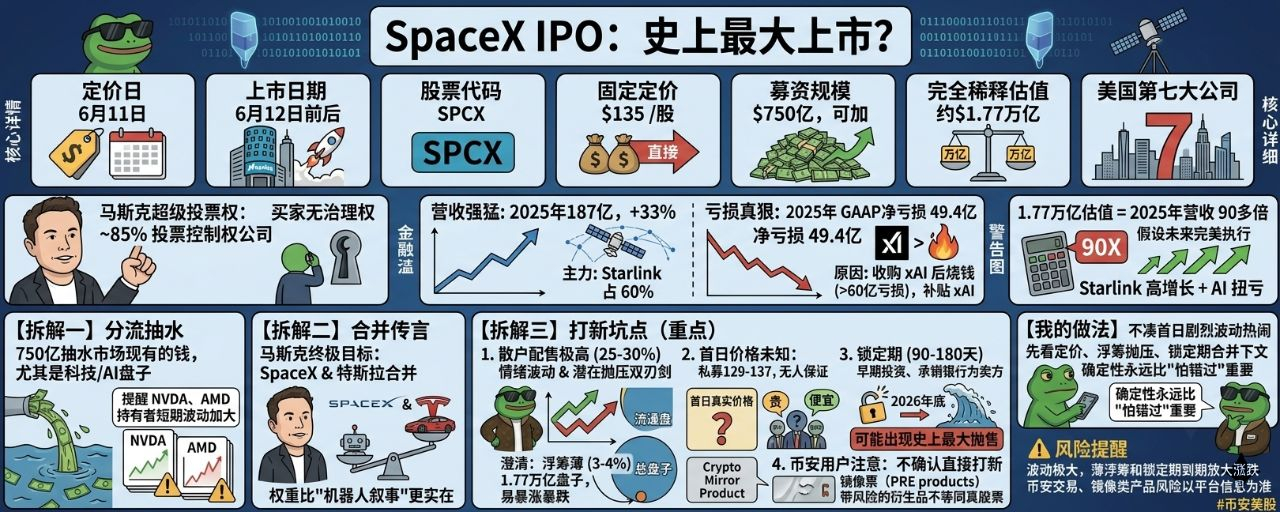
Elon's SpaceX is slated to hit NASDAQ around June 12 under the ticker SPCX (pricing is expected to be finalized on June 11).
According to the official filing: the fixed price is set at $135 per share, raising about $75 billion (underwriters have an additional option to increase, potentially adding another $11.2 billion), corresponding to a valuation of approximately $1.77 trillion.
After going public, it will become the seventh largest company by market cap in the U.S. This fundraising scale is more than double that of Saudi Aramco's in 2019, smashing all previous historical IPOs, truly earning the title of "largest IPO ever." Musk retains about 85% of voting control through super-voting shares, keeping the company firmly in his grip; those buying SPCX will mainly get economic benefits, with almost no governance voice.
Let's take a quick look at its fundamentals: the revenue is really strong, but the losses are equally harsh.
In 2025, revenue is projected at $18.7 billion, a year-on-year growth of about 33%, with Starlink accounting for about 60% of total company revenue. However, the GAAP net loss for the same year could reach $4.94 billion.
It's not that the main business is bad; it's just that after acquiring xAI in February 2026, the AI department is burning cash big time. Just for AI, they lost over $6 billion in 2025, which means the money earned from Starlink is subsidizing xAI. So you're buying a company with a strong satellite business that is being dragged into huge losses by AI dreams.
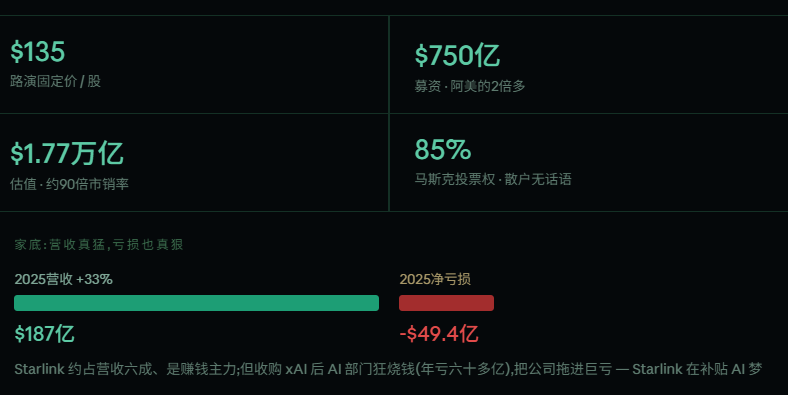
Another number to remember: $17.7 trillion valuation is equivalent to over 90 times the projected revenue for 2025. This price-to-sales ratio assumes 'perfect execution in the future.'
Starlink is growing rapidly, and AI is turning around. Analysts are already asking: what if Starlink's revenue per user declines, or if AI losses continue to expand? This multiple could shrink dramatically.
Here are three things I really want to point out that are relevant to us.
[Breakdown One] How will this affect the stocks you already hold?
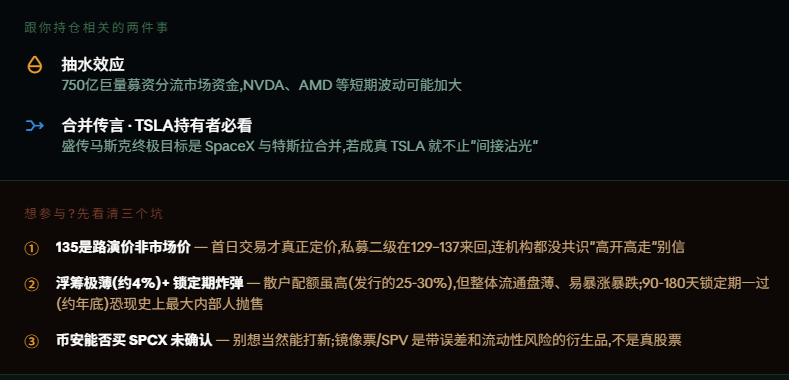
750 billion is a staggering amount; such a large capital raise will siphon money from the existing market, especially funds related to tech/AI, which could be diverted to subscribe to SPCX. Last Friday, there was already a drop in chip stocks and market fluctuations at high levels; such a magnitude of capital withdrawal could exacerbate volatility. If you hold stocks like NVDA or AMD, be mentally prepared for increased volatility in the short term. I'm not bearish; I'm just reminding you not to be caught off guard.
[Breakdown Two] There's a rumor for TSLA holders that you need to know.
There's been a growing saying in the market: Musk's ultimate goal is to merge SpaceX and Tesla. If it's just about 'conceptual synergy' (rockets, Starlink, xAI computing), then TSLA is only indirectly benefiting. But if the merger rumors ever come true, the relationship between SpaceX and TSLA will not be something that can be summarized as 'indirect.' I don't know if it will happen, but TSLA holders need to keep an eye on this—this line's weight is more substantial than those 'robot narratives.'
[Breakdown Three] If you really want to get involved, first be aware of these pitfalls.
New stocks are the easiest to get burned by, so I'll be blunt about this part:
Let me mention a point that might be misunderstood. There's a 'highlight' that's been widely talked about: the retail allocation ratio is extremely high, reportedly reaching 25-30% of this offering. Ordinary investors might be able to buy over $20 billion worth through specific brokerage platforms (Fidelity, Robinhood, Charles Schwab, etc.).
This is indeed rare in the history of large IPOs (usually, retail investors only get about 5%). But don't take it purely as a benefit: why are they willing to give so much to retail investors? The more shares retail investors get, the greater the emotional volatility and potential selling pressure on the first day—it's a double-edged sword.
Here’s a point that seems contradictory but needs clarification: some say that retail investors can get 30%, while others say that the float is only about 3-4%. Which one is correct? Actually, both are correct—this $750 billion is all new stock, which only accounts for about 4% of the total market capitalization of $17.7 trillion (that's the 'float as a proportion of the entire company'); while the '25-30%' refers to the slice of that $750 billion new stock allocated to retail investors. But the key conclusion is: the overall float is extremely thin, and a thin float makes it very susceptible to wild price swings.
135 isn't the market price; it's set during the roadshow. The real price will be determined by the market on the first trading day, June 12. Before the listing, private placements in the secondary market have been bouncing between 129 and 137, with some bidding higher than 135 and others lower—there's no consensus even among institutions about whether it's expensive or cheap. So don't buy into the narrative that 'the stock will definitely open high and rise'; nobody can guarantee the direction on the first day.
Thin float means high volatility on the first day is very likely. With such a low float ratio, if emotions run high, it's easy to chase the price at peaks.
There's also a bomb that many people overlook—lock-up periods. New stocks typically have lock-up periods of 90 to 180 days. Once that lock-up period is over (around the end of 2026), early employees, early investors, and underwriters could all turn into sellers at the same time, compounded by Musk's 85% control. This could result in the largest insider sell-off in history. For those getting in today, mark that date on your calendar.
For us Binance US stock users, don't assume you can directly participate in the new offering. I haven't seen confirmation of whether Binance will list SPCX, when it will be listed, or if you can participate in the new offering, so don't take it for granted. On the crypto side, there are some 'pre-listing mirror tickets' or 'SPV tokens' (similar to SPACEXPRE), so be clear—those are derivatives with tracking errors and liquidity risks, and do not equate to owning actual SpaceX shares. Don't mistake mirror tickets for original stocks.
[My Approach]
As usual, I won't change my pace because of the largest IPO in history.
The extreme volatility on the first day is for those willing to take on first-day risks, not for people like me who just want to watch the show. I'll be observing first—watching where the real pricing lands on the first day, whether there's selling pressure after the float is released, and whether there are any developments regarding the lock-up period and merger rumors. It's not too late to decide whether to jump in after the price is worked out by the market.
I won't regret missing the first day's surge. I've seen too many new stocks open high and then drop, trapping people at the peak; certainty is always more important than 'fear of missing out.'
⚠️ Risk Warning: Investing carries risks, and new stocks can be extremely volatile on their first day of trading. Thin floats and the expiration of lock-up periods can amplify price swings. The above is purely my personal observation and sharing; it does not constitute any investment advice. For the specific risks of SPCX trading on Binance and mirror products, please refer to the actual information provided by the platform and verify it yourself for rational decision-making.#币安美股