

Ive been around long enough to know when a project is trying too hard to sound important. Walrus does not do that and Im not sure if that is confidence or quiet exhaustion. No mascots. No hype cycles. Just talk about storage privacy and infrastructure. The boring stuff. The stuff that fails slowly while everyone is busy chasing the next chart.
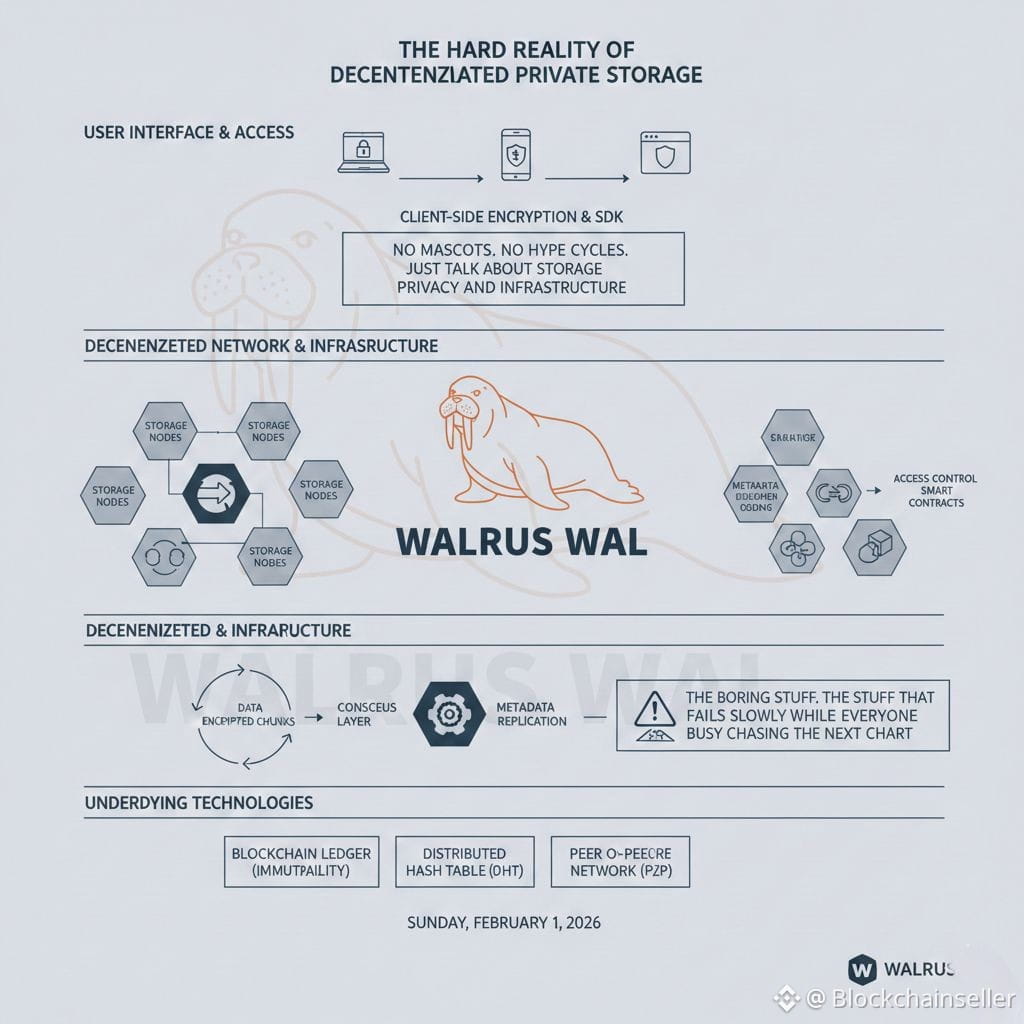
WAL is the native token sure but Ive found that calling it just a token is how people fool themselves. WAL is not decoration. It holds weight. If it cracks the whole structure goes with it and Ive seen that happen more times than I care to count.
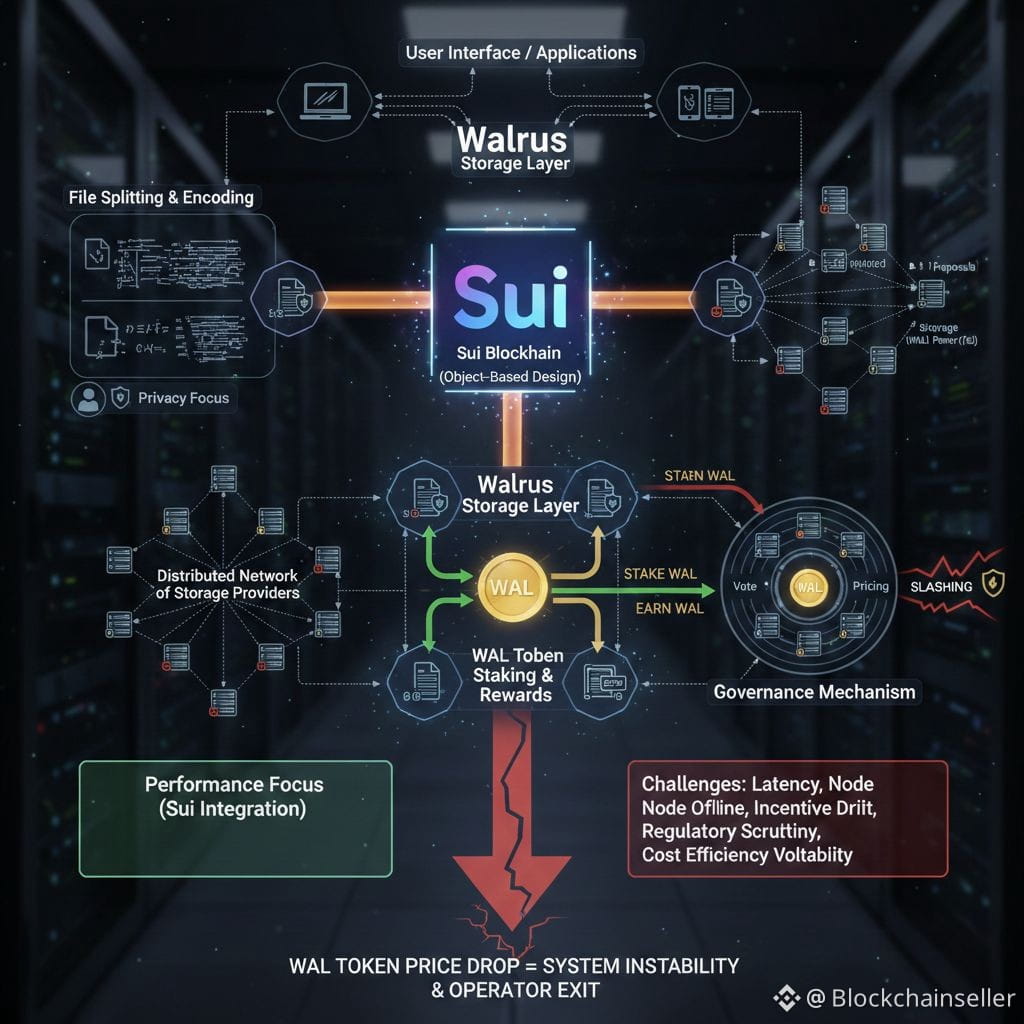
Walrus runs on Sui which tells me two things right away. One they actually thought about performance. Two they are willing to tie their fate to a chain that is still trying to prove it belongs in the room. Suis object based design makes sense for blob storage and large files. I will give them that. But building your entire storage layer on a young chain is not bravery. It is a bet that only looks smart until growth slows.
The core idea is familiar. Split files. Encode them. Scatter them across a decentralized network so no single node can see or control the whole thing. On paper it looks clean. In the real world it gets ugly. Nodes go offline. Incentives drift. Latency shows up when you least want it. Decentralized storage rarely fails in dramatic fashion. It just gets worse until users quietly leave.
Privacy is where Walrus really starts making people uncomfortable even if they wont say it out loud. Everyone claims to care about privacy. Then they hand everything to a cloud provider because it is easy and cheap. Walrus assumes users will accept friction for the sake of privacy. Some will. Most will not. And regulators definitely will not clap for it. Privacy focused infrastructure has a way of attracting attention from exactly the people you do not want watching.
WAL is meant to keep everyone honest. Storage providers stake it. They earn it by behaving. They lose it by disappearing. Governance runs through it. In theory incentives align. If Im being honest governance tokens usually align power not judgment. Big holders decide. Everyone else complains and pretends it matters. When governance controls pricing redundancy and slashing the imbalance stops being philosophical and starts being fatal.
Cost efficiency is another promise Ive learned to doubt. Redundancy costs money. Bandwidth costs money. Paying operators costs money. WALs price does not care about any of that. It moves when the market feels like it. When the token drops and rewards shrink do operators stay out of loyalty or do they shut down servers and move on. Be honest. What would you do?
What matters is not how Walrus looks in demos or whitepapers. It is how it behaves when things go wrong. When usage spikes. When a bad governance vote slips through. When WAL goes nowhere for months and no one is excited anymore. That is when projects show what they really are.
I do not think Walrus is trying to be famous. That might be its best and worst quality. If it works no one will talk about it. The storage will just exist quietly doing its job. If it fails it will not be because the tech was weak. It will be because building decentralized infrastructure people truly rely on is brutally hard and belief alone does not keep servers running.


