
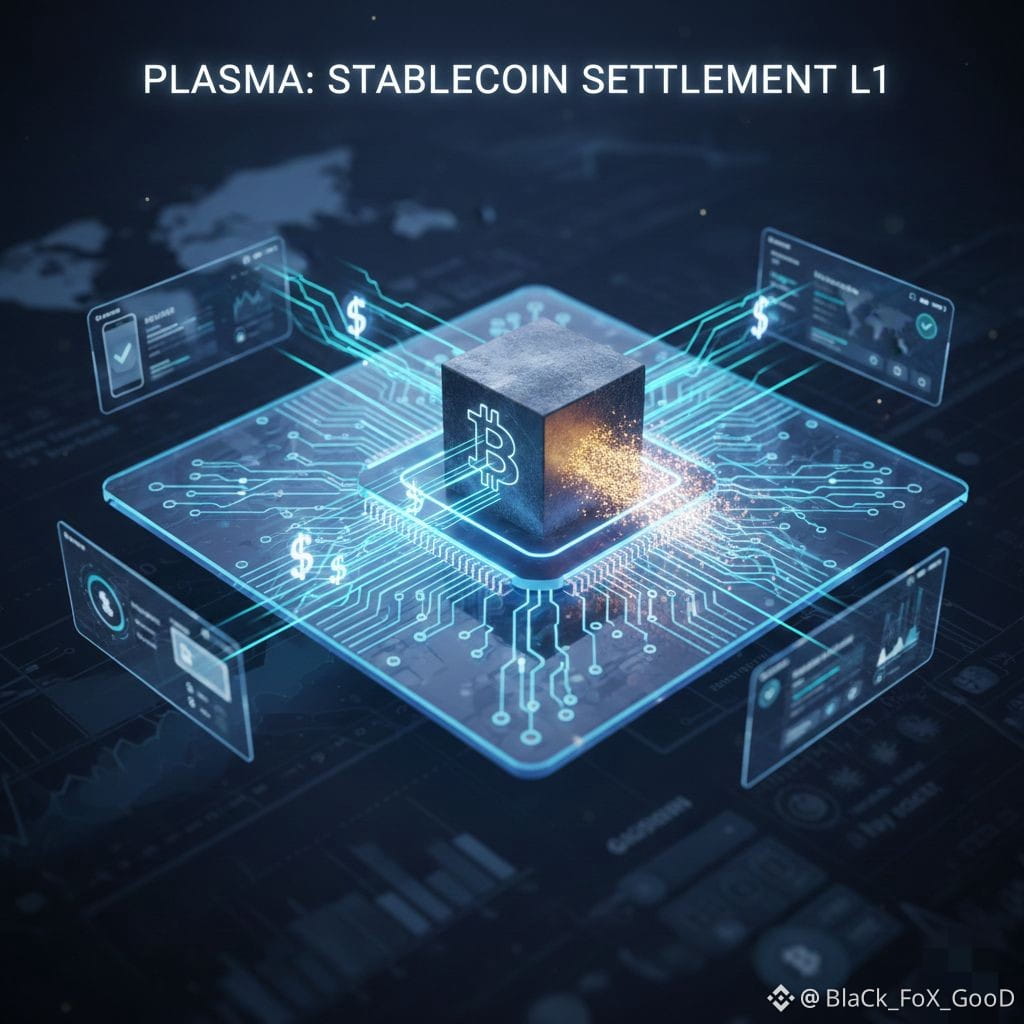
@Plasma is positioned as a Layer 1 blockchain explicitly optimized for stablecoin based settlement rather than general purpose token speculation. Its proposed stack combines full EVM compatibility via Reth, deterministic sub second finality through a BFT consensus mechanism PlasmaBFT, stablecoincentric transaction economics including gasless USDT transfers and stablecoin denominated fees, and periodic anchoring to Bitcoin for external security guarantees. Together, these design choices suggest an infrastructure focused on predictable, low latency movement of dollar pegged value across both retail and institutional contexts. What follows is a technical, non promotional examination of the goals behind this architecture, how it is intended to function, and the trade offs it introduces.
The underlying problem Plasma addresses
#Plasma At its core, Plasma aims to reduce friction that emerges when blockchains are used primarily for payments and settlement rather than speculative activity. These frictions include transaction fees denominated in volatile native tokens, confirmation models that are probabilistic or slow, poor user experience caused by mandatory gas token management, and dependence on external chains or bridges to achieve stronger security or censorship resistance. For payment systems especially those involving merchants, remittances, or regulated institutions such unpredictability undermines reliability and limits adoption.
Why this matters for on chain payments
Payment and settlement use cases demand properties that differ from those prioritized by many smart contract platforms. Retail transactions, cross-border transfers, and institutional settlements favor fast, deterministic confirmation, fees expressed in stable units, and minimal user overhead. If blockchains fail to meet these requirements, stablecoins remain constrained to custodial systems, off chain payment rails, or layered solutions that reintroduce trust assumptions. Improving the base layer for stable value settlement directly affects whether Web3 can support everyday commerce and regulated financial activity in a meaningful way.
High level view of Plasma’s technical approach
Plasma is described as an L1 that exposes a standard EVM interface, allowing developers to deploy existing smart contracts and use familiar tooling without modification. Consensus is handled by a Byzantine Fault Tolerant protocol optimized for rapid finality, enabling transactions to be confirmed in well under a second. This approach implies a validator set designed for performance and coordination rather than open ended participation. Two additional design decisions define Plasma’s focus: abstracting transaction fees so they can be paid or subsidized in stablecoins, and enabling “gasless” transfers through meta-transaction infrastructure. To augment security and neutrality, Plasma periodically commits cryptographic representations of its state to Bitcoin, creating externally verifiable checkpoints that are difficult to reverse.
Core functional mechanisms
Gasless USDT transfers Likely implemented through meta transactions, where users sign transfer intents and relayers submit transactions on their behalf. Relayers are compensated via stablecoins or paymaster contracts. This design raises questions around relayer incentives, liquidity provisioning, and protections against abuse or censorship.
Stablecoin denominated gas Fees may be paid directly in stablecoins, algorithmically mapped from a native fee unit, or abstracted entirely through third party underwriting. While this simplifies UX, it introduces economic and security considerations such as denial of service resistance and fee market responsiveness.
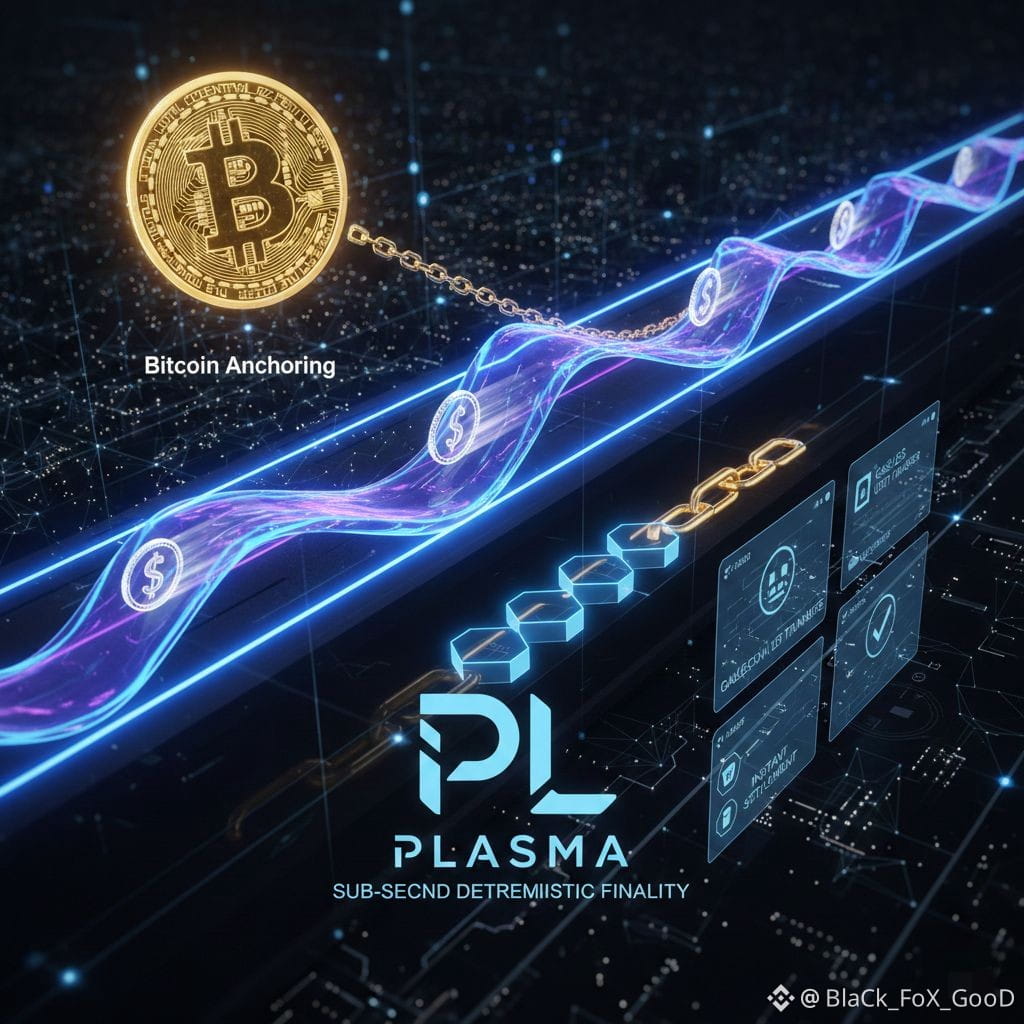
Sub second deterministic finality A BFT based consensus delivers immediate settlement guarantees after a bounded number of communication rounds. This is advantageous for payments but typically requires a smaller, higher performance validator set, with implications for decentralization.
Bitcoin anchoring: Periodic commitments of Plasma’s state to Bitcoin provide an external audit trail and increase the cost of history rewrites. While anchoring does not replace strong internal consensus or eliminate bridge risks, it adds an independent security reference point that enhances transparency and perceived neutrality.
Architectural and system level considerations
#PlasmaXPL likely architecture separates execution, consensus, and anchoring concerns. The execution layer maintains EVM compatibility and standard RPC interfaces to ensure wallet and contract interoperability. The consensus layer is tuned for speed, with short block times and fast finality guarantees. Anchoring is achieved by committing Merkle roots or epoch hashes to Bitcoin transactions at regular intervals. Supporting infrastructure such as relayer networks, paymasters, and liquidity pools for fee abstraction is essential to delivering the promised user experience and must be robustly designed and governed.
Representative use cases
Payments and remittances Near instant, low cost stablecoin transfers without requiring users to hold gas tokens.
Retail point of sale and micropayments Fast confirmation enables workflows similar to card networks, including immediate receipts and offline reconciliation.
Institutional settlement rails Financial institutions can leverage deterministic finality and Bitcoin anchored auditability for treasury operations or inter entity transfers.
Programmable stablecoin payments Recurring payments, payroll, and invoicing logic benefit from stable fee models and predictable execution.
Developer and user experience
For developers, full EVM compatibility lowers migration costs and preserves access to established tooling, libraries, and standards. For users, the primary advantage is simplicity: transactions can be executed directly in stablecoins without exposure to volatile gas tokens or unexpected fee spikes. Gasless flows enable signature only interactions, improving usability for consumer applications. Institutions benefit from predictable accounting and reduced operational complexity, though many conveniences rely on off chain services whose trust and availability must be clearly understood.
Security, reliability, and trust trade offs
Several risks accompany Plasma’s design. Relayer and paymaster systems introduce additional trust assumptions and potential attack vectors if they become centralized or collusive. BFT consensus remains secure only if validator fault thresholds are maintained, requiring careful incentive and governance design. Bitcoin anchoring strengthens auditability but depends on consistent execution; delayed or missing anchors reduce its protective value. Any bridges or interoperability layers used to source liquidity represent additional risk and must be carefully audited.

Scalability and compatibility considerations
A low latency BFT chain can achieve high throughput if networking, mempool design, and validator hardware are appropriately provisioned. EVM compatibility ensures composability and ecosystem alignment but may restrict certain execution optimizations unless parallelism or advanced scheduling is supported. Compatibility with existing wallets, standards, and RPC interfaces significantly lowers adoption barriers.
Cost and performance implications
Stablecoin native fees and gas abstraction reduce both psychological and financial transaction costs for users. If consensus overhead is low and blocks remain compact, transaction fees should undercut those of general purpose chains that rely on volatile fee markets. However, the sustainability of fee subsidies and relayer incentives is critical: long term viability depends on clear economic flows and congestion handling mechanisms.
Long term positioning and competitive pressures
Plasma’s durability will depend on real adoption by merchants, institutions, and developers; the strength of its integrations; and its performance under adverse conditions. Competition is intense, with many L1s, L2s, and traditional payment networks offering alternative settlement solutions. Regulatory clarity around stablecoins, AML requirements, and custody will heavily influence institutional uptake. The balance between performance and decentralization will remain a central challenge.
Conclusion
Plasma advances a focused design thesis: that stablecoin settlement deserves a dedicated Layer 1 optimized for speed, predictability, and usability. By combining EVM compatibility, fast BFT finality, fee abstraction, and Bitcoin anchoring, it targets specific limitations that have constrained on chain payments. Whether this approach succeeds will depend less on conceptual appeal and more on execution specifically, decentralized relayer infrastructure, transparent anchoring practices, rigorous security audits, and credible regulatory engagement. If those elements are delivered effectively, a stablecoin centric L1 can occupy a practical middle ground between experimental blockchains and legacy payment rails in an increasingly competitive environment.

