
@Dusk #dusk $DUSK
I was reading Dusk’s architecture again this time focusing on Piecrust.I expected a simple explanation of where Dusk smart contracts run. Instead one detail changed how I saw the execution layer.
The question that caught me was simple: what happens if different nodes execute the same contract but reach different results?
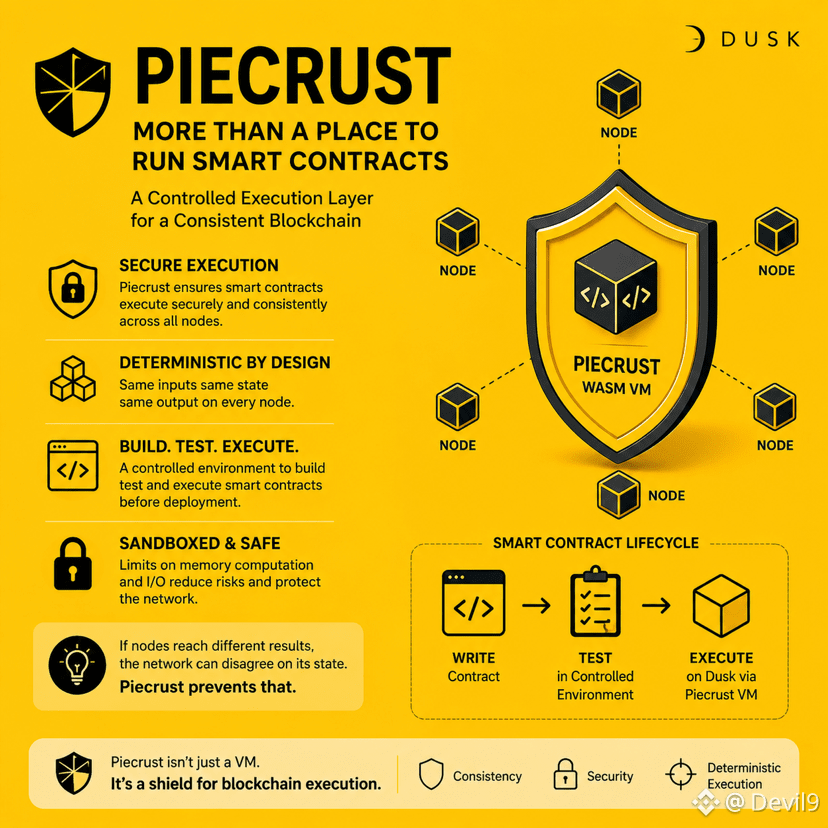
That is where Piecrust became more interesting to me.Dusk describes Piecrust as a WASM virtual machine built for smart contracts. But the important part is not simply that contracts can execute.Execution needs to be deterministic so nodes receiving the same inputs and state can arrive at the same output.If nodes disagree on a contract’s result they can disagree about the state of the network itself.So the VM is not just a place where code runs. It helps keep execution consistent across the network.I also noticed the controlled environment around contract development.Piecrust supports building testing and executing contracts while sandboxing limits on memory computation and I/O help reduce the attack surface.
Instead of asking only “Can Dusk run smart contracts?” I started asking “How does Dusk make smart contract execution predictable controlled and secure?”For me that is the more interesting angle behind Piecrust.A blockchain VM may sit in the background but its design can affect how reliably application logic is executed.Piecrust looks less like just an engine for running contracts and more like a controlled execution layer protecting consistency.
Now I want to understand how it connects with Dusk’s privacy architecture.
Keywords🤝Dusk Network Piecrust WASM VM smart contracts deterministic execution blockchain security privacy architecture
@Dusk #dusk
$BEAT
$TUT
I was reading Dusk’s architecture again this time focusing on Piecrust.I expected a simple explanation of where Dusk smart contracts run. Instead one detail changed how I saw the execution layer.
The question that caught me was simple: what happens if different nodes execute the same contract but reach different results?
That is where Piecrust became more interesting to me.Dusk describes Piecrust as a WASM virtual machine built for smart contracts. But the important part is not simply that contracts can execute.Execution needs to be deterministic so nodes receiving the same inputs and state can arrive at the same output.If nodes disagree on a contract’s result they can disagree about the state of the network itself.So the VM is not just a place where code runs. It helps keep execution consistent across the network.I also noticed the controlled environment around contract development.Piecrust supports building testing and executing contracts while sandboxing limits on memory computation and I/O help reduce the attack surface.
Instead of asking only “Can Dusk run smart contracts?” I started asking “How does Dusk make smart contract execution predictable controlled and secure?”For me that is the more interesting angle behind Piecrust.A blockchain VM may sit in the background but its design can affect how reliably application logic is executed.Piecrust looks less like just an engine for running contracts and more like a controlled execution layer protecting consistency.
Now I want to understand how it connects with Dusk’s privacy architecture.
Keywords🤝Dusk Network Piecrust WASM VM smart contracts deterministic execution blockchain security privacy architecture
@Dusk #dusk
$BEAT
$TUT