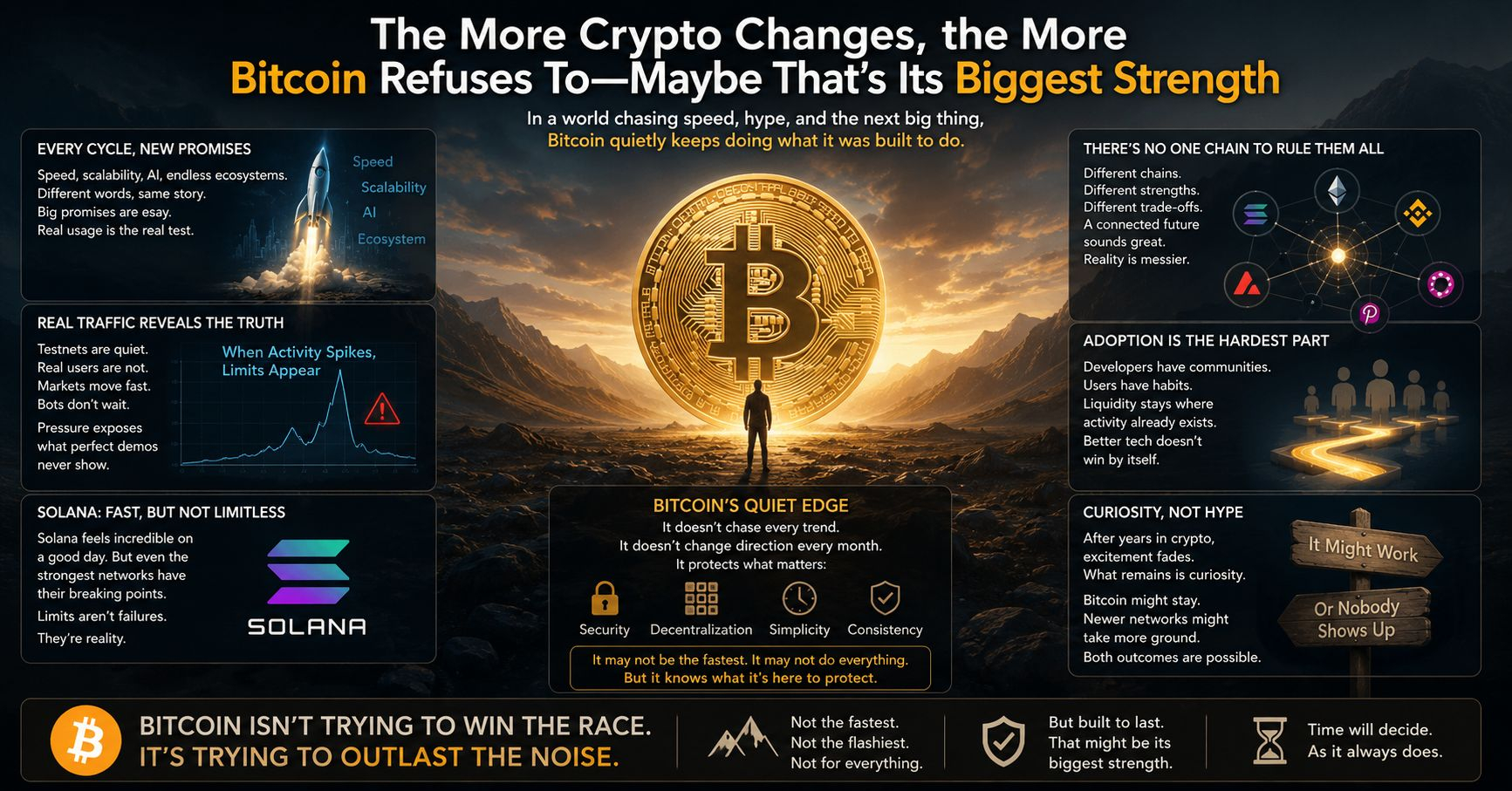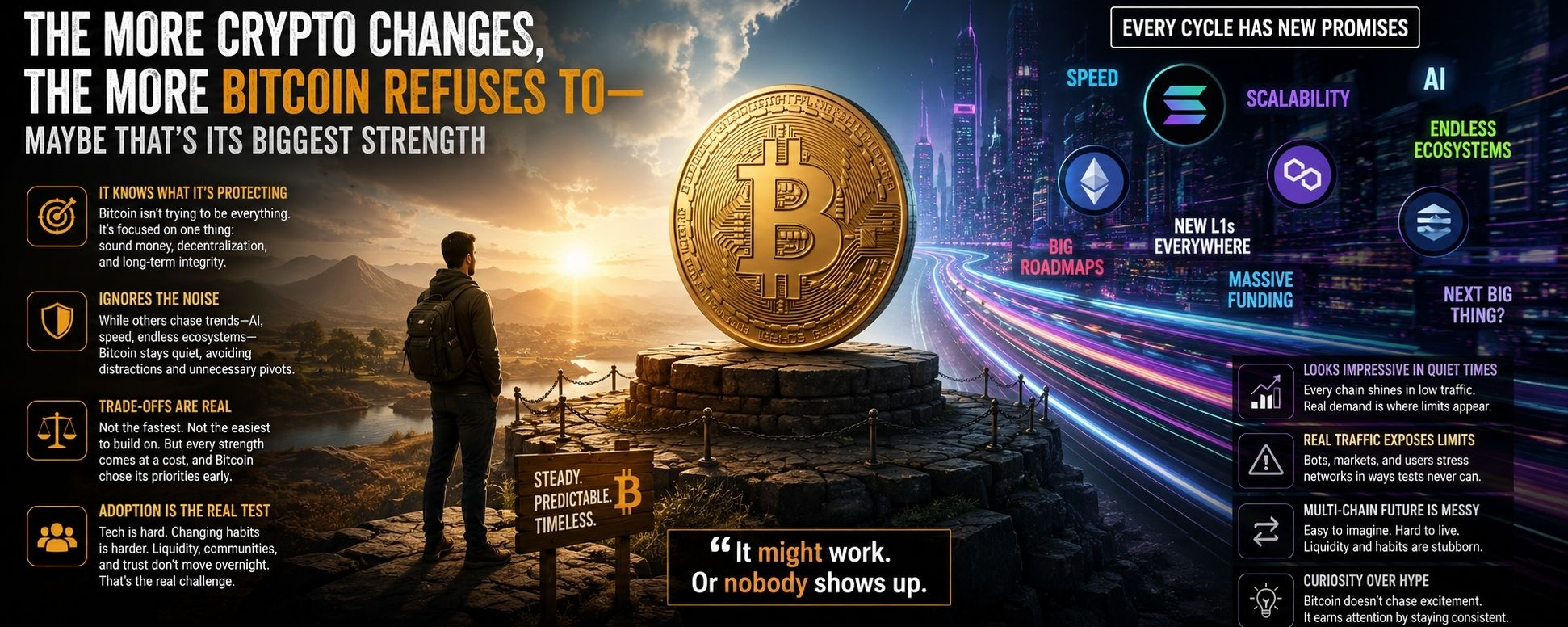
At first, Bitcoin doesn't feel like a project that's trying to win anyone over. It feels more like something that's already found its place and has stopped worrying about whether people approve of it. After spending years in crypto, that stands out more than another flashy roadmap ever could. I've seen enough Layer 1 launches to know how easy it is to make big promises. Speed, scalability, AI, endless ecosystems. Every cycle has its own vocabulary, but after a while it all starts sounding strangely familiar. You don't become cynical exactly. You just become slower to believe.
What I've noticed over the years is that almost every blockchain looks impressive when nothing much is happening. The difficult part comes later, when real users arrive. Not a few thousand people testing things for fun, but actual demand. Markets moving fast. Bots competing for every opportunity. Applications all trying to use the network at once. That's where the nice diagrams stop mattering. Real traffic has a way of exposing things that nobody noticed during the quiet days.
Solana is probably the easiest example. On a normal day it feels fast, smooth, and honestly enjoyable to use. There's a reason so many people like building there. But we've also seen moments where heavy activity pushed the network harder than expected. I don't bring that up to criticize it. If anything, it reminds me that every Layer 1 has limits. The difference is simply where those limits appear. No design escapes trade-offs forever.
Sometimes I think we've become too focused on finding the one blockchain that's supposed to do everything. Maybe that's never been a realistic goal. Maybe different networks will end up doing different jobs, each becoming reliable in its own corner of the ecosystem. It sounds reasonable, although reality is usually messier. People don't like moving assets around unless they have a very good reason. Liquidity is even more stubborn. It's easy to imagine a perfectly connected multi-chain future. It's much harder to convince millions of users to behave that way.
What I appreciate about Bitcoin is that it doesn't seem interested in joining every new trend. It quietly ignores a lot of noise that other projects feel obligated to chase. That means it misses opportunities, sure. It also means it avoids changing direction every time the market discovers a new obsession. There's something refreshing about that kind of restraint. It knows what it's trying to protect, even if that makes it look old-fashioned next to newer chains.
Of course, none of this means Bitcoin is perfect. It isn't the easiest place to build. It isn't the fastest network. It doesn't try to compete with every smart contract platform, and sometimes that choice feels limiting. Those trade-offs are real, and pretending otherwise doesn't help anyone. Every blockchain gives something up in order to prioritize something else. Bitcoin simply made its decision a long time ago and has been surprisingly consistent ever since.
The bigger question is still adoption. That's the part people underestimate. Building technology is difficult, but convincing people to leave familiar ecosystems might be even harder. Developers already have communities. Users already have habits. Capital tends to stay where activity already exists. None of that changes overnight because another chain has better benchmarks or a cleaner architecture.
So I don't look at Bitcoin with excitement anymore. I look at it with curiosity. After enough years in this space, that feels more honest. Maybe its slower approach will continue to matter. Maybe newer networks will gradually take over more of the work. Both outcomes seem possible. Crypto has a habit of surprising people who think they've finally figured it out.
It might work. Or nobody shows up.
#FootballSeason2026 #KospiFallsOnTechSelloff #SKHynixADRsTradeOver25%Premium #SKHynixADRsTradeOver25%Premium