

I picked up a latency spike this weekend that turned out to be pointing at something I hadn't separated properly before.
I was watching a vault protected by Newton's Chainalysis Hexagate integration, and one specific transaction — nothing shady, just a normal deposit — took noticeably longer to clear than others around it. My first assumption was network congestion. That felt like the boring, obvious explanation, and I moved on.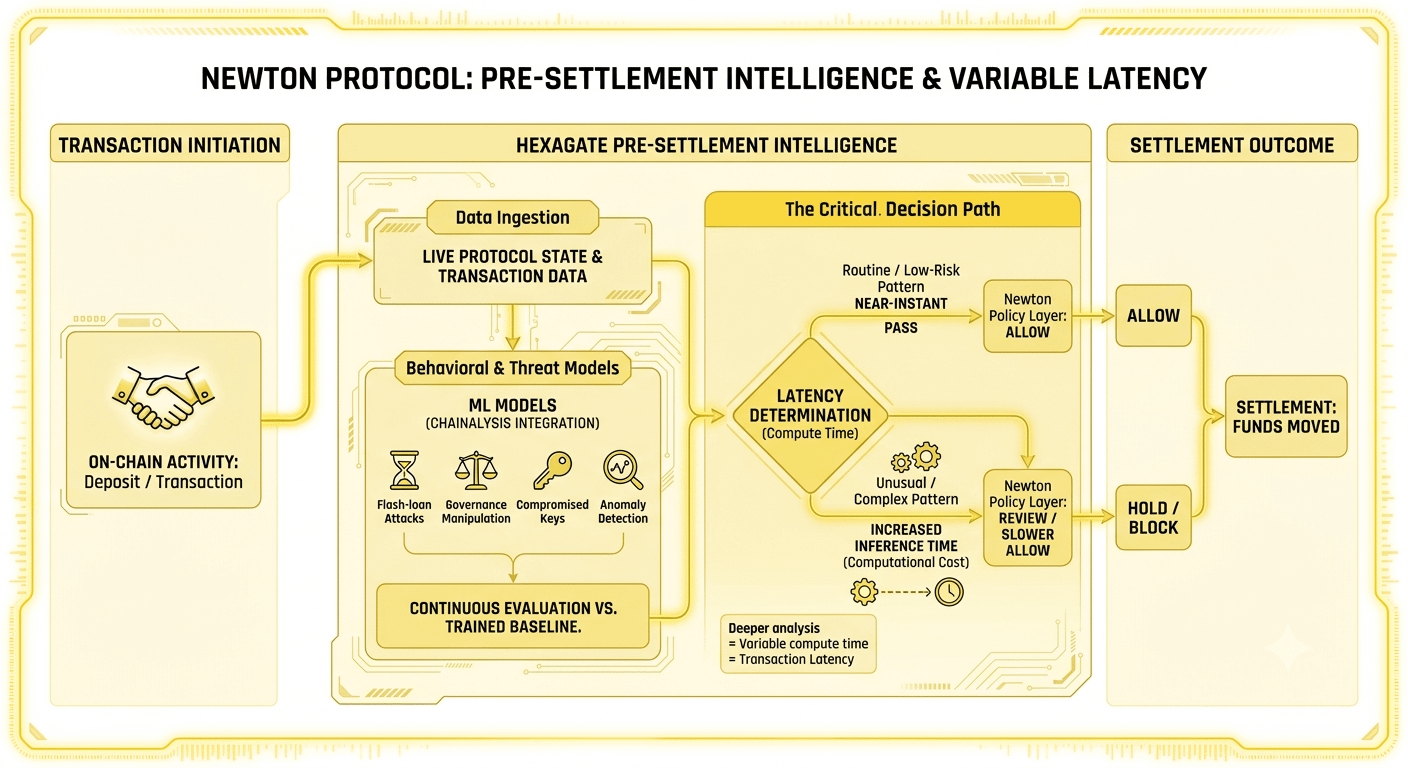
It wasn't that simple.
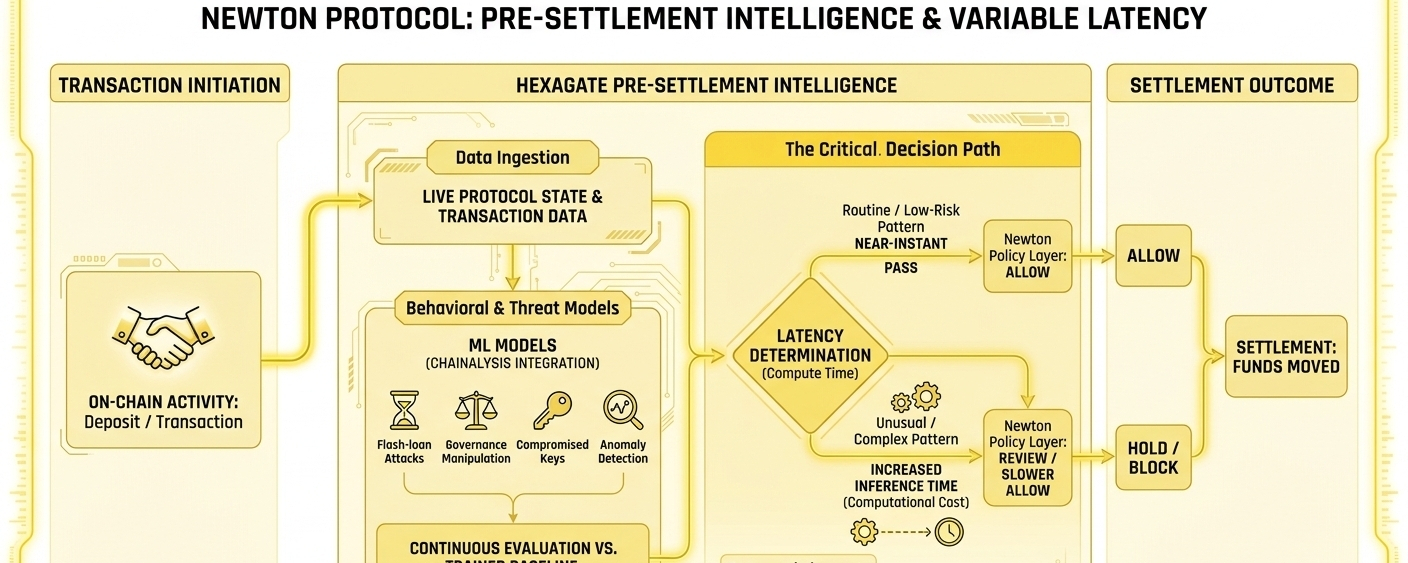
Because Hexagate isn't a static sanctions list lookup the way I'd been mentally filing it. It's ML models continuously evaluating on-chain activity and protocol state, combining threat intelligence and behavioral analytics to flag risky patterns in real time. That's a fundamentally different kind of check than "is this address on a list." A list lookup is near-instant. Behavioral pattern matching against live protocol state is a computation, and computations don't all take the same amount of time depending on how unusual or borderline the activity looks against the trained baseline.
Presence of monitoring ≠ uniform evaluation speed. I'd been assuming a security layer either passes you fast or blocks you — I hadn't considered a third state, where it's genuinely still deciding, and that deciding takes variable time depending on what your transaction pattern actually resembles.
Tracing the dependency chain made it clearer: deposit initiated → Hexagate ingests the transaction alongside broader protocol state → ML models compare against known exploit patterns, governance manipulation signatures, and flash-loan attack shapes → a risk read emerges → Newton's policy layer uses that to allow or hold the transaction → settlement follows. Somewhere in step three, my ordinary deposit apparently resembled something worth a closer look, even though it resolved cleanly a few seconds later.
The hidden dependency I hadn't thought through is what "real-time" actually costs computationally when the detection target is behavioral rather than categorical. Catching flash-loan attacks, compromised keys, and governance manipulation before funds move means running inference against a model trained on a huge range of on-chain activity, for every transaction, continuously. That's not free, and it's not uniform — a transaction shaped like known attack patterns, even innocently, probably takes a heavier pass through the models than one that looks completely routine.
I got shaken out of a position earlier this week because I misread a delay as the market moving against me, when it was actually my own order routing sitting in a longer validation queue than usual. Different system, same lesson: a pause isn't always a signal, sometimes it's just the machinery working harder than expected.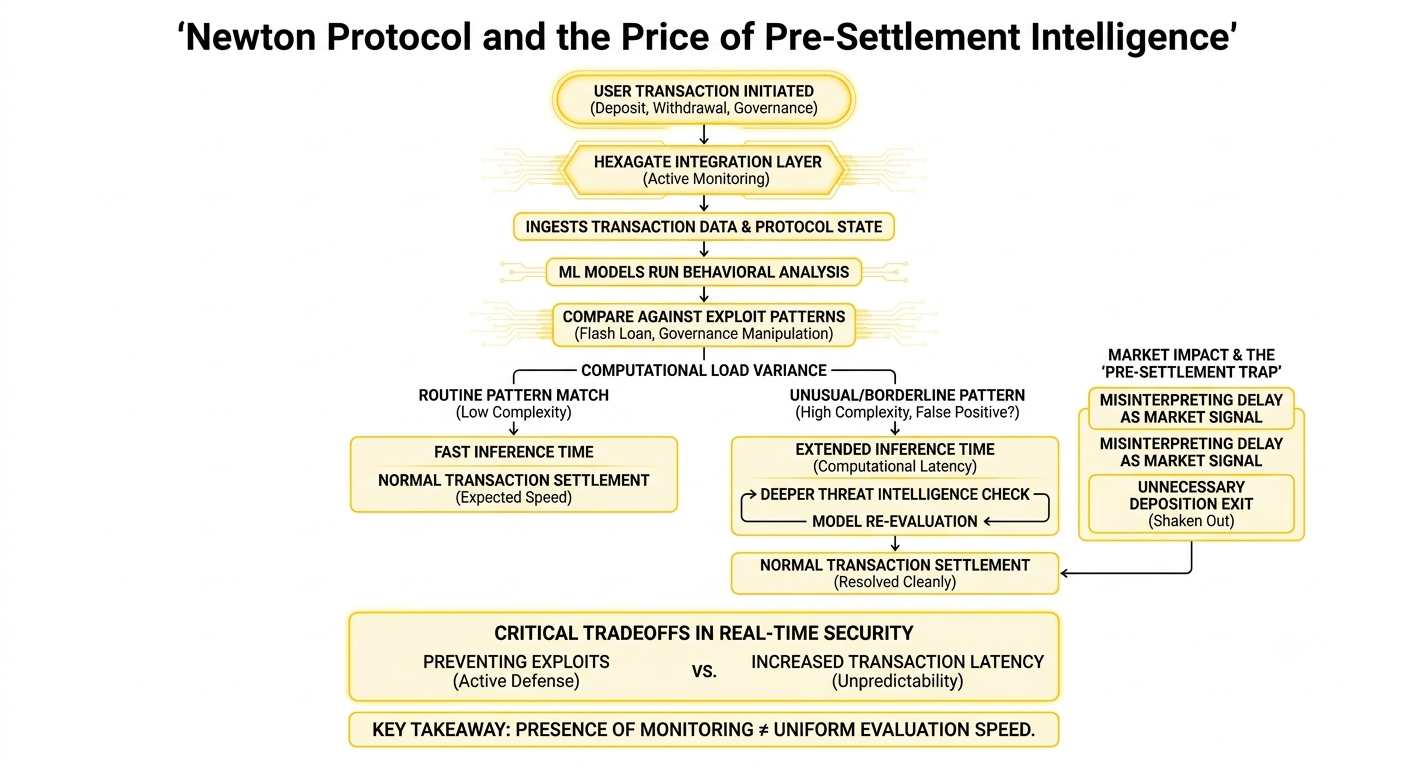
What I still can't resolve: during a genuine high-volume event — a lot of vaults, a lot of simultaneous deposits and withdrawals, real exploit attempts mixed in among legitimate traffic — does Hexagate's evaluation speed hold steady across the board, or does the model's inference time start climbing exactly when the transaction volume looks least like its training baseline, right when speed matters most?