Most conversations around blockchain infrastructure still begin with speed. We compare transaction throughput, execution costs, and network performance as though these measurements alone determine whether a system deserves attention. While researching Newton Protocol, I found myself questioning a different issue. If software increasingly acts on behalf of users, perhaps the more difficult challenge is not execution itself but proving that every automated action remains faithful to the user's original intent. #Newt
That idea changed the way I looked at the protocol.
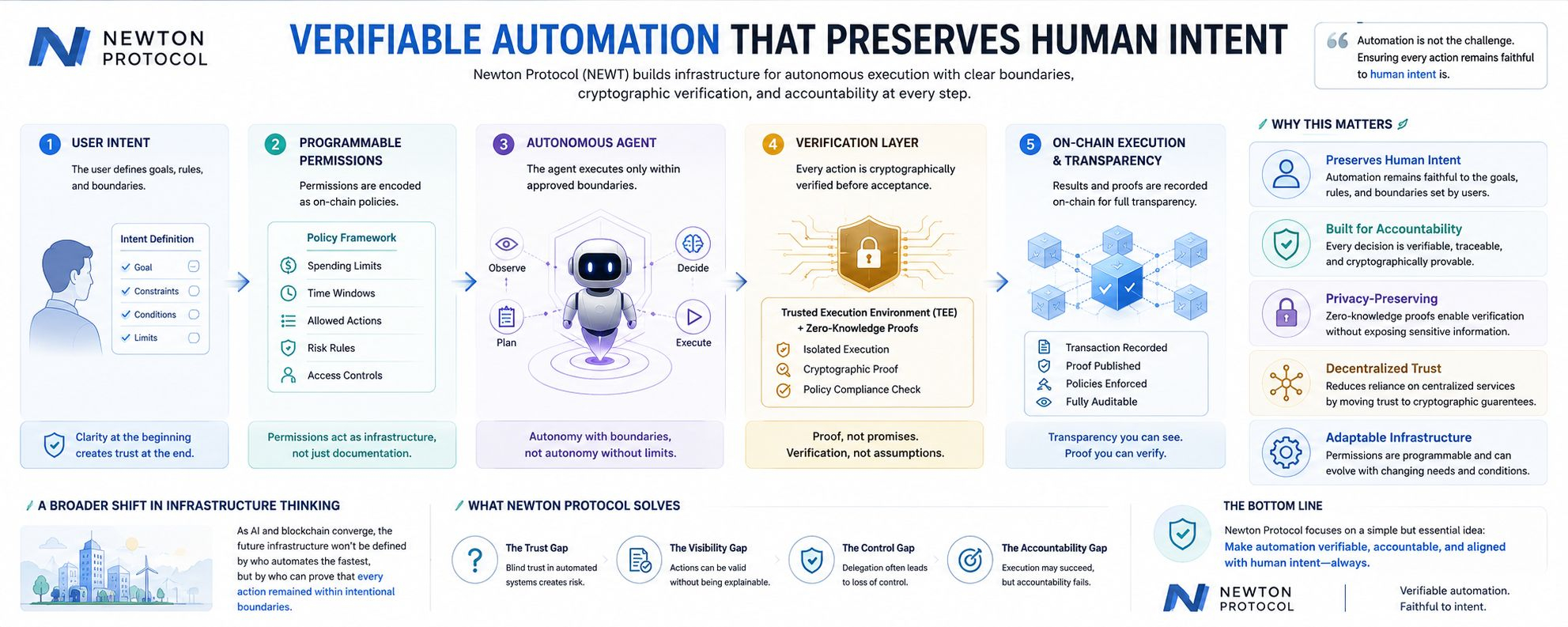
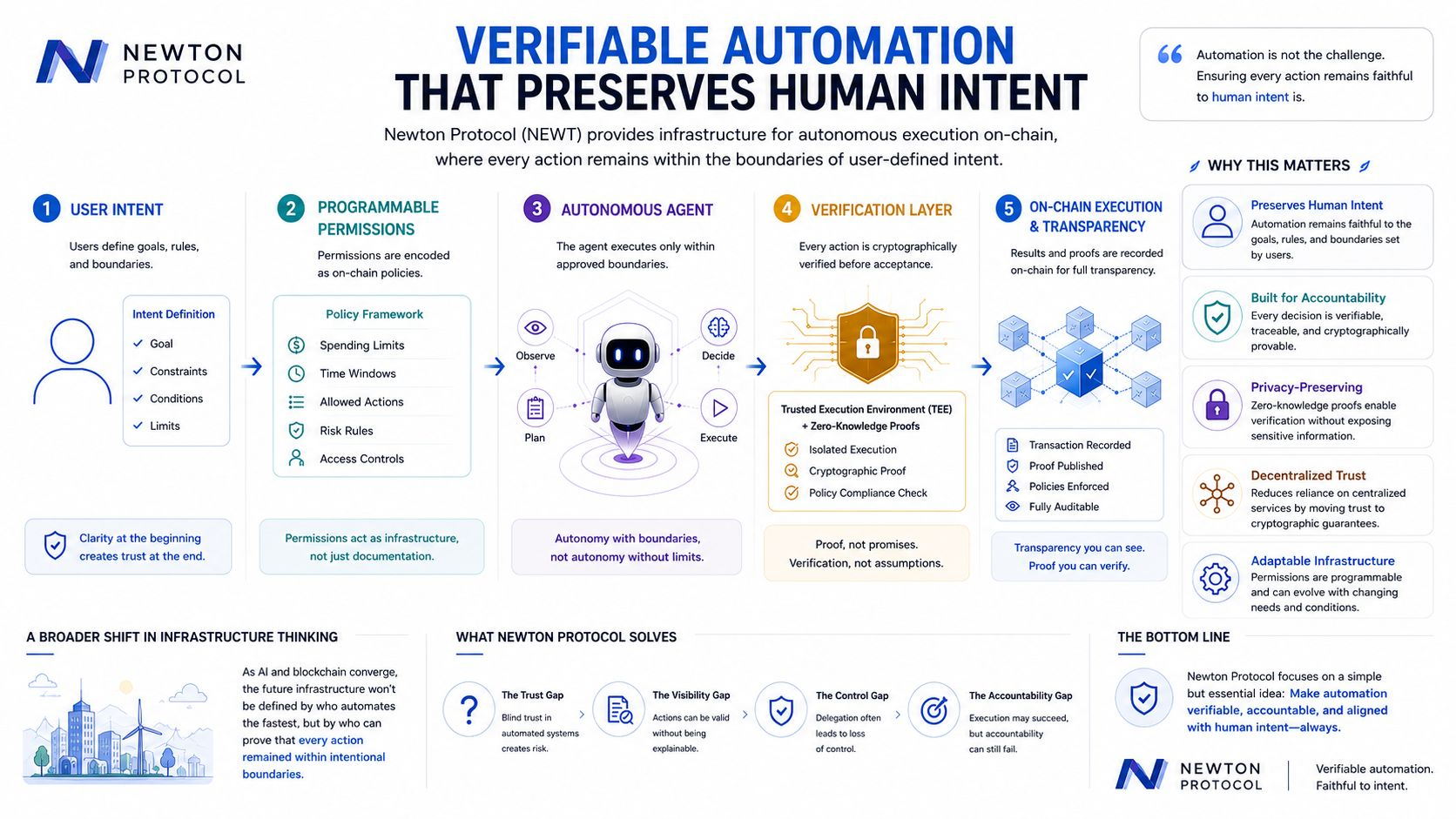
Newton Protocol positions itself as infrastructure for verifiable on-chain automation rather than simply another automation framework. Instead of assuming autonomous agents should be trusted because they successfully complete tasks, the protocol focuses on defining what those agents are allowed to do before execution begins. Programmable permissions, cryptographic verification, and secure execution environments are designed to ensure delegated actions remain within boundaries established by the user.
The distinction initially seemed subtle.
After spending more time reading the documentation, I realized the protocol is really addressing a governance problem rather than an efficiency problem. Automation becomes increasingly valuable as blockchain ecosystems become more complex, yet every delegated permission introduces new questions. Who remains responsible after automation starts? Can someone independently verify why an action occurred? Can authority be delegated without permanently surrendering control?
Those questions extend beyond cryptocurrency.
Artificial intelligence is gradually moving from generating information to performing tasks. Financial management, treasury operations, portfolio adjustments, compliance checks, and cross-chain interactions are all becoming candidates for autonomous execution. The challenge is no longer whether machines can perform these operations. Instead, the challenge becomes creating infrastructure where every automated decision remains transparent, reviewable, and constrained by explicit policies rather than hidden assumptions. @NewtonProtocol
That perspective also explains why Newton Protocol combines technologies such as Trusted Execution Environments (TEEs) with zero-knowledge proofs. Rather than asking users to trust invisible software, the protocol seeks to make authorization and execution independently verifiable while preserving privacy where appropriate. This architecture attempts to reduce dependence on centralized automation services by moving trust toward cryptographic guarantees.
Another aspect I found interesting is how the protocol treats policies as programmable infrastructure instead of static documentation. In many digital systems, rules are written separately from execution, leaving room for interpretation or inconsistent enforcement. Newton Protocol explores the idea that permissions themselves should become part of the computational process, allowing actions to be evaluated against predefined conditions before they are executed.
Reading through this approach made me think about a broader shift happening across technology.
For years, software development has focused on making systems increasingly autonomous. Yet autonomy without clear boundaries often creates uncertainty rather than confidence. The more responsibility software receives, the more valuable accountability becomes. A perfectly executed transaction still leaves unanswered questions if nobody can demonstrate why that transaction was authorized in the first place.
Perhaps infrastructure is entering a stage where trust is built less through promises and more through evidence.
Newton Protocol does not eliminate every challenge surrounding autonomous systems, nor does it claim automation alone solves existing problems. What it does highlight is an issue that may become increasingly difficult to ignore as AI and blockchain continue to intersect. Automation is relatively easy to imagine. Designing systems that preserve human intent after delegation may ultimately prove to be the harder engineering problem.
That possibility stayed with me long after I finished reading about the protocol, and it seems like a discussion that extends well beyond a single blockchain project.