
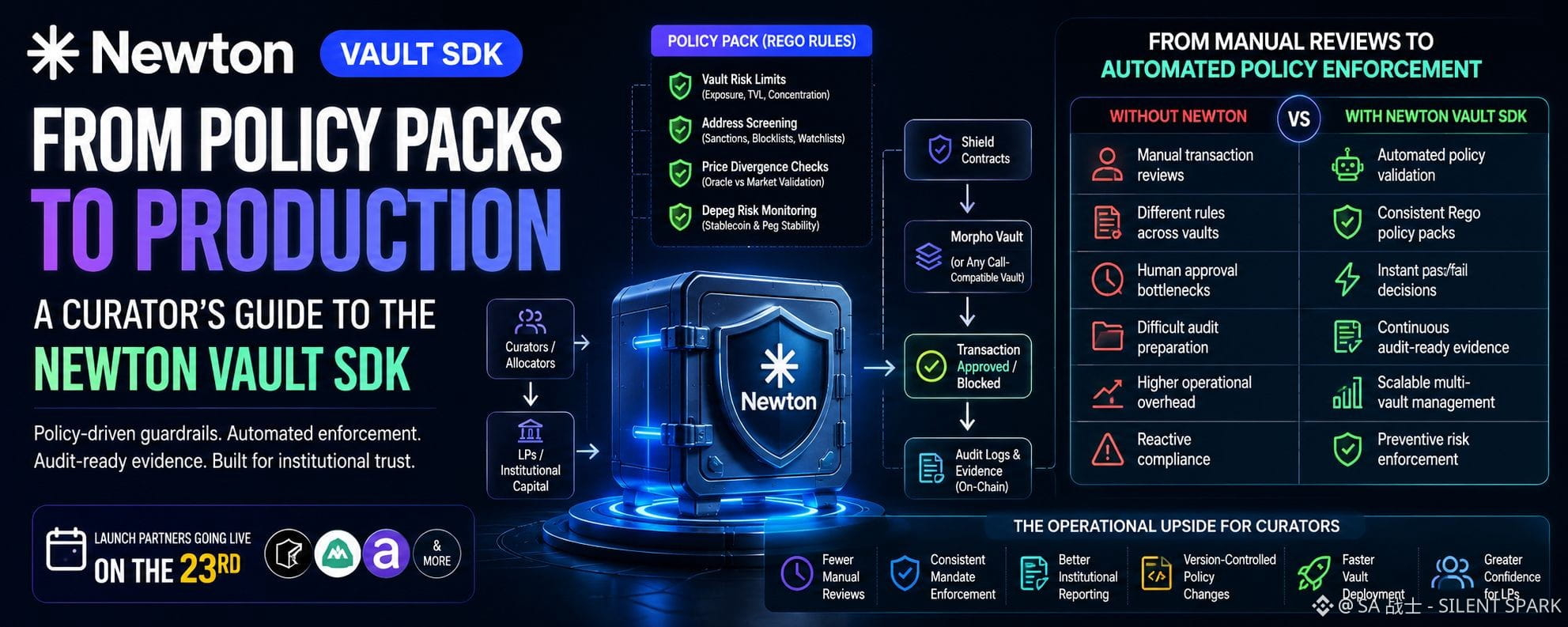
The busiest conversations in DeFi lately have not been about chasing the next source of yield. They've been about something quieter: how to keep yield strategies consistent once they scale beyond a handful of vaults. That shift matters because institutional capital is asking different questions than retail users. The conversation is moving from "How much can this vault earn?" toward "Can every decision inside this vault be explained after the fact?"
That is exactly where Newton's Vault SDK enters the picture. Rather than replacing an existing vault architecture, it is changing how policy enforcement sits underneath it. For curators already running strategies on Morpho, or teams using other vault frameworks with generic call support, the SDK from Magic Labs works alongside Shield contracts instead of forcing a redesign. The practical outcome is that risk checks become part of execution itself instead of another item on an operational checklist.
Understanding that helps explain why Newton keeps describing policy packs rather than permission lists. A policy pack is essentially a collection of machine-readable rules written with Rego, a language already familiar in cloud security. On the surface, that means a transaction either passes or fails before reaching production. Underneath, it means every action can be evaluated against the same mandate regardless of which curator or operator initiated it. That consistency becomes difficult to achieve once dozens of vaults are running simultaneously.
Developer discussions around policy-as-code have grown well beyond infrastructure software during the past year, and DeFi appears to be borrowing that foundation instead of inventing another custom standard. The interesting part is not the language itself. It is that vault policies become versioned, reviewable, and auditable in the same way software code already is.
The individual guardrails also reflect how institutional risk teams actually think. Vault risk policies can limit exposures before allocations drift outside a mandate. Address screening prevents interactions with blocked or suspicious wallets without relying on manual review. Price divergence checks compare execution against trusted market references, reducing the chance that abnormal pricing quietly slips through. Depeg monitoring extends that logic to assets whose stability cannot simply be assumed, an increasingly relevant consideration after several stablecoin disruptions over the past few years.
That momentum creates another effect. Curators managing multiple strategies spend less time reviewing repetitive operational decisions and more time evaluating actual investment opportunities. Instead of asking whether every transaction followed internal rules, they can focus on whether those rules still reflect market conditions. The distinction sounds subtle, but operationally it removes a significant amount of repetitive work.
Recent institutional reports continue to point in the same direction. Tokenized real-world assets have now grown beyond $25 billion in on-chain value, reflecting rising institutional participation rather than speculative trading alone. At the same time, Morpho has expanded into one of the largest decentralized lending ecosystems, supporting billions of dollars in supplied assets. Those figures matter because larger pools of capital naturally increase the cost of inconsistent governance. Meanwhile, GitHub activity across risk tooling and permission frameworks has remained steady, suggesting developers are investing in operational infrastructure instead of only new financial products.
There are fair questions to ask. Every additional policy layer introduces complexity, and poorly designed rules could block legitimate transactions or slow operational flexibility. It also remains to be seen how broadly launch-partner implementations going live on the 23rd translate into production usage beyond early adopters. Early integrations often reveal edge cases that documentation cannot anticipate.
Even so, the overlooked story is not that Newton is adding another security feature. It is that it is treating governance itself as software. If that approach holds, the vaults attracting long-term institutional liquidity may not be the ones taking the biggest risks, but the ones leaving behind the clearest evidence of every decision they make.
