
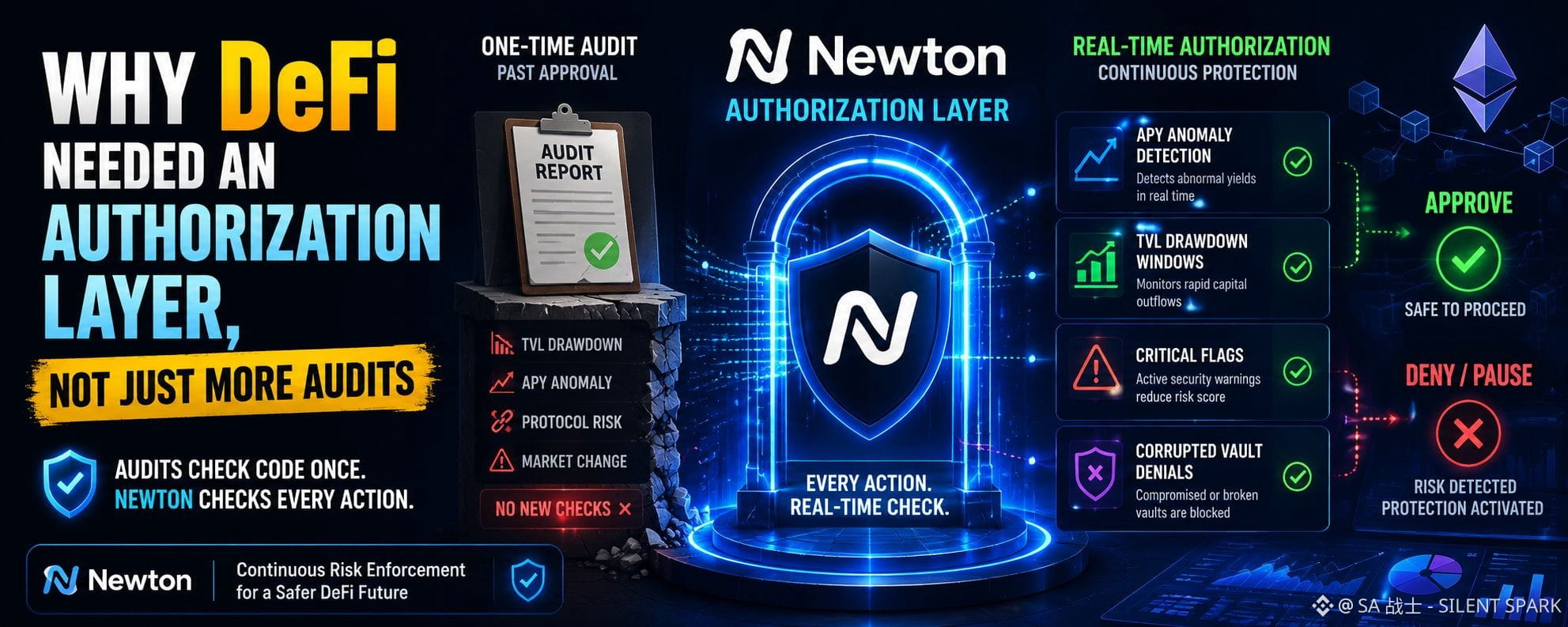
We had audit debate or conversations for years. The deeper issue is that DeFi keeps asking users to trust decisions made weeks or months earlier, even though markets can change in minutes.
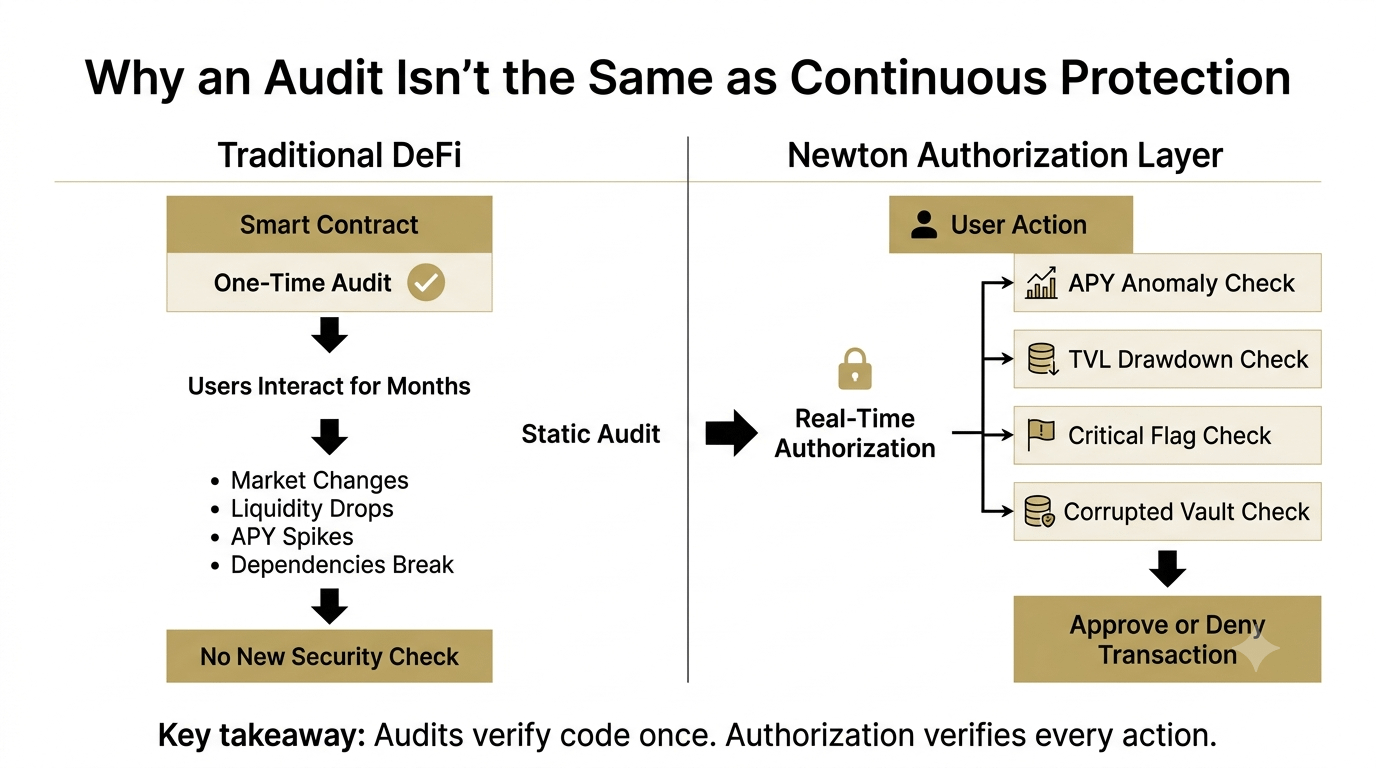
An audit answers a narrow question. Was the code written correctly when someone reviewed it? That's valuable, and nobody serious argues against audits. But an audited vault can still become a bad place to deposit if liquidity disappears, incentives distort returns, or a protocol further down the dependency chain develops problems. Security isn't only about whether the code executes correctly. It's also about whether the conditions surrounding that code remain healthy.
That's where an authorization layer starts making more sense than another checklist. Instead of approving a protocol once and hoping nothing changes, Newton flips the model. Every action is evaluated in real time before permission is granted. The difference sounds subtle until you think about what actually causes many losses in DeFi. They rarely begin with someone ignoring an audit. They begin because reality changed after the audit was finished.
The strongest proof point is Newton's integration with the Vaults.fyi risk-rating pack. Vaults.fyi already tracks more than 30 live data points across over 1,000 vaults spanning 80-plus protocols and more than $100 billion in tracked value. Those numbers are interesting on their own, but what matters is how they become enforcement instead of information.
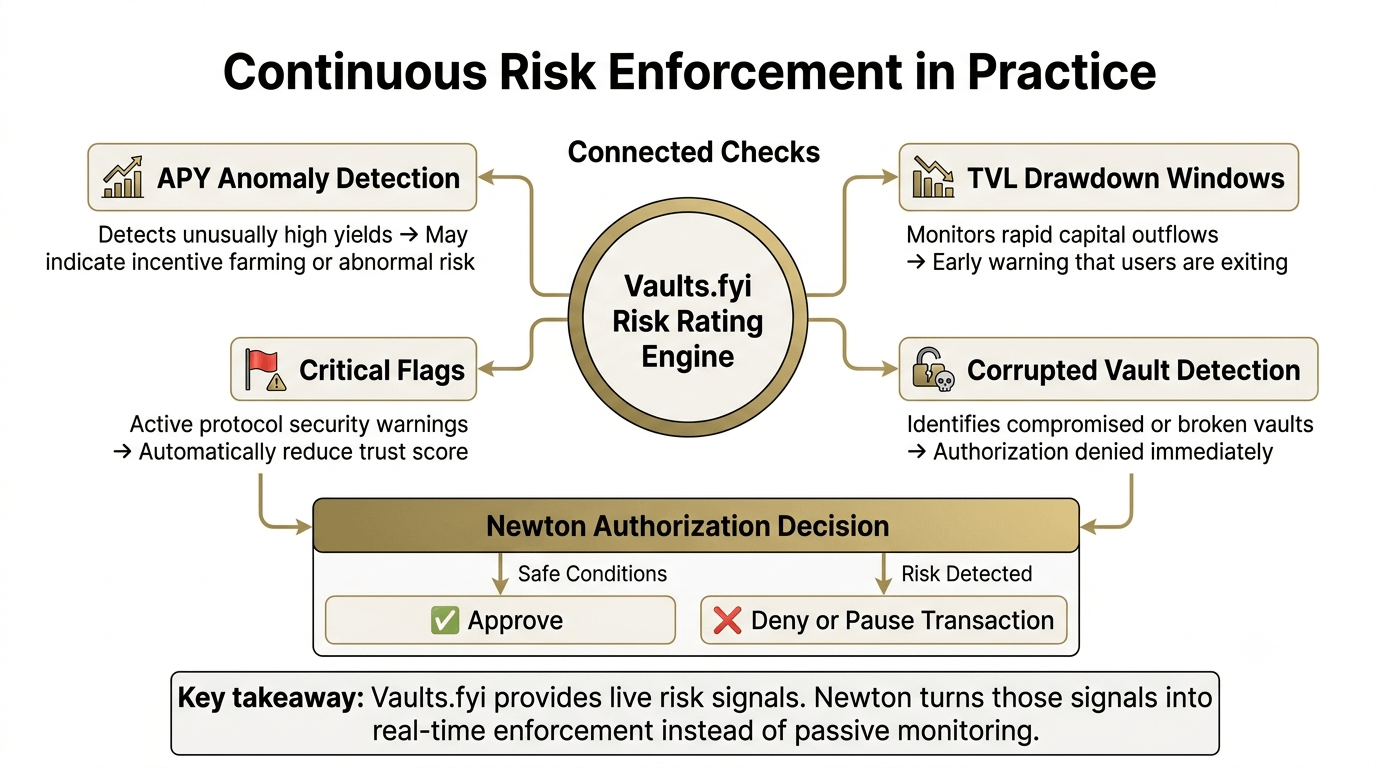
Take APY anomaly detection. On the surface, it simply watches for yields that suddenly spike beyond expected ranges. Underneath, it is looking for something more important. Abnormally high yields often signal temporary token incentives, liquidity stress, or unusual borrowing activity rather than genuine demand. A dashboard might simply display a bigger number. Newton can interpret that as a reason to deny or pause authorization until the situation becomes clearer. The data stops being passive.
The same logic applies to TVL drawdown windows. A vault losing a meaningful share of its deposits over a short period is rarely random. Capital tends to leave before the wider market understands why. Looking only at today's TVL misses the texture of what's happening. Watching the rate of decline tells a different story. Early exits become signals rather than historical observations.
Then there are the hard stops. Critical flags and corrupted-vault denials remove discretion entirely. If a vault carries an active critical warning or is identified as corrupted, authorization simply doesn't happen. That may sound restrictive, and critics will argue it creates false positives or blocks legitimate opportunities. They're right that no automated system will be perfect. But that's also the point. Missing one profitable trade is usually cheaper than authorizing deposits into an environment that is quietly deteriorating. Vaults.fyi itself recently updated its reputation methodology so active warnings directly reduce scores rather than existing as passive notices, reinforcing the idea that risk should influence decisions, not just dashboards.
Understanding that helps explain why the conversation around DeFi security is changing. Due diligence is no longer just about proving something was safe yesterday. It's increasingly about verifying that it still deserves trust right now.
If this approach holds, the next generation of DeFi won't be defined by who writes the smartest contracts. It will be defined by who decides, in real time, when those contracts should no longer be trusted. That is a quieter shift than another audit, but it may end up being the stronger foundation.
