
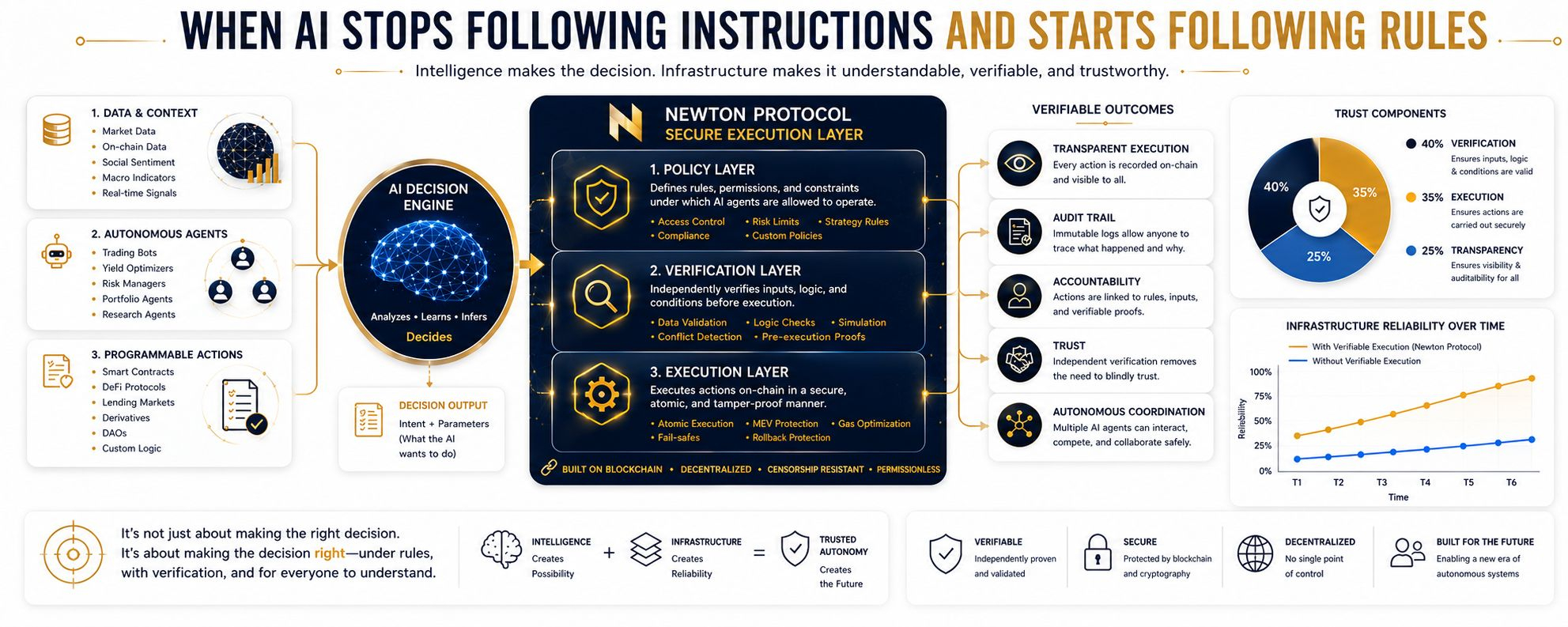
What if the next stage of artificial intelligence isn't about making better decisions, but about making decisions that remain understandable long after they have already been executed?
That question stayed with me while I was exploring Newton Protocol ($NEWT). I initially approached it the same way I approach most blockchain infrastructure projects. I compared architecture, execution environments, and the broader role AI might play in decentralized systems. But somewhere along the way, my attention shifted from what AI can do to what happens after AI has already decided to do something.
It made me realize that discussions around AI often begin in the wrong place. We spend enormous amounts of time debating how intelligent a model has become, yet comparatively little attention is given to the environment where that intelligence eventually operates. Intelligence creates a decision. Infrastructure determines whether anyone can later understand why that decision became reality.
That distinction feels increasingly relevant because autonomous systems are beginning to move beyond analysis. They are becoming participants. Instead of simply generating recommendations for humans to review, they are gradually interacting with digital assets, responding to market conditions, executing predefined strategies, and coordinating with other software. Once software begins acting rather than merely suggesting, execution becomes part of the trust equation.
While thinking about this, I found myself comparing AI to an experienced pilot. Most people naturally focus on the pilot's ability to make good decisions, yet aviation safety depends just as much on checklists, communication systems, black-box recorders, standardized procedures, and independent verification. The skill of the pilot certainly matters, but an entire infrastructure exists to ensure that every important action can later be reconstructed and understood.
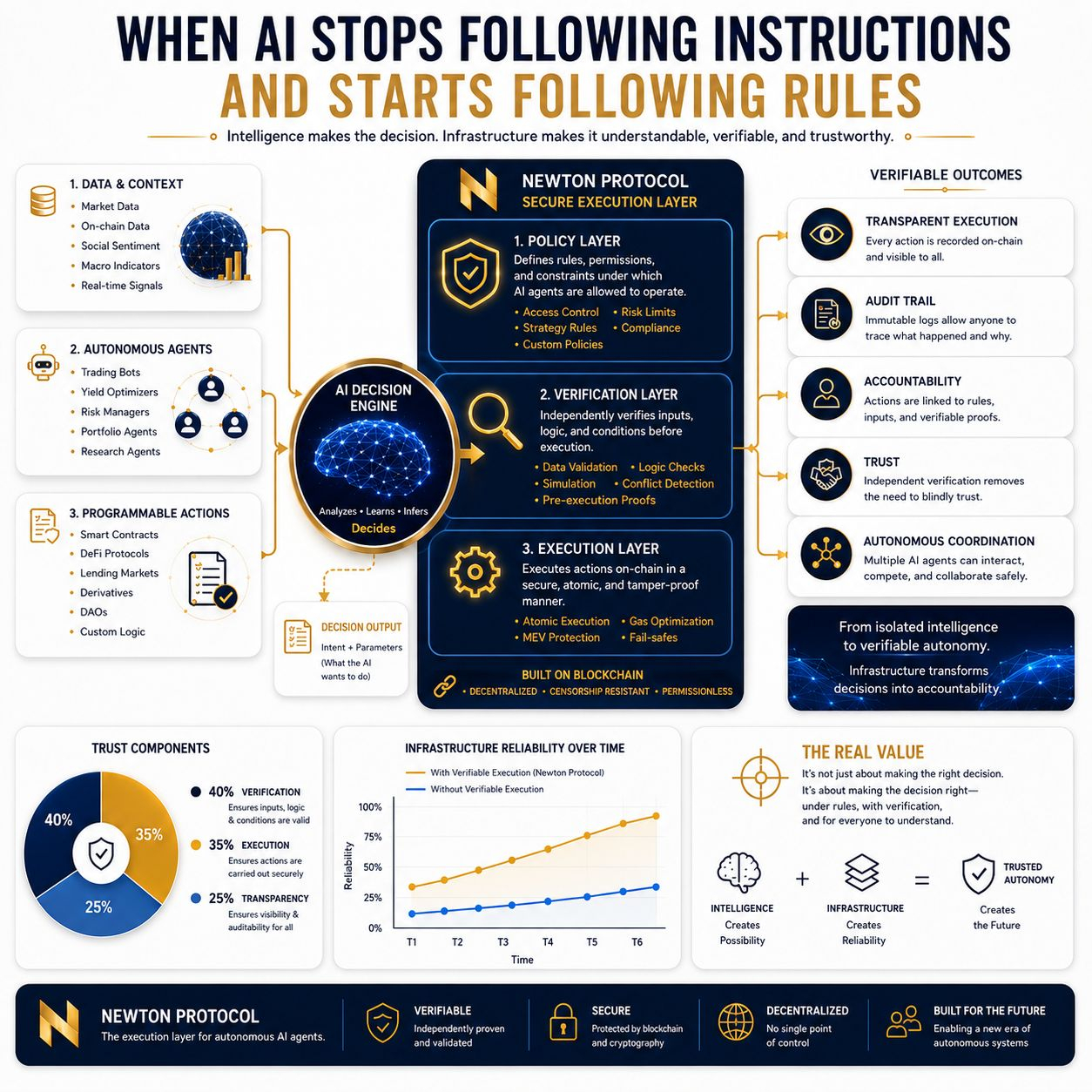
Blockchain may eventually serve a similar purpose for autonomous systems.
That possibility is what made Newton Protocol particularly interesting to me. Rather than approaching AI only as a problem of intelligence, it encourages thinking about execution itself as infrastructure. Instead of asking whether an autonomous system reached a reasonable conclusion, another question emerges: can the surrounding environment clearly demonstrate how that conclusion became an executed action?
The more I reflected on that idea, the more I realized how often infrastructure disappears from public conversation. Applications receive recognition because users interact with them directly. Models receive recognition because they produce visible results. Infrastructure, however, succeeds by remaining almost invisible. When it functions correctly, people rarely notice it. Yet every reliable system eventually depends upon it.
This also changes how I think about transparency. Transparency is frequently treated as publishing more information, but perhaps genuine transparency is something more practical. It is the ability for independent observers to examine execution after the fact without relying solely on trust. In complex AI environments, that difference could become increasingly significant because explanations generated afterward are not always equivalent to evidence preserved during execution.
Another thought continued to surface while researching Newton Protocol. Markets have traditionally rewarded faster execution because speed often creates competitive advantages. Yet autonomous AI introduces another dimension that speed alone cannot solve. Decisions may become increasingly complex, interactions increasingly autonomous, and execution increasingly continuous. Under those conditions, understanding why something happened may gradually become as valuable as how quickly it happened.
That doesn't necessarily reduce the importance of performance. Instead, it broadens the definition of quality. A sophisticated execution environment is not simply measured by efficiency but also by whether every important action remains observable, accountable, and understandable within the broader system.
I also found it interesting to think about developers from a different perspective. Innovation often happens in isolated environments where strategies evolve independently. Bringing those strategies into a shared execution framework creates opportunities for comparison based not only on outcomes but also on how those outcomes are produced. Over time, that could encourage evaluation based on observable behavior instead of reputation alone.
Perhaps the broader lesson extends beyond a single project. As artificial intelligence becomes increasingly autonomous, blockchain infrastructure may gradually shift from recording transactions to documenting responsibility. That would represent a meaningful evolution because responsibility is ultimately what allows trust to exist between participants who never meet each other.
After spending time exploring Newton Protocol, I came away with a question that feels larger than the project itself. We often ask whether AI will become intelligent enough to manage increasingly complex systems. Maybe an equally important question is whether the infrastructure surrounding AI will mature quickly enough to make those intelligent actions transparent, verifiable, and understandable for everyone who depends on them.
