
The "Agentic Web" is no longer a sci-fi concept; it is a multi-billion dollar shift in how we interact with the internet. But for most of us, AI agents have been little more than sophisticated chatbots. Kite AI is changing that narrative by transforming these agents into "first-class economic actors."
If you’ve ever wondered how to move from being a passive observer to an active earner in the AI revolution, the KITE Token incentive structure is your roadmap. Here is how participation works in the ecosystem that PayPal Ventures and former leaders from Uber and Databricks are betting on.
1. The Engine: Proof of Attributed Intelligence (PoAI)
Most blockchains use Proof of Stake to secure the network. Kite AI goes a step further with Proof of Attributed Intelligence (PoAI). This is a unique consensus mechanism designed to solve the "black box" problem of AI.
In simple terms: if an AI agent solves a complex task, PoAI traces exactly who contributed what. Did you provide the high-quality data? Did you refine the model? PoAI ensures the reward reaches the right hands. It isn’t just about "doing work"; it’s about verifiable impact.
The Contributor’s Journey: Three Ways to Earn
A. The Architect: Building & Deploying Agents
Developers aren't just writing code; they are creating "digital employees." Using the Kite [Build] SDK, you can deploy agents with their own KitePass (Agent Passport).
• The Reward: Every time your agent is hired—whether to analyze DeFi trends or manage customer queries—you earn KITE tokens.
• Real-Life Scenario: Imagine building a "Smart Auditor Agent" that scans smart contracts for vulnerabilities. Every time a new project uses your agent for a pre-launch check, KITE tokens flow directly into your wallet.
B. The Provider: Contributing Workloads & Data
You don’t need to be a coder to participate. AI agents are "hungry" for data and compute power.
• The Reward: By providing specialized datasets or hosting modules, you earn based on the marginal impact of your data. Kite uses a framework called Data Shapley to ensure that high-quality, unique data earns more than redundant information.
C. The Guardian: Validating & Staking
For those who prefer a "set and forget" approach, securing the network is key.
• The Role: You can act as a Validator or a Delegator.
• The Reward: By staking KITE tokens, you help verify that agent transactions and workloads are honest. In return, you receive a share of the network fees.
2. Visualizing the Flow: From Task to Token
To understand how value moves through the ecosystem, imagine this flow:
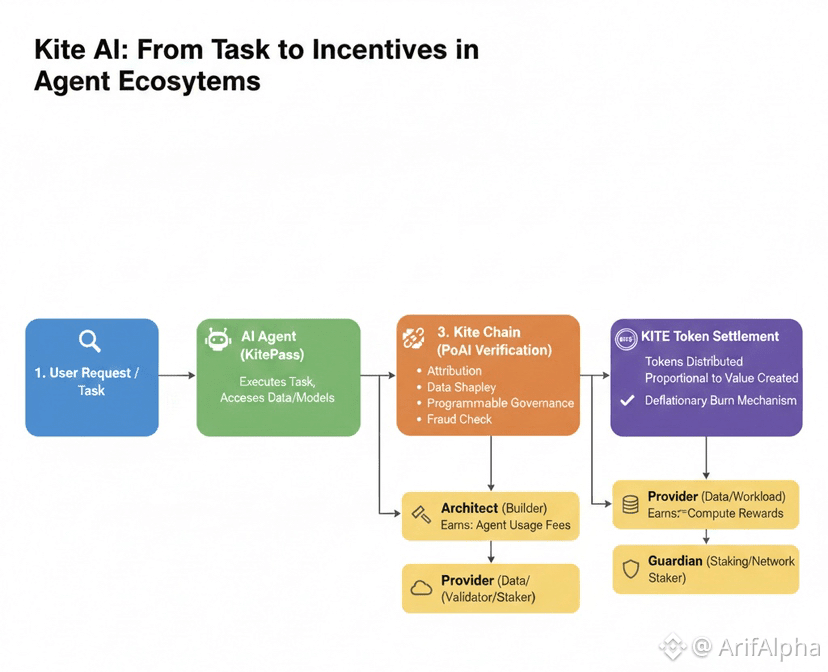 Step 1: A user pays for a task (e.g., a complex data research).
Step 2: The Agent executes using specific models and data.
Step 3: The PoAI layer attributes "Value Points" to the model creator, the data provider, and the validator.
Step 4: KITE tokens are distributed proportionally.
3. Creating Trust in an Autonomous World
The biggest barrier to AI adoption is trust. Why would you give an AI agent access to your wallet? Kite AI solves this through Programmable Governance.
• Spending Limits: You can set a "session allowance." If an agent tries to spend more than 50 KITE on a task, the protocol blocks it.
• Identity Resolution: Every agent has a verifiable on-chain identity. This removes the risk of "ghost bots" or malicious actors hiding behind anonymity.
Why This Matters for the KITE Token Value
Unlike inflationary "farm-and-dump" tokens, KITE is built on a deflationary mechanism. As AI agents buy datasets or pay for API access, a small portion of the transaction is burned. More utility equals a shrinking supply—a classic supply-demand win for the community.
The Road Ahead
We are moving toward an era where your "Agent" works while you sleep, earning KITE by providing utility to the global network. Whether you are a developer building the next "killer agent" or a staker securing the foundation, the ecosystem is designed to reward participation, not just speculation.
If you could build one AI agent today to automate a part of your daily life and earn rewards in the process, what would its primary mission be? Share your ideas below—let’s brainstorm the next generation of the Agentic Web!

