
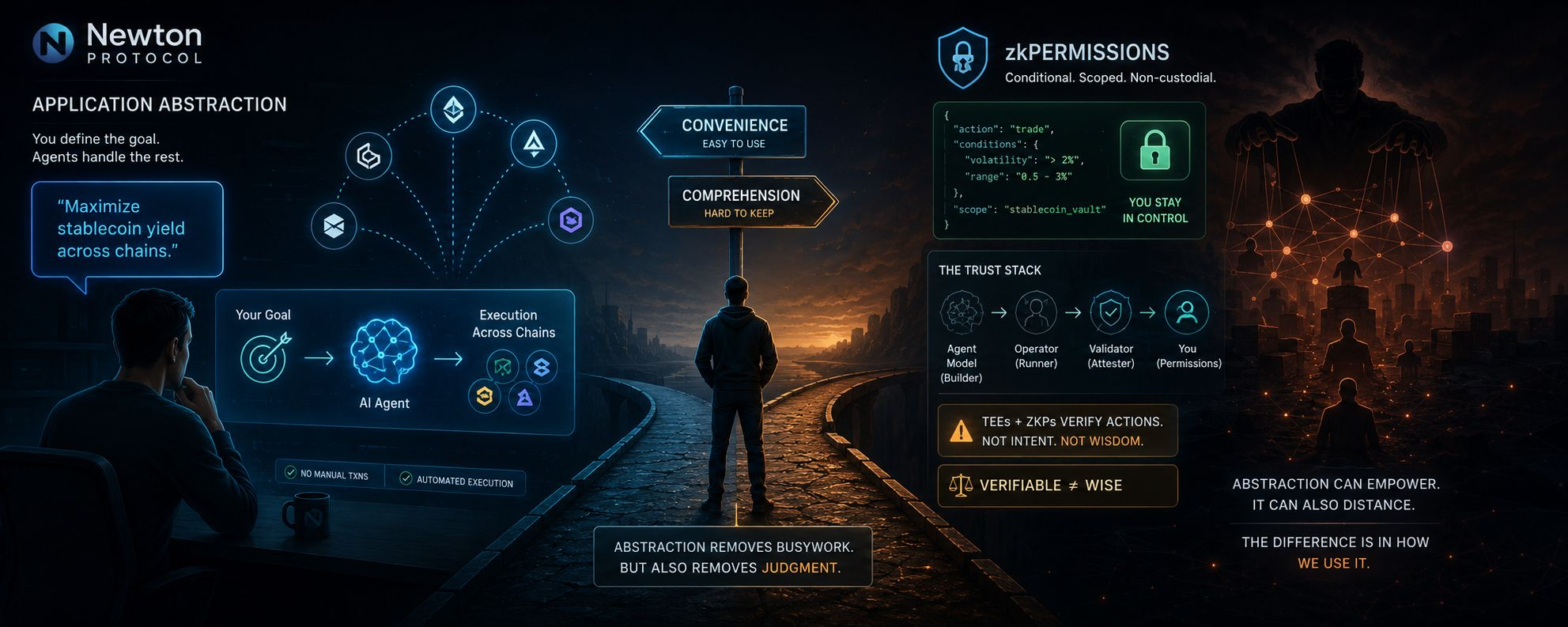
I've been sitting with one phrase from Newton's own materials longer than I expected to.
Application abstraction.
The idea is simple to describe. Instead of a user manually constructing transactions, they state a goal something like maximizing stablecoin yield across chains and an agent figures out the rest. No more picking protocols, timing entries, chasing rates across five different chains by hand.
On its face, that's just good design. Most people don't want to be their own execution engine. They want the outcome without the busywork.
But something about it kept nagging at me.
Every layer of abstraction in software works the same way. It removes a decision from the user and hands it to the system underneath. That's not new, and it's not inherently bad. Nobody reads assembly to send a text message.
The difference here is what's being abstracted away.
It isn't formatting. It's judgment. Which protocol counts as safe enough. Which yield is worth the underlying risk. When market conditions have shifted enough that the original goal no longer makes sense. Those aren't mechanical decisions. They're the actual substance of financial risk-taking, and Newton's architecture is explicitly designed to let users hand that substance to something else.
zkPermissions are supposed to be the safeguard. You don't give up full custody, you give conditional, scoped authority trade only if volatility exceeds a threshold, act only within a defined range. That's a real constraint, and it's more thoughtful than blanket approval.
But a scoped permission is only as good as the scope someone actually understood when they set it.
I think this is where the gap opens up.
Writing a good zkPermission requires the same judgment that application abstraction was supposed to remove. If a user doesn't understand the risk well enough to manage it manually, will they understand it well enough to constrain an agent that manages it for them? Or will most people just accept whatever default permission template an interface hands them, the way most people accept default privacy settings without reading them?
That's not a criticism unique to Newton. It's a pattern that shows up everywhere convenience and comprehension trade off against each other. Default settings almost always win.
Where it gets more interesting is the marketplace layer. Once the Model Registry is live and agent models are published for anyone to activate, users aren't just trusting their own permission logic. They're trusting whoever built the agent model, and trusting that the model's actual behavior matches its advertised behavior, and trusting the operator executing it, and trusting the validator attesting to it.
TEEs and zero knowledge proofs verify that an agent did what it claimed to do. They don't verify that what it claimed to do was a good idea.
Verifiable and wise are different properties. Newton solves for the first one. The second one is still the user's problem, just pushed one layer further from view than it used to be.
Maybe that's fine. Maybe most people were never actually managing their own risk carefully to begin with, and this just formalizes a decision outsourcing that was already happening informally through exchange automation and copy trading. If that's true, Newton isn't removing legibility so much as replacing an unverifiable black box with a verifiable one. That would be real progress, quietly.
But I don't think it's obvious yet which version of this we're getting.
The infrastructure is careful. The cryptography is doing what it says. What I can't tell from the outside is whether the humans setting the permissions will bring the same care to defining what "safe enough" means for their own capital, or whether abstraction will just relocate the risk instead of reducing it.
That's not a question Newton's documentation can answer. It's a question about how people actually behave once a system makes it easy enough to stop paying attention.