
I’m waiting. I’m watching. I’m looking. I’ve been seeing the same question on loop: Okay, but how much can it really handle? I follow the numbers, but I also follow the silences—the pauses between requests, the moments where things feel just a little slower than they should. Those tiny details usually tell me more than any headline statistic.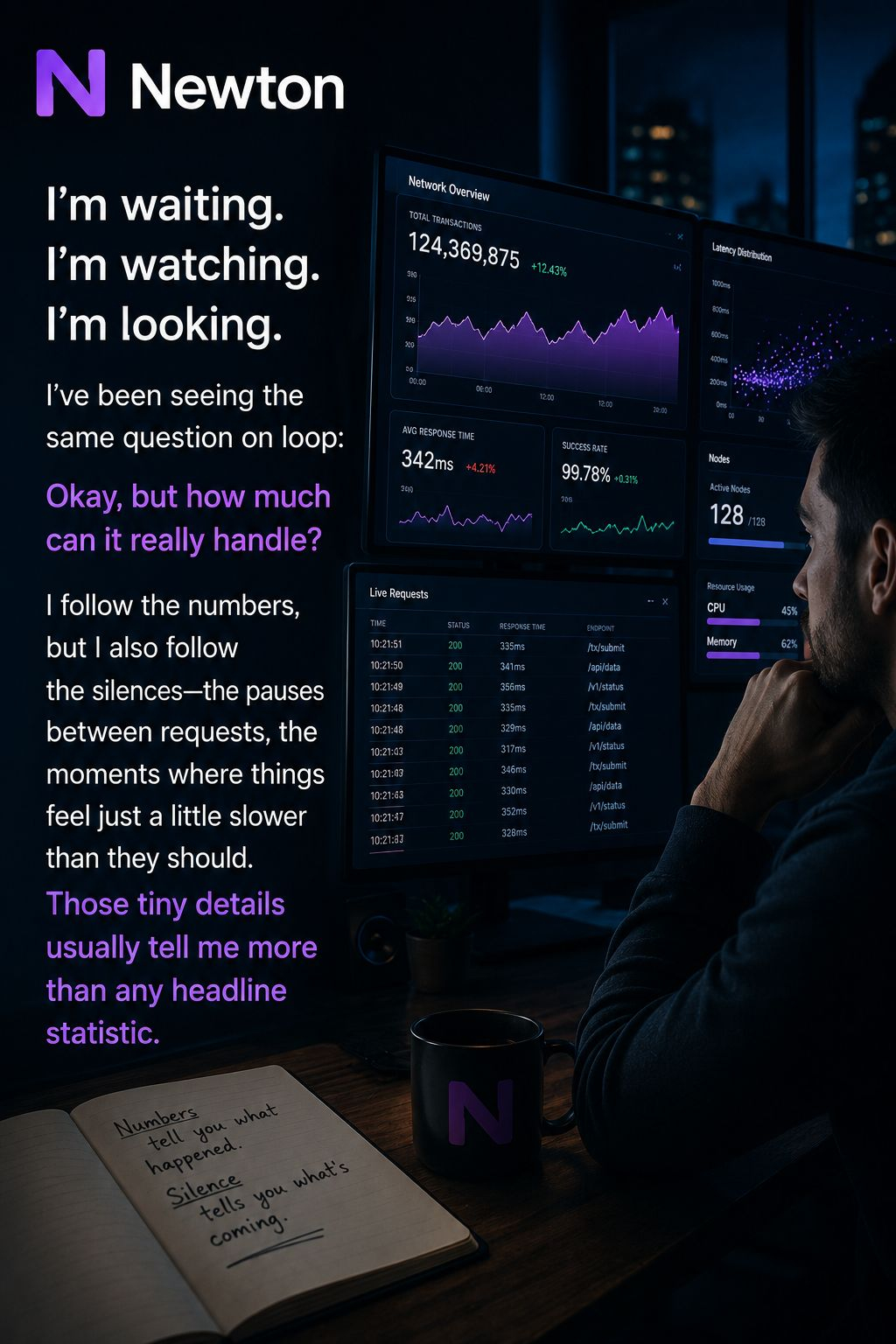
I've been checking back on Newton Protocol every few days. Not because I'm expecting some huge surprise, but because projects built around AI and automated trading don't get tested during quiet markets. They get tested when everyone shows up at once.
It's funny how every project seems to have impressive performance claims now. After a while, those numbers all start blending together. I don't ignore them, but I don't let them convince me either. What keeps my attention is how a network behaves after the excitement wears off and people begin using it as part of their everyday routine.
Real trading isn't clean. Markets don't wait for infrastructure to catch up. Prices move without warning, bots fire hundreds of requests, liquidations stack on top of each other, and suddenly everyone is trying to do something at the exact same moment. That's where systems stop looking like diagrams and start acting like real infrastructure.
That's why I don't think about performance as one big number anymore.
A network can look incredibly fast for a short burst and still struggle once activity becomes constant. Staying smooth for five seconds isn't the same as staying reliable for five hours. The difference matters more than most people admit.
Newton's approach caught my attention because it's trying to sit closer to the decision-making process instead of simply pushing transactions from one block to another. When AI-driven strategies and automated execution become part of the picture, every delay matters. A small pause can completely change the outcome of a trade.
But those delays don't always come from computation.
Sometimes it's networking.
Sometimes requests compete for the same resources.
Sometimes signatures take longer to verify.
Sometimes different parts of the system simply have to wait for each other.
Those are the slowdowns I'm interested in because they're much harder to hide than benchmark results.
I also spend a lot of time looking at the parts that most people ignore. Public RPC endpoints, explorers, wallet responsiveness, indexers, and developer tools may not sound exciting, but they're what builders rely on every single day. If those pieces stay consistent while activity increases, confidence grows naturally. If they begin falling behind, people notice long before they start posting complaints.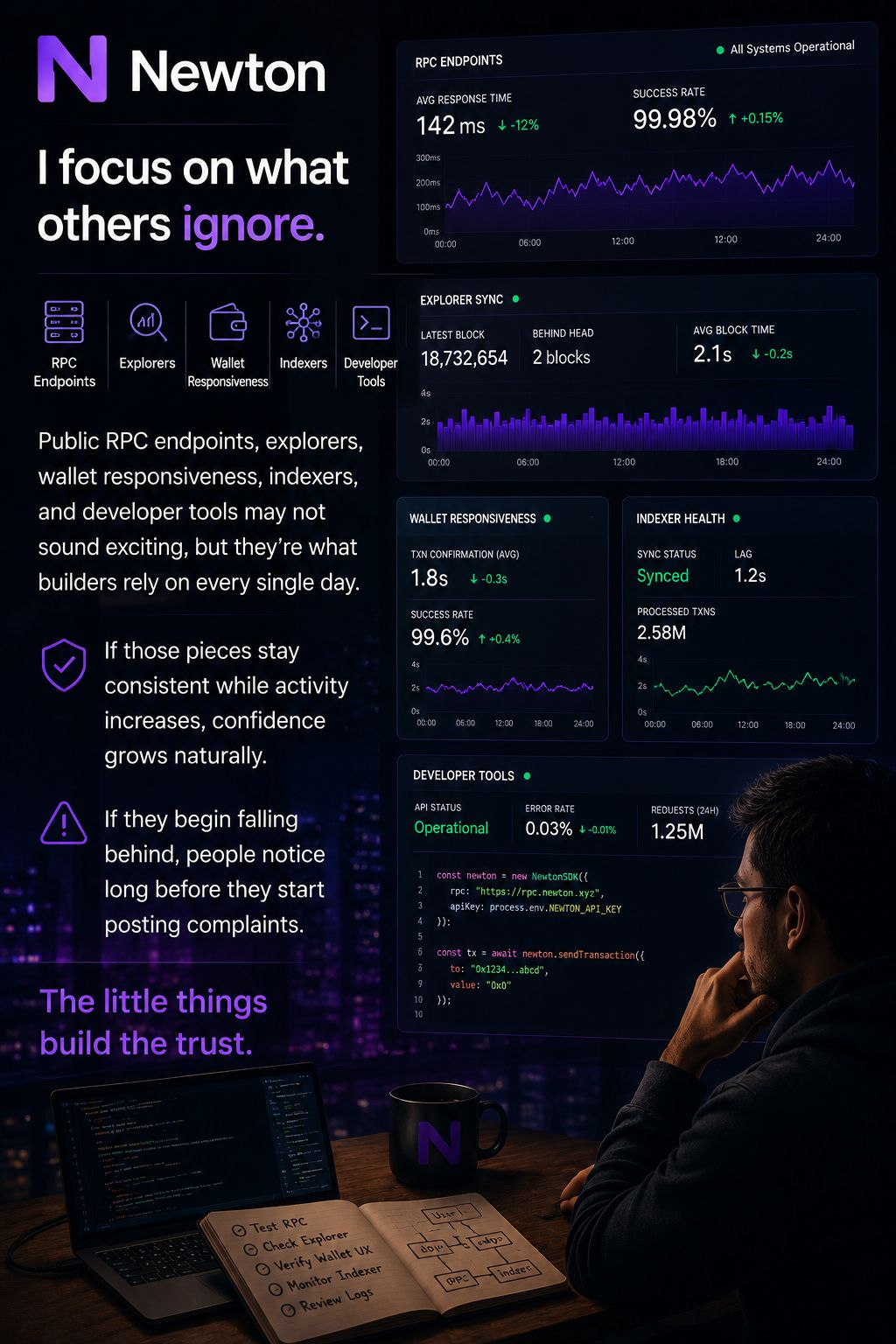
One thing I've learned from watching networks over time is that problems rarely begin at the center.
They usually start around the edges.
A request needs another attempt.
An explorer updates a little later than expected.
Wallet balances feel delayed.
Applications quietly retry failed calls without users realizing what's happening.
None of those moments look dramatic by themselves, but together they paint a much clearer picture than any promotional graphic ever could.
That's why I still think the most interesting period for Newton is ahead, not behind.
Launching is one thing.
Living with real users every day is something completely different.
I'm not expecting perfection because no protocol gets everything right immediately. What I want to see is consistency. I want to see the same level of responsiveness on an ordinary Tuesday afternoon as during a volatile trading session when everyone is rushing to react at once.
Over the next few weeks, that's exactly what I'll keep watching.
I'll watch whether public infrastructure continues feeling dependable instead of overloaded.
I'll watch whether automated activity creates noticeable friction for everyone else.
And I'll watch whether the network still feels predictable after the novelty disappears.
Those aren't the kind of observations that create flashy headlines.
They're slower than that.
But over time, they're the observations that decide whether a protocol earns trust or simply enjoys a few weeks of attention.
For now, I'm still watching. Not for the biggest numbers, but for the smallest signals. In my experience, they're usually the first to tell you whether a network is genuinely growing into its role or simply passing through another moment of excitement.
