
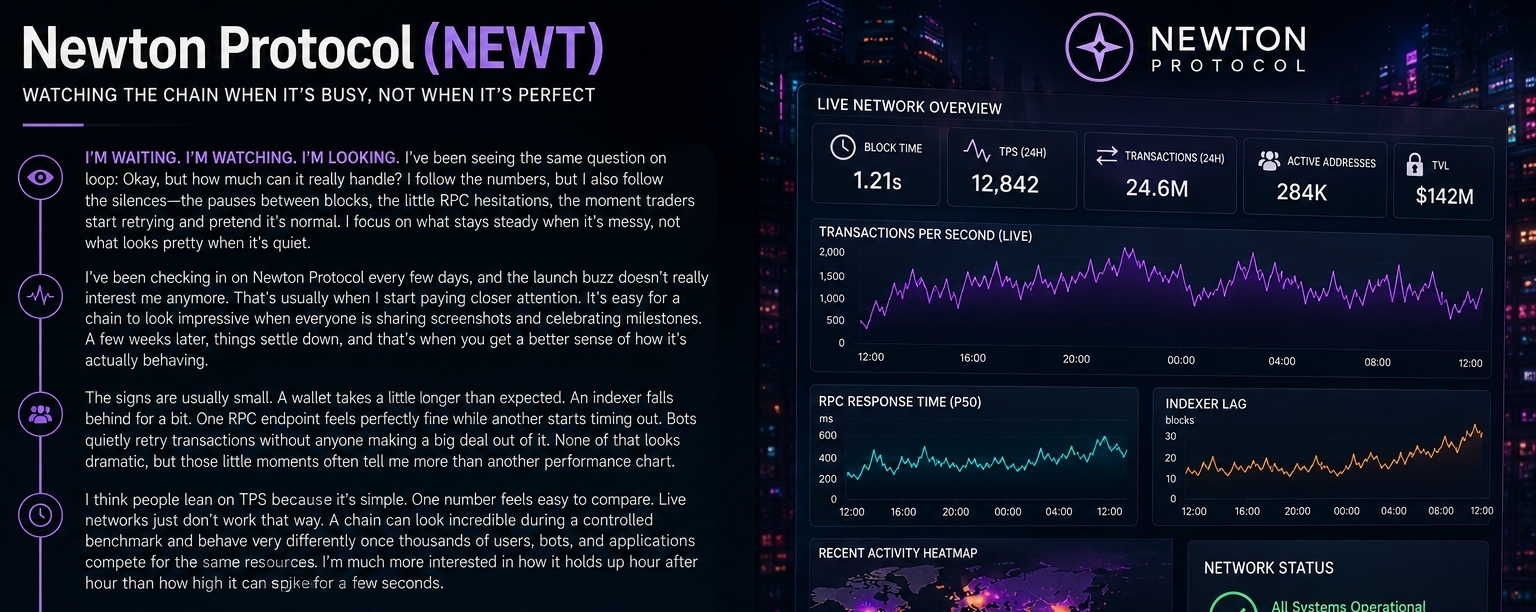
I’m waiting. I’m watching. I’m looking. I’ve been seeing the same question on loop: Okay, but how much can it really handle? I follow the numbers, but I also follow the silences—the pauses between blocks, the little RPC hesitations, the moment traders start retrying and pretend it’s normal. I focus on what stays steady when it’s messy, not what looks pretty when it’s quiet.
I've been checking in on Newton Protocol every few days, and the launch buzz doesn't really interest me anymore. That's usually when I start paying closer attention. It's easy for a chain to look impressive when everyone is sharing screenshots and celebrating milestones. A few weeks later, things settle down, and that's when you get a better sense of how it's actually behaving.
The signs are usually small. A wallet takes a little longer than expected. An indexer falls behind for a bit. One RPC endpoint feels perfectly fine while another starts timing out. Bots quietly retry transactions without anyone making a big deal out of it. None of that looks dramatic, but those little moments often tell me more than another performance chart.
I think people lean on TPS because it's simple. One number feels easy to compare. Live networks just don't work that way. A chain can look incredible during a controlled benchmark and behave very differently once thousands of users, bots, and applications start competing for the same resources. I'm much more interested in how it holds up hour after hour than how high it can spike for a few seconds.
That's part of why Newton Protocol has kept my attention. The idea isn't just AI. It's what AI-powered systems actually mean once they're running on-chain. They don't spread activity out nicely. They all react at once. The same market move triggers thousands of decisions almost simultaneously. They hit the same contracts, chase the same opportunities, and compete for the same state. That's when you start finding out where the real limits are.
People also talk about block time like shorter automatically means better. I don't really see it that way. Faster blocks can make everything feel more responsive, but every block still has to move through networking, signature checks, scheduling, and execution. A chain pushing tiny blocks very quickly isn't solving the same problem as one processing larger batches less often. What matters to me is whether the experience stays consistent when activity ramps up, not whether the average block is a fraction of a second faster.
Most of the real bottlenecks don't even come from computation anymore. Networking matters. Signature verification matters. Transaction scheduling matters. Parallel execution sounds great until everyone starts touching the same liquidity pool or the same account. Then suddenly a lot of that parallelism disappears because the chain has to serialize conflicting work.
That's why DeFi is such a good stress test. Quiet markets don't tell you much. Volatile markets do. Liquidations pile up. Arbitrage bots all chase the same spread. Oracle updates trigger waves of transactions. Fees climb. Retries become more common. Nothing looks broken, but you can feel the pressure building across the network.
I've seen chains where consensus keeps producing blocks just fine while everything around it starts struggling. RPCs become unreliable. Explorers disagree for a few minutes. Wallets show stale balances. Indexers lag behind. Technically, the chain is still running. From a user's perspective, though, it just feels slower. That's the difference between measuring consensus and measuring the experience people actually have.
That's also why I don't spend much time staring at benchmark numbers anymore. I'd rather watch explorer responsiveness, RPC reliability, wallet confirmations, and bridge transfers. Those are the things builders and users deal with every day, and they usually reveal problems before the headline metrics do.
Over the next few weeks, I'll be paying attention to whether Newton stays consistent as activity grows. I want to see public RPC endpoints stay dependable during busy periods, indexers keep pace without noticeable lag, and wallets continue feeling predictable instead of forcing retries. If those parts stay uneventful while more builders, more bots, and more users show up, that'll tell me a lot more than another impressive TPS claim ever could.
