

Some projects make a lot of noise before they have anything meaningful to show. Others spend months building while most of the market is busy chasing the next trend. Newton Protocol has always felt closer to the second category. It didn't grab my attention because of the AI narrative or because another token was about to launch. What made me stop and read was the problem it was trying to solve. Crypto has become incredibly good at moving assets from one address to another, yet it still assumes that if a transaction is technically valid, it should probably happen. After everything this industry has been through, that assumption feels less convincing than it did a few years ago.
The ecosystem has changed dramatically. Wallets are no longer controlled only by individuals clicking buttons on a screen. Automated trading systems execute strategies around the clock, DAOs manage treasuries worth millions of dollars, institutions are slowly experimenting with on-chain finance, and AI agents are beginning to make decisions without waiting for human approval every single time. The pace is accelerating, but the way transactions are authorized hasn't evolved at the same speed. That's the gap Newton Protocol is trying to address.
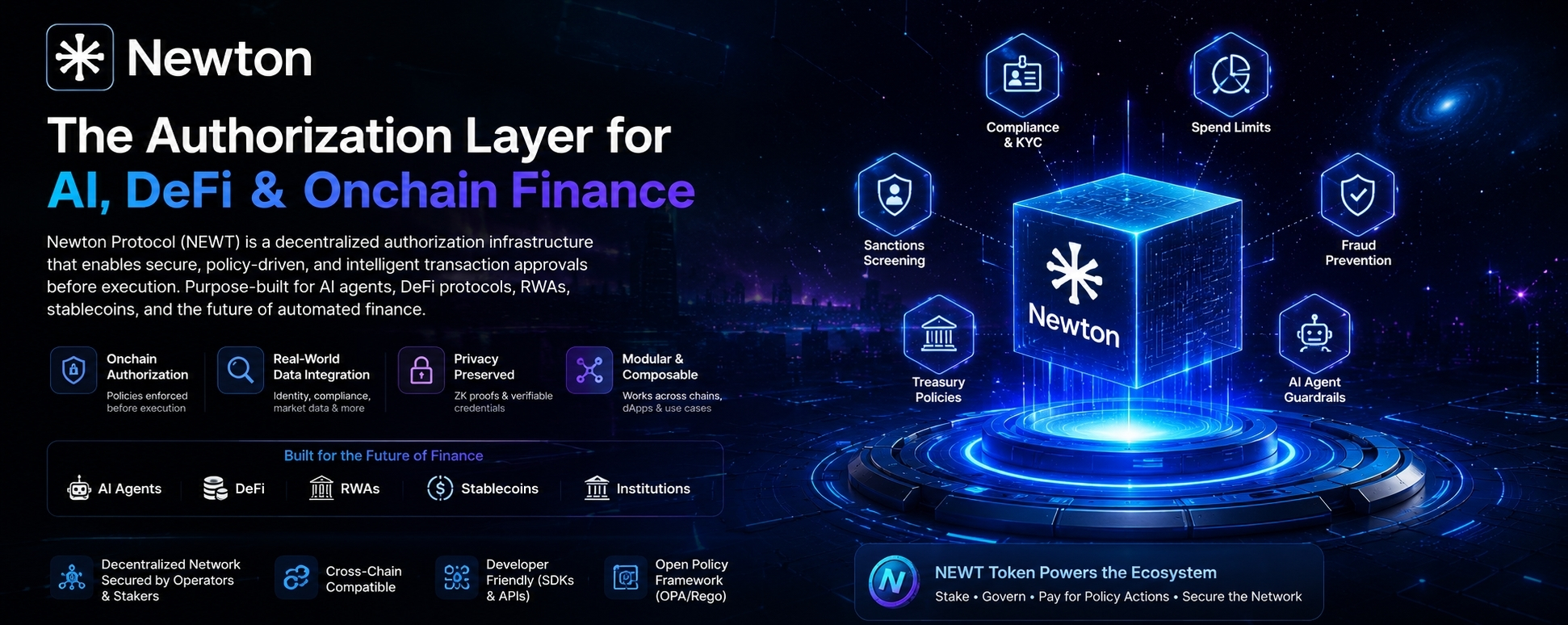
Instead of focusing only on where transactions settle, Newton focuses on whether they should be allowed in the first place. The protocol introduces an authorization layer that evaluates predefined policies before an action reaches the blockchain. Those policies can include spending limits, wallet permissions, compliance requirements, sanctions screening, identity verification, treasury rules, or any other logic developers choose to define. Rather than trusting a centralized service to make those decisions behind closed doors, the protocol distributes that responsibility across its own network, making the process transparent and verifiable.
What makes this idea interesting is that it doesn't ask developers to abandon the infrastructure they're already using. Newton is designed to integrate with existing smart contracts instead of replacing them. Applications can continue operating on familiar blockchain networks while adding an extra layer of programmable authorization. That approach feels much more practical than asking an entire ecosystem to migrate somewhere completely new.
The conversation around AI has also made Newton feel increasingly relevant. Autonomous software is becoming capable of managing wallets, executing trades, interacting with decentralized applications, and coordinating complex financial strategies with very little human input. That's exciting until you remember that software can make mistakes just as quickly as it can make profits. A poorly configured trading agent or compromised automation system doesn't need hours to create damage. It can do it in seconds. Building intelligent systems without equally intelligent permission controls has always felt incomplete.
Privacy is another area where Newton appears to be taking a balanced approach. Public blockchains are transparent by design, but many financial applications require sensitive information that shouldn't become permanently visible to everyone. Newton combines programmable policies with cryptographic techniques that allow applications to verify certain conditions without unnecessarily exposing private user data. That balance between transparency and confidentiality will likely become more important as blockchain technology continues moving beyond retail users.
Looking through the protocol itself, it's clear that the team isn't building around a single use case. The same authorization framework can support decentralized finance, tokenized real-world assets, stablecoins, institutional treasury management, smart accounts, AI-powered financial systems, and cross-chain applications. The underlying idea remains consistent even though the environments are very different. Every application reaches a point where it needs rules before execution, and that's exactly where Newton is positioning itself.
The native token, NEWT, is designed to support that ecosystem rather than existing separately from it. It plays a role in network security through staking, participates in governance, and is used within different protocol operations. Whether that utility grows over time depends entirely on adoption, but the relationship between the network and the token appears to be built around participation instead of speculation alone.
One thing that stands out is how the project's direction has evolved over time. Earlier discussions focused heavily on improving the experience of interacting across multiple blockchain networks. More recent development places greater emphasis on authorization infrastructure for programmable finance and AI-driven applications. That progression feels less like changing narratives and more like narrowing the focus toward the problem the protocol is best equipped to solve.
Crypto has always rewarded speed. Faster block times, faster bridges, faster trading, faster execution. But experience has also shown that moving quickly without thoughtful safeguards can become incredibly expensive. Some of the largest losses in this industry happened because systems executed exactly as they were programmed to, even when the outcome was disastrous. That's why infrastructure built around authorization feels more relevant today than it might have a few years ago.
Whether Newton ultimately becomes a widely adopted standard is something only time can answer. Markets have a way of surprising everyone, no matter how confident the predictions seem at the time. Still, there is something refreshing about seeing a project focus on a problem that usually stays invisible until it fails. Most people never think about authorization when everything works as expected. They only notice it when one transaction changes everything, and by then it's already too late.