
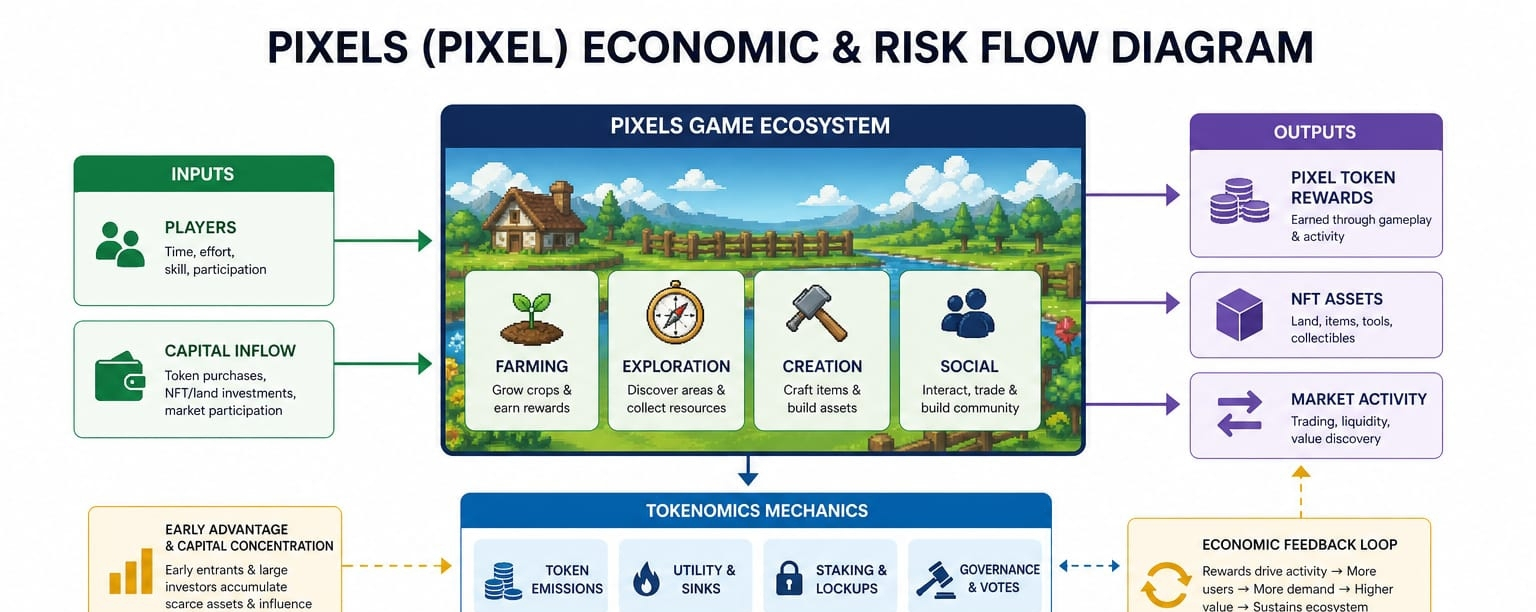
Let’s not pretend this is complicated. PIXELS is not a game that happens to use blockchain. It is a financial system that happens to look like a game.
That distinction matters. It always does.
I’ve watched this pattern repeat for years. Wrap a speculative economy in something soft, accessible, and nostalgic, and call it innovation. This time it’s pixelated farmland. Last time it was something else. The mechanics don’t change. Only the packaging improves.
PIXELS isn’t simplifying gaming. It’s monetising it.
---
Ownership for Whom? The Quiet Consolidation of Advantage
The pitch is familiar. Digital ownership. Player empowerment. A fairer system.
It sounds persuasive until you follow the money.
Value in PIXELS isn’t evenly distributed. It never is in systems built on scarcity. Land, early access, positioning — these are the levers that matter. And they are disproportionately captured by those who arrived first or came prepared with capital.
Everyone else is told they can catch up. They can’t.
They are entering an economy where the most meaningful gains have already been extracted. What remains is optimisation at the margins. More effort for less return.
Call it a game if you like. The structure looks closer to a ladder that’s already been climbed.
---
Built on Ronin: Confidence or Complacency?
PIXELS rests on Ronin, a network that carries both scale and baggage.
That baggage isn’t theoretical. It includes one of the most damaging breaches in crypto’s recent history. The industry moved on quickly. It always does. Memory is inconvenient when growth is the priority.
But risk doesn’t disappear because it’s no longer fashionable to discuss it.
So what exactly is PIXELS offering here? A robust foundation, or a dependency that amplifies its exposure? If Ronin falters again, PIXELS doesn’t get to claim independence. It goes down with it.
This is not decentralisation. It’s reliance with better branding.
---
A New Name for an Old Incentive Problem
“Play-to-earn” became a dirty phrase. So it was retired. Now we have “social casual”.
The language has softened. The incentives have not.
Players are still nudged toward efficiency, extraction, and optimisation. That changes behaviour. It always has. When outcomes carry financial weight, leisure turns into labour whether the developers admit it or not.
Fun becomes conditional. Engagement becomes transactional.
And here’s the uncomfortable truth: people don’t stay in these systems because they enjoy them. They stay because they believe they’re gaining something.
Take that belief away, and the exit begins.
---
Tokenomics: The Same Fragility in a Cleaner Suit
Every cycle produces a new claim. This time it’s sustainable token design.
Balanced emissions. Smart sinks. Controlled supply.
It sounds convincing until you strip it down to its core dependency: demand must keep expanding.
Without new participants, the system tightens. Rewards lose meaning. Liquidity thins. Activity declines. It’s a slow shift at first, then a sudden one.
PIXELS is not immune to this dynamic. It is built on it.
Dress it up however you like. If growth slows, pressure builds. And pressure exposes everything.
---
Community as Retention Strategy, Not Social Ideal
PIXELS leans heavily on its social layer. Collaboration. Shared worlds. Player interaction.
It’s presented as organic. It’s anything but.
Community in these environments serves a function. It keeps people in place. It increases switching costs. It makes departure psychologically harder.
People don’t just leave a game. They leave relationships, routines, identity.
That hesitation buys time for the system. Sometimes more time than it deserves.
Call it community if you want. But understand what it does.
---
The Soft Aesthetic That Masks Hard Incentives
PIXELS looks harmless. That’s deliberate.
Pastel visuals. Familiar farming loops. A tone designed to reassure.
But the mechanics underneath are not soft. They reward calculation. They punish inefficiency. They push players toward behaviour that looks less like play and more like optimisation.
The contrast is striking. The design invites you to relax. The system pressures you to perform.
That mismatch is not an accident. It lowers resistance. It keeps scrutiny low.
And it works.
---
Strip Away the Token — What’s Left?
Here is the test that matters, and it’s rarely asked out loud.
If the token stopped appreciating tomorrow, would people still play?
Not speculate. Not optimise. Play.
If the answer is no — or even uncertain — then the product isn’t the game. It’s the economy.
And economies built on constant inflow don’t stabilise. They contract.
When they do, the underlying experience is exposed. Often it isn’t enough.
---
Exit Is Not Equal — It Never Is
These systems do not treat participants equally on the way out.
Those closest to the structure — early entrants, insiders, well-informed players — have options. They understand timing. They see the signals. They leave with gains.
The rest provide the liquidity that makes those exits possible.
They arrive when confidence is highest. They commit when narratives are strongest. And they are the last to recognise when the conditions have changed.
This is not a flaw. It is the design.
---
When the Story Stops Holding
PIXELS presents itself as the refined version of Web3 gaming. Less aggressive. More sustainable. Better aligned.
It may well be more polished. That’s not the same as being more durable.
The same tensions remain. Financial incentives dominate behaviour. Growth underpins stability. Value concentrates early.
Eventually, the story collides with behaviour. Players don’t read whitepapers when things turn. They react.
Engagement drops. Liquidity shifts. Confidence breaks.
That’s when the real test begins. Not of the technology. Of the model.
---
The Verdict
PIXELS is not solving the fundamental problem of Web3 gaming. It is managing it more elegantly.
It still asks players to participate in a system where enjoyment is tied to financial outcomes. Where advantage is uneven. Where sustainability depends on continued inflow.
I’ve seen this before. Many times.
It doesn’t fail because it looks crude. It fails because the underlying incentives don’t hold.
Better graphics won’t fix that. Softer language won’t fix that.
And when the economics stop working, no one will be talking about farming.
They’ll be looking for the exit.
