
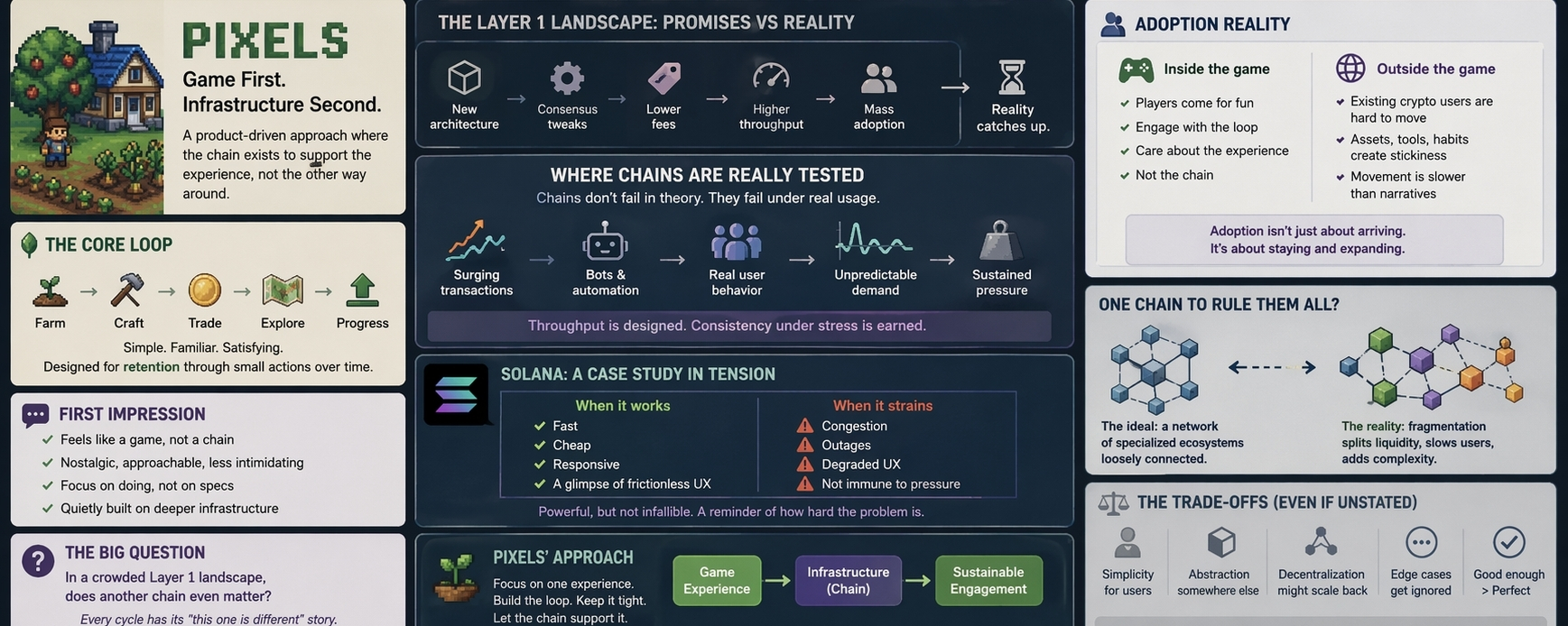
The first time I looked at Pixels, I didn’t think “Layer 1.” I thought… game. A slightly nostalgic one, honestly. Something about the farming loop, the open-world feel, the quiet emphasis on doing small things over time. It didn’t come across like a chain trying to prove something. It felt like a product first, infrastructure second. That alone is unusual in this space. Most projects start by telling you how fast they are, how cheap they are, how they’ll replace everything else. Pixels just sort of exists, and then you realize it’s sitting on top of something deeper.
But then you zoom out, and it’s hard not to feel that familiar fatigue. Another chain, another ecosystem, another attempt to carve out space in a landscape that already feels crowded in a very specific way. Every cycle has its “this one is different” narrative. New architecture, new consensus tweaks, new promises about scale and cost. And for a while, it works. People move, liquidity shifts, timelines fill up with charts and comparisons. Then reality catches up, and things slow down. Not always because the tech is bad. Sometimes just because usage is messier than whitepapers expect.
That’s the part people still underestimate. Chains don’t really fail in theory. They fail when people actually use them. When transactions pile up, when bots show up, when real behavior replaces test conditions. That’s when the cracks appear. You can design for throughput, you can optimize execution, but sustained, unpredictable demand is a different kind of pressure. It’s less about peak performance and more about consistency under stress. And that’s where even the more established names have had their moments.
Solana is a good example of that tension. When it’s working well, it feels almost too smooth. Fast, cheap, responsive. It gives you a glimpse of what crypto applications could feel like if friction really disappeared. But it’s also had periods where that smoothness breaks, where the system shows strain in ways that remind you how difficult this problem actually is. Not broken beyond repair, but not immune either. It’s a reminder that performance claims are always conditional.
So when something like Pixels ties itself to a Layer 1 story, even indirectly, the question isn’t just what it can do. It’s what happens when people actually show up in numbers. Not just players clicking around casually, but real engagement, real economies forming, real incentives pushing behavior in unpredictable directions. Games are actually a pretty brutal test for infrastructure. They’re constant, they’re repetitive, and they don’t tolerate friction well.
There’s also this broader idea floating around that maybe the future isn’t one dominant chain at all. Maybe it’s a network of ecosystems, each handling its own niche, loosely connected. It sounds reasonable on paper. Distribute the load, let specialization emerge, avoid bottlenecks. But in practice, fragmentation has its own cost. Liquidity gets split. Users hesitate to move. Developers hedge their bets. Interoperability becomes its own layer of complexity that never quite feels seamless.
Pixels, in a quiet way, seems to lean into a different observation. It doesn’t try to solve everything. It focuses on a specific kind of experience and builds around that. The underlying chain becomes a means to support that loop rather than the main story. That might be the more honest approach, even if it limits ambition. Instead of saying “we can handle everything,” it says “we’ll do this one thing well enough that people stay.”
But that comes with trade-offs, whether they’re explicitly stated or not. Simplifying the user experience usually means abstracting away complexity somewhere else. Maybe decentralization takes a slight step back. Maybe certain edge cases are ignored because they don’t matter for the core loop. Maybe scalability is assumed to be “good enough” rather than fully stress-tested. None of these are necessarily bad decisions, but they shape what the system can become later.
Adoption is where things get less theoretical. It’s easy to imagine players coming in for the game. It’s harder to imagine them caring about the underlying chain, or moving assets across ecosystems, or engaging with anything beyond the immediate experience. And outside the game, convincing existing crypto users to shift attention is its own challenge. People tend to stay where their assets, tools, and habits already are. Movement in this space happens, but it’s slower and more selective than the narratives suggest.
There’s also the question of whether success in one domain translates to credibility in another. A game can be engaging without proving that the underlying Layer 1 is broadly competitive. It might not need to. But if the goal is to expand beyond that initial use case, the expectations change. The same infrastructure that feels fine for a controlled environment might behave differently when opened up.
I keep coming back to that initial impression, though. Pixels doesn’t feel like it’s trying too hard to be the next big chain. That might be intentional, or it might just be a byproduct of focusing elsewhere. Either way, it creates a different kind of starting point. Less noise, fewer grand claims, more room to observe what actually happens.
There’s still uncertainty in all of this. Execution matters more than positioning, and time tends to expose the gaps between intention and reality. But there’s also something slightly refreshing about a project that doesn’t immediately lean into the usual playbook.
It might work. Or nobody shows up.
