
I didn’t go into Pixels expecting depth.
At first, it honestly felt like something I’ve seen too many times before. You plant, you harvest, you move around a bit, maybe craft something, then log off. Clean loop, nothing complicated. In a space like Web3 where everything tries so hard to prove itself immediately, Pixels almost felt… too simple.
That’s probably why most people misunderstand it early.
Because if you only stay on the surface, you’ll walk away thinking you’ve already figured it out.
But if you stay a little longer, something starts to feel off. Not in a bad way. Just… different.
I remember the moment it clicked for me.
I was playing the same way I had been for days. Same loops, same actions, same time spent. But the outcomes didn’t feel consistent anymore. Not worse, not better… just not fixed.
That’s when I started noticing it.
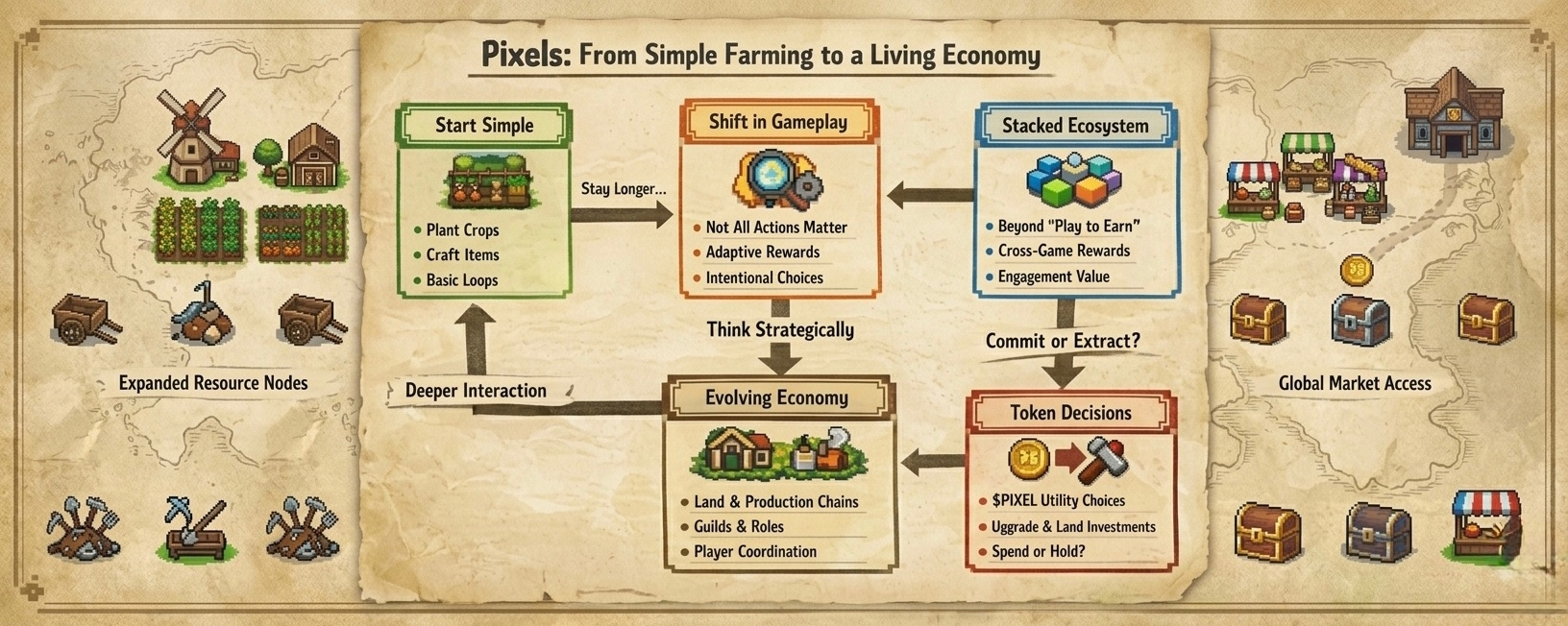
Not everything I was doing actually mattered.
I could stay busy for hours, farming, crafting, moving around, and still feel like nothing really “stuck.” Then I’d do a smaller set of actions, more intentional, more structured, and suddenly that’s what actually moved me forward.
That shift is subtle, but once you see it, you can’t unsee it.
Most games reward activity.
Pixels feels like it filters it.
That’s where it starts getting interesting.
Because now it’s not about how much you do, it’s about what you’re doing and how consistent you are with it. Random play starts fading out. Repeated patterns start showing up in your progress. The system doesn’t stop you from doing anything, but it quietly decides what deserves to carry forward.
And that changes how you play.
You stop asking “what can I do next?”
You start asking “what actually works?”
Another thing that stood out to me is how rewards behave.
In most GameFi systems, everything is predictable. You do X, you get Y. If too many people do X, rewards inflate and the whole thing starts breaking. Then comes the usual fix… reduce emissions, add sinks, try to slow the bleeding.
I’ve seen that cycle enough times to expect it here too.
But Pixels doesn’t really follow that pattern.
Rewards don’t feel fixed. The same loop doesn’t always give the same result. It’s like the system is constantly adjusting based on how players are interacting with it.
At first, that feels confusing.
Then it starts making sense.
Because it forces you to think instead of just repeat.
The Stacked side of things adds another layer I didn’t expect.
It’s not just “play and earn” in the usual sense. It’s more like your activity, your consistency, even the way you engage with the ecosystem can translate into rewards beyond just the basic loop.
That changes the feeling completely.
You’re not just grinding resources anymore. You’re participating in something that’s tracking more than just output. And whether people realize it or not, that kind of system keeps players around longer than simple reward loops ever could.
Over time, the economy itself starts feeling heavier.
Not complicated… just more real.
Land begins to matter more. Production chains get deeper. Crafting isn’t just something you do on the side anymore, it becomes part of a bigger structure. And then you start seeing coordination come in. Guilds, groups, players taking on different roles.
That’s when it stopped feeling like a game to me.
It started feeling like a small digital economy.
You’ve got producers, traders, organizers… and value actually moves between them. What one group does starts affecting others. It’s no longer just about your own loop, it’s about where you fit into the system.
One thing I keep coming back to is how Pixels separates activity from progress.
That sounds simple, but it’s actually rare.
You can be active all day and not move forward in a meaningful way. At the same time, a smaller set of intentional actions can push you much further. That forces a mindset shift most Web3 games never really demand.
It breaks the idea that more time automatically equals more rewards.
And honestly, that’s probably why the system doesn’t feel like it’s collapsing under its own weight.
From a token perspective, this also changes how $PIXEL behaves.
It doesn’t feel like a pure “farm and dump” loop. There are real decision points. Upgrades, land, guild participation, deeper crafting… these are moments where you choose whether to spend or hold.
And that choice matters.
Because now players aren’t just extracting value, they’re deciding when to commit to the system. That’s a completely different dynamic compared to most GameFi tokens that just circulate until they lose meaning.
I’m not saying it’s perfect.
It still has the same risks every Web3 economy has. If hype takes over and price starts moving independently from what’s happening inside the game, things can shift quickly. Players turn into traders, and once that happens, the system slowly loses its purpose.
But what I will say is this.
Pixels feels like it’s actually trying to solve that problem instead of ignoring it.
What makes it different isn’t how it looks.
It’s how it behaves once you spend enough time inside.
It doesn’t rush to reward you. It doesn’t treat everything you do as meaningful. It doesn’t try to hook you instantly.
It lets you stay… and then slowly changes how you think about value.
And somewhere along the way, you stop just playing a farming game.
You start paying attention to a system that feels like it’s learning from how you move inside it.
That’s the part that stuck with me.
