
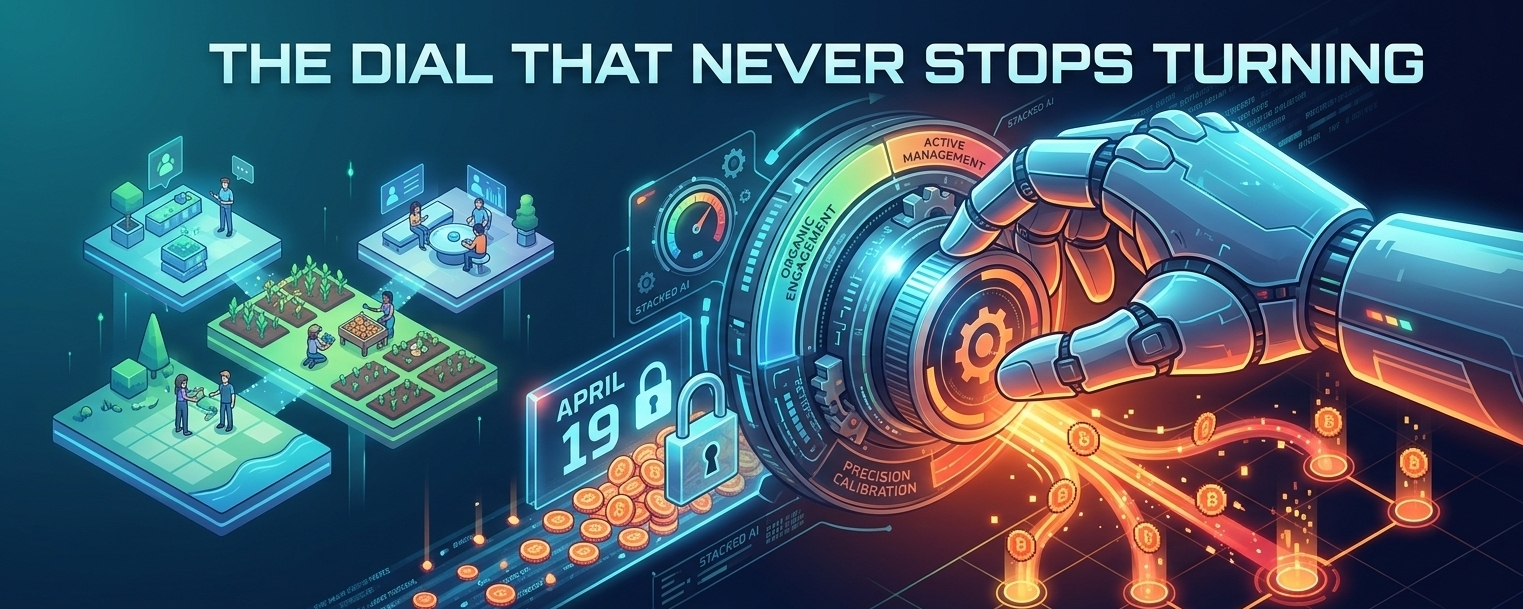
What keeps bothering me about Pixels is how its token design looks disciplined on the surface yet relies on precise, ongoing calibration to remain stable. In three days, on April 19, roughly 91 million $PIXEL tokens unlock across advisors, team, private sale, ecosystem rewards, and treasury. This adds to the fixed daily mint of exactly 100,000 new tokens, allocated only through Stacked the project’s AI engine that scores and rewards genuine ecosystem-positive behavior. With nearly two-thirds of the 5 billion hard cap already circulating and a tight MC/FDV relationship, the mechanics feel deliberately engineered. The public story is sustainable Web3 gaming, but the structure shows a system where participation quality is actively managed rather than left entirely to organic gameplay.
The Real Architecture
Pixels uses a smart hybrid setup on Ronin: off-chain servers ensure farming, Chapter 2 animal care, crafting, pet hatching, and social loops feel responsive and fun, while on-chain handles ownership of land NFTs, pets, and $PIXEL. Stacked sits at the core as the intelligent layer. It analyzes on-chain activity in real time and directs the daily 100,000 tokens precisely toward actions that drive retention, economic health, and long-term value.
This targeting explains the controlled wallet concentration and sustained on-chain activity despite broader GameFi challenges. $PIXEL’s utility for speed-ups, cosmetics, staking into the publishing flywheel, and governance draws real demand because Stacked keeps the incentive flywheel aligned with actual player behavior. The core gameplay is strong, but the incentive setup has become a foundational structural element, not just supplementary support.
The April 19 Test
The unlock is manageable relative to the large circulating supply, and liquidity on Katana’s RON/PIXEL pool plus CEXs has proven resilient so far, backed by controlled emissions and consistent burns from premium in-game spends. Staking further absorbs flow by tying holders directly to the success of current and future games in the ecosystem.
Even so, April 19 will be a clear stress test. If Stacked needs to intensify its targeting afterward to maintain participation levels, it would indicate that demand still leans more on incentives than pure organic stickiness. High DAU numbers look good, but when reward precision does so much work, the deeper question is whether the farming, crafting, and social loops can independently carry the experience long-term. The market appears to be pricing in robust product-market fit; the mechanics suggest we should watch how much of that fit depends on active management.
What This Means for Viability
Pixels demonstrates impressive engineering maturity: a hard supply cap, strict daily mint limit, meaningful token burns, and a publishing flywheel built for gradual decentralization. It has tackled the classic play-to-earn inflation problem more effectively than almost any other project in the space.
What stands out most is that current stability comes from deliberate calibration through Stacked rather than gameplay alone. The daily dial and multi-year unlock schedule create smooth sustainability precisely because the system is actively tuned. This is sophisticated, not fragile.
The key signal I’ll be watching closely after April 19 is direct and decisive: will $PIXEL demand and on-chain participation quality remain steady purely because the core experience is compelling, or will Stacked have to accelerate its targeting to hold the line? That single outcome in the coming weeks will reveal more about Pixels’ true long-term viability than any headline user numbers. The dial keeps turning and its hidden mechanics are about to face a very public test.
