
It was late April 2025, and I almost missed SING completely.
I was doing my usual late-night TGE routine lying in bed, phone brightness cranked down so low my wife wouldn’t wake up, mindlessly scrolling through the flood of recycled hype. You know the posts: random accounts that suddenly became “early believers,” entry prices flexed like trophies, and price targets invented on the spot with zero doubt. I’ve seen it too many times, so I was about to keep scrolling.
Then one tiny detail made me stop.
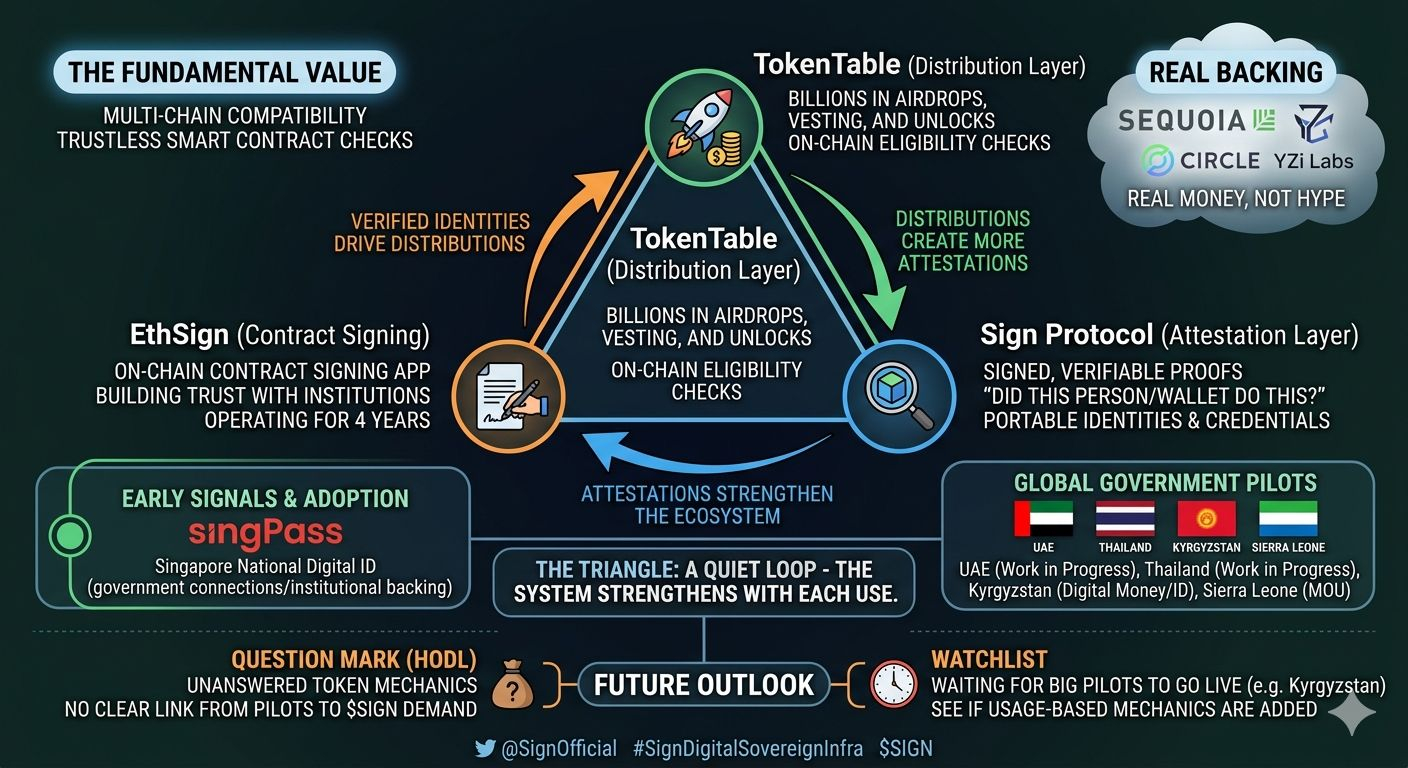
EthSign (what they used to be called before rebranding to SIGN) had quietly hooked up with SingPass Singapore’s official national digital ID system. Not after raising a bunch of money or launching the token. Just… built the thing and connected it.
I put the phone down for a second, then picked it back up and read it again. Singapore doesn’t just let any crypto project plug into something that important. We’re talking millions of real users and government teams whose whole job is making sure nothing sketchy gets near their infrastructure. If a project clears that bar before they even have a token, it usually means they actually built something solid.
That little fact stuck with me, so I did something I don’t do often enough I went straight to the docs. Spent a few late nights reading the whitepaper, the protocol specs, and poking around GitHub. At one point my wife walked in, saw me staring at all these schema diagrams, and asked what on earth I was reading. I tried explaining on-chain attestations to someone who designs gardens for a living. She gave me that polite “okay honey” look and went back to her book.
The more I read, the more it clicked. At its heart, Sign Protocol just answers one simple question really well: “Did this person or wallet actually do this thing?” And it answers it with signed, verifiable proofs that work across pretty much every major blockchain and that smart contracts can check without needing to trust some central company in the middle.
That core piece powers three things that actually fit together:
- EthSign, their original on-chain contract signing app that had been running for four years and built real trust with institutions.
-Sign Protocol itself the attestation layer that makes identities, credentials, and eligibility portable and verifiable.
-TokenTable the distribution tool sitting on top that’s already handled billions in airdrops, unlocks, and vesting, often with proper on-chain checks instead of messy spreadsheets.
What got me wasn’t any one of them alone. It was how they feed into each other like a quiet loop. Once you have verified identities, you naturally need a smart way to get money or tokens to those people. Those distributions then create more attestations, which makes the whole system stronger for the next user or government that comes along. I even sketched it out on a piece of scrap paper at the kitchen table one morning. My wife glanced over and said, “It looks like a triangle.” She was right and triangles are pretty damn stable.
That same setup seems to be what attracted real money and attention: Sequoia from multiple regions, Circle, and folks from YZi Labs (with CZ even showing up for some key moments). These aren’t the types who chase hype. They show up when they see something that can actually compound and stick.
The government stuff caught my eye too live work in the UAE and Thailand, a full national digital money + ID + payment system in Kyrgyzstan, and an MOU with Sierra Leone. It didn’t feel like random announcements. It felt like different countries plugging into the same connected system.
But after getting excited for a week, I ran into the same question that always matters with infrastructure projects: okay, this all sounds useful… but what actually makes people need to buy and hold SING as usage grows?
I went back through everything. There’s schema registration, governance, staking the usual stuff. Still, I couldn’t find a clear, mechanical link where big government deployments or huge distribution volumes directly drive consistent demand for the token in a way you can see and measure on-chain. A lot of really good protocols have quietly died in that exact gap between solid tech and a token that actually captures the value.
So right now I’m sitting with a small bag and way more questions than conviction. I like the team’s quiet, pre-hype approach and the SingPass integration feels like a real signal. The triangle makes sense to me. I just want to see whether the big pilots (especially Kyrgyzstan) actually go live and whether the team adds clear usage-based mechanics that tie real activity to the token.
Until that bridge feels solid, I’m staying curious more than all-in. In this space, that might honestly be the smartest place to be. The loudest people usually stopped asking questions a long time ago.
I’m still asking. And that little triangle has me watching.
@SignOfficial #SignDigitalSovereignInfra $SIGN
