

For anyone who’s survived enough cycles in this space, a certain pattern becomes painfully predictable. A new buzzword emerges—DeFi, Gaming, Metaverse, and now, AI. Suddenly, every whitepaper is plastered with stock photos of robots. The market pumps, everyone chases the "narrative," and 99% of it ends up in the graveyard. But if you’ve been watching as long as I have, you learn to filter the noise. You look for the projects that aren't riding the wave, but are quietly building the sea walls.
That’s why I’m obsessed with Fabric Protocol and its native token, ROBO. This isn’t some shiny "AI" wrapper. It feels like the team is asking a harder, grittier, and ultimately more vital question than anyone else in the room.
1. The First Clue: It’s Not About the Hardware
When people talk about automation, they focus on the "cool" stuff. We gawk at Boston Dynamics’ robots doing backflips or drones delivering tacos. The assumption is that the hardware is the final boss.
Fabric looks at that and says, "Fine, let’s assume the hardware is solved. Let’s say the world is crawling with millions of autonomous bots. What then?"
That’s where the nightmare starts. If you have a thousand robots from a hundred different vendors, owned by fifty different companies, all occupying the same street, how do they talk? How does a delivery bot from Company A pay a sensor owned by Company B for a real-time traffic update? How do they trust each other without a middleman taking a 30% cut? Without a neutral system, we’re headed for either total chaos or a future where Big Tech owns the only "walled gardens" that actually work. Fabric’s bet is simple: we need an economic infrastructure for machines before the machines can actually run the economy.
2. The Architecture of Trust: Fabric as the Coordination Layer
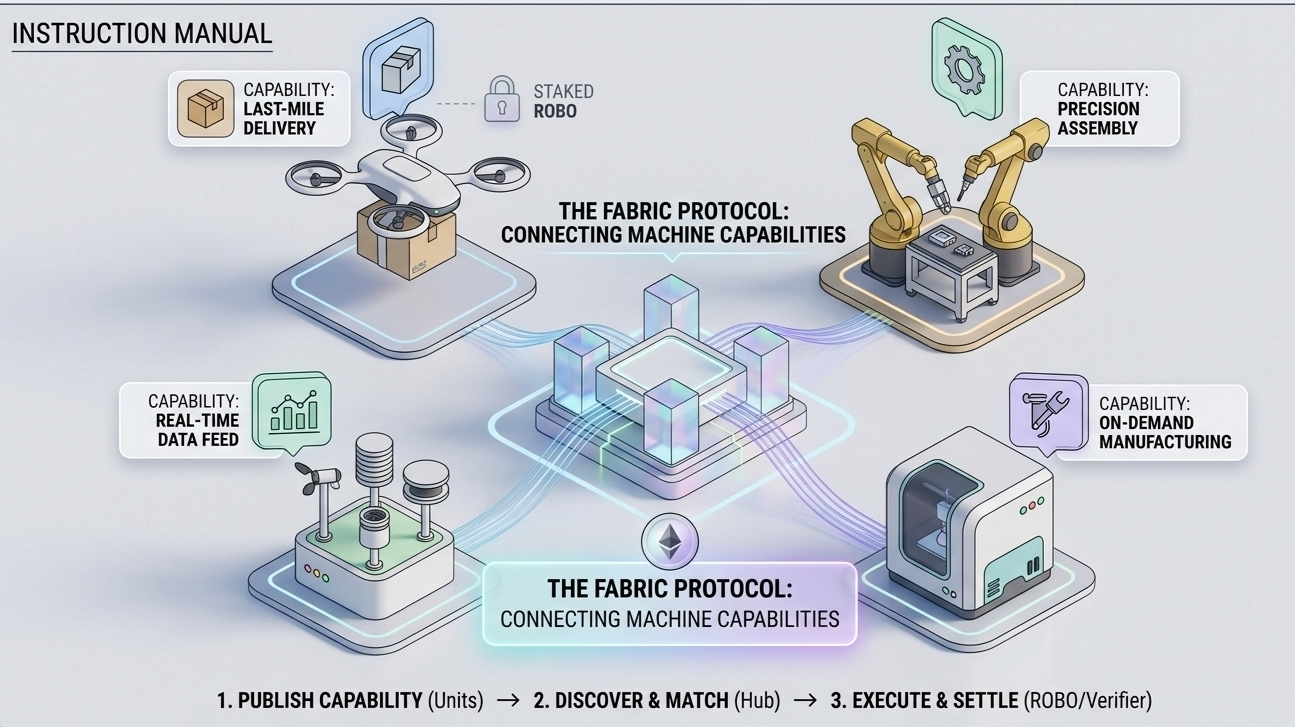
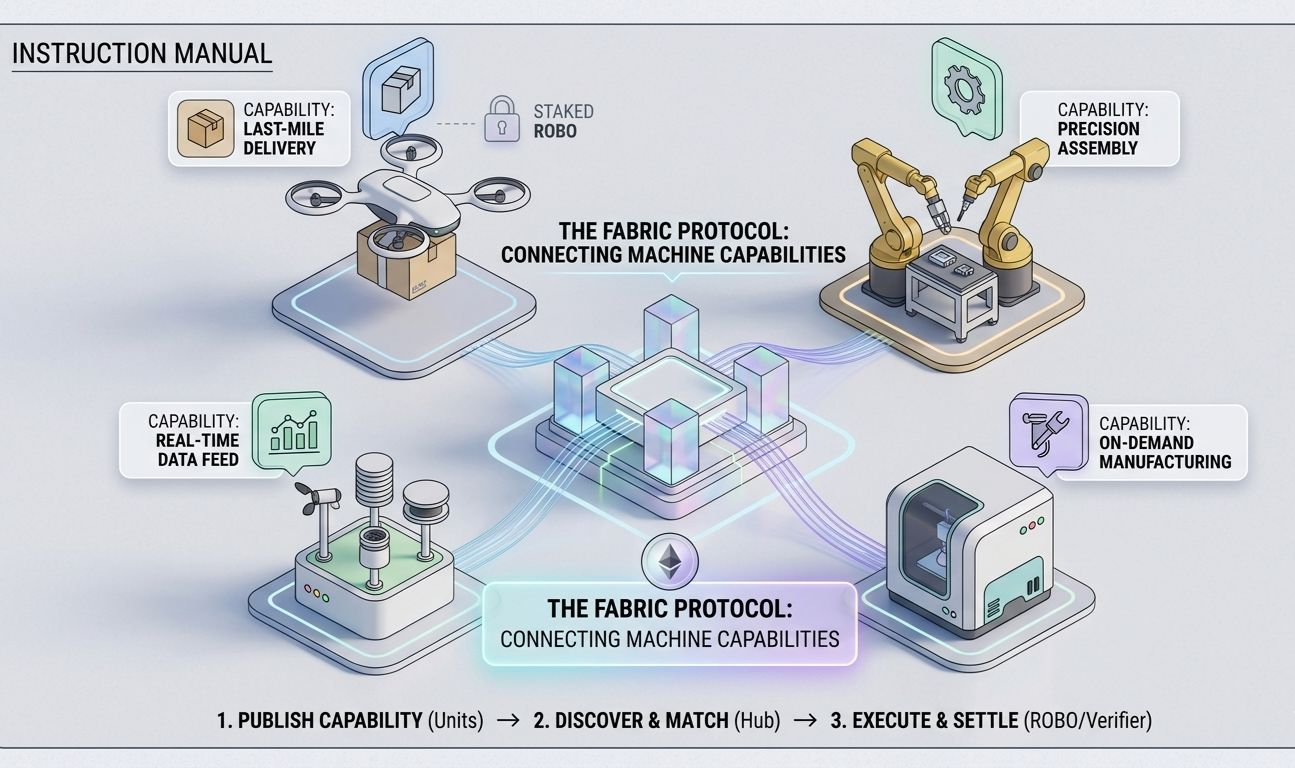
Fabric isn't building a better robot; they’re building the "tracks" for the robotic railway. They call it Machine Commerce. Imagine a world where any device—a drone, a 3D printer, a weather station—can "publish" what it’s capable of to a public, decentralized network. Instead of apps talking to APIs, machines discover and contract each other directly.
They’re using blockchain because they have to, not because it’s trendy. When you have untrusting parties (Company A’s drone, Company B’s warehouse) trying to coordinate in real-time, you need a neutral arbiter. You need rules enforced by math, not by a handshake and a 50-page legal contract that a robot can’t read anyway.
3. The Fuel and the Fences: The ROBO Token
The ROBO token is where the theory meets the pavement. It isn't a "governance" meme; it’s the literal fuel and the security fence of the ecosystem.
Network Fees: It’s the gas. You want to coordinate a machine task? You pay in ROBO.
Staking (The Fences): This is the "skin in the game." If you’re a robot operator, you stake ROBO as collateral. It’s your "good faith" deposit.
The Verifiers: People (and machines) who check the work earn ROBO for keeping everyone honest.
With a 10 billion total supply and a distribution focused on long-term ecosystem growth rather than a quick VC exit, the tokenomics suggest this is a project funded for a decade-long marathon, not a sprint to an exchange listing.
4. The "Who Verifies the Work?" Problem
In a decentralized world, how do you know the drone actually delivered the package? You can’t put every single sensor reading on-chain—it’s too slow and too expensive.
Fabric uses a "Challenge-Based Verification" model. It’s elegant game theory: the system assumes honesty by default, but holds payment in escrow. If a "verifier" suspects foul play, they issue a challenge. If the robot cheated, its stake is slashed and the challenger gets a cut. If the challenge was fake, the challenger loses their stake. This "swarm intelligence" keeps the cost of operation low while keeping the cost of lying high. It’s brilliant, but it’s also the biggest technical risk—the economic math has to be perfect, or bad actors will find the gaps.
5. A Marketplace of Capabilities
What fascinates me most is the shift in perspective. Fabric doesn't talk about TPS (transactions per second); they talk about capabilities.
A drone publishes a "Delivery" capability. A 3D printer publishes "Manufacturing." A sensor publishes "Data." This turns the entire network into a giant, decentralized Amazon for machines. A software agent says, "I need X moved to Y," and the protocol handles the matching, the contract, and the micro-payment. The value of ROBO becomes tied to the literal volume of machine work happening globally.
6. The "Cold Start" Reality Check
So, why am I still "watching" instead of diving headfirst? Because the biggest hurdle isn't the code—it’s the humans.
How do you convince a massive corporation to take their proprietary, closed-loop robotic system and plug it into a public protocol? Companies are terrified of risk. They’d rather use a shitty, siloed system they control than a perfect, decentralized one they don't.
This is the "Cold Start" problem. The network is useless without robots, and robots won't join without demand. Fabric’s success hinges on whether they can move from "visionary whitepaper" to "must-have toolkit" for the next generation of agile robotics startups.
7. The Sideline Verdict
I’m convinced the Fabric team has identified the right problem. The future will be multi-vendor and autonomous. We will need a coordination layer. They aren't just slapping "AI" on a token for a pump; they’re building the plumbing for the next century.
But a great idea isn't a guaranteed win. The road is littered with the corpses of "elegant solutions" that no one used. I’m watching the developer forums. I’m looking for the first real-world case studies of a task completed end-to-end. I’m looking for the moment the "capabilities marketplace" stops being a theory and starts being a tool.
The potential is massive. The vision is world-changing. But the proof will be in the cold, hard reality of adoption. Until then, I’ll be right here—watching the machines to see if they finally start talking to each other.
$ROBO @Fabric Foundation #ROBO #robo #Robo
