
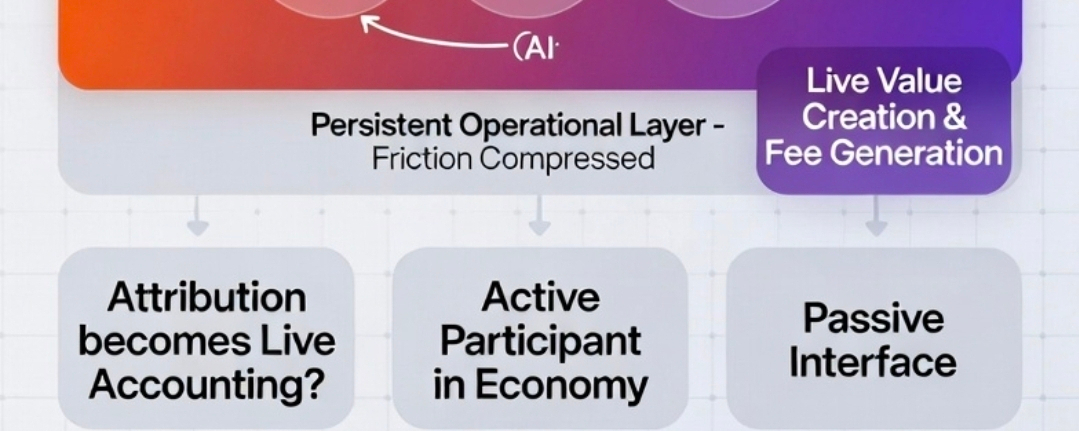


I’ve been trying to understand what Octoclaw actually changes in the OpenLedger stack beyond the obvious “agent layer” framing. The more I sit with it, the more it feels like it quietly collapses the boundary between intent and execution.
Most AI systems still operate in discrete steps: you think, you prompt, something is generated, then you manually take action elsewhere. Even with tools connected, there’s always a small translation gap between decision and doing.
Octoclaw removes much of that friction by turning workflows into something closer to continuous execution threads. You don’t just ask for output — you define direction and constraints, and the system starts operating inside that space across data retrieval, inference calls, and on-chain actions.
Why This Matters in OpenLedger
What makes this important in the OpenLedger context is not just convenience. It’s what gets compressed.
Once agents become execution-native, they stop behaving like passive interfaces sitting on top of models. They start acting like active participants in the fee-generating layer itself. Every decision can trigger inference, every inference can reference DataNets, every action can settle somewhere in the OpenLedger economy.
Octoclaw is not just sitting at the application edge. It is constantly pulling the entire stack inward.
And that changes how value moves:
DataNets are no longer only feeding training pipelines — they are being queried through live agent-driven flows.
Models are no longer only evaluated at deployment time — they are being stress-tested through continuous agent activity.
Even the EVM bridge starts to matter more because execution is no longer localized; it is distributed across environments the agent touches in real time.
The subtle shift is that intelligence stops being a “request-response” loop and becomes a persistent operational layer that agents live inside.
The Attribution Question
But there is also a quieter question that comes with that.
If Octoclaw is constantly executing across models, chains, and data sources, then attribution is no longer just about tracing influence after the fact. It becomes a live accounting problem embedded inside motion itself.
I can’t tell yet whether that makes the system cleaner or just too dynamic to ever fully reconcile at perfect granularity.
What do you think?