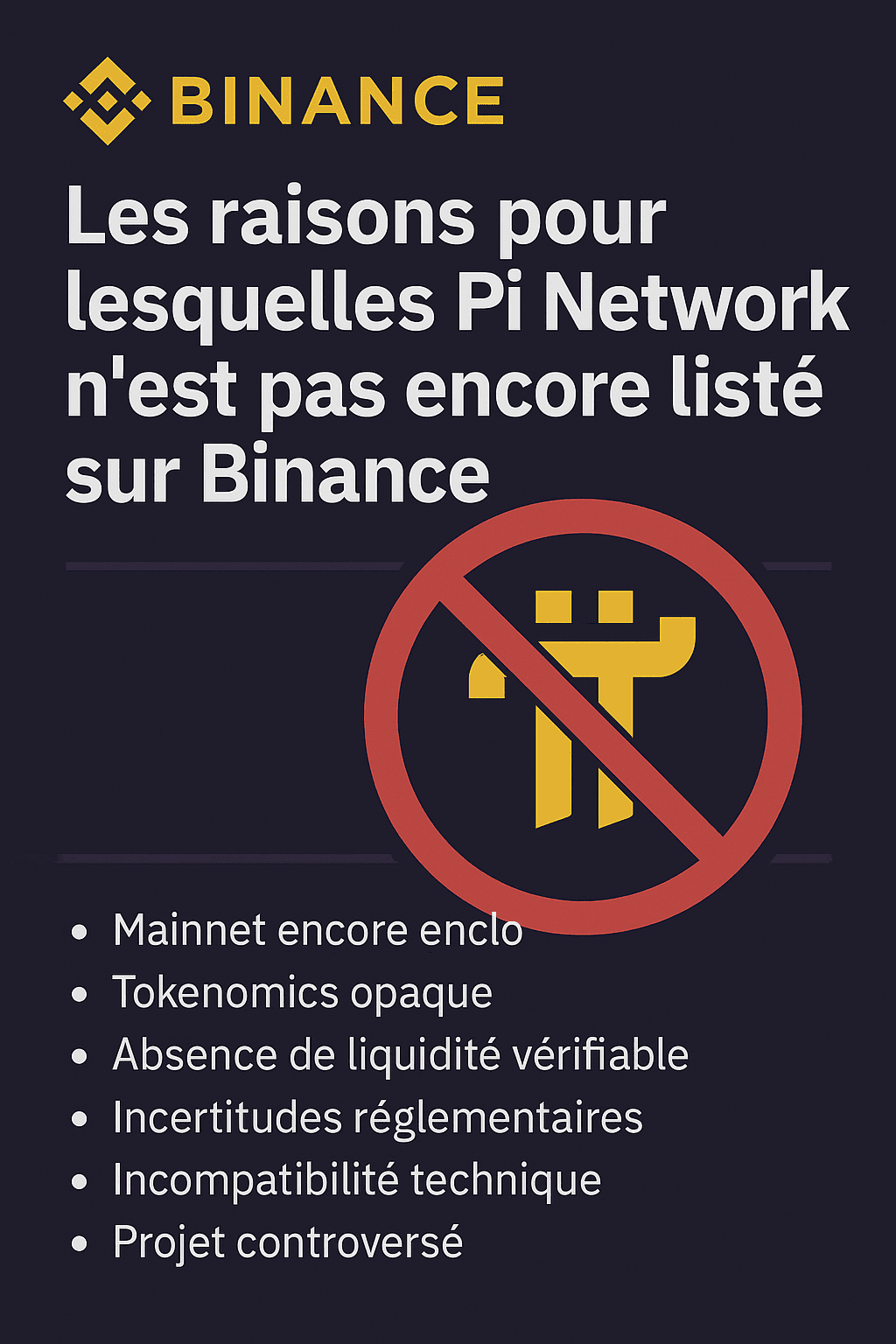
Here are the main reasons why Pi Network is still not listed on Binance (as of April-May 2025):
🚫 1. Mainnet still 'enclosed' and lack of transparency ≪ closure ≫
Although the official mainnet was launched on February 20, 2025, it remains in a so-called 'enclosed' phase, meaning it is locked with a firewall, without external connectivity. This prevents exchanges like Binance from examining the network, measuring its liquidity, and evaluating its actual decentralization.
Moreover, the source code and smart contracts are not yet public, which contradicts the transparency criteria required by Binance.
2. Opacity of tokenomics and centralized governance
Analysts, including Dr. Altcoin, highlight the opacity in the locking and burning mechanisms, as well as uncertainties about the circulating supply (approximately 6.77 billion, after the removal of 10 million tokens).
The control by the central team (PCT) over a large portion of the tokens raises doubts: this allegedly violates the governance standards sought by Binance.
3. Absence of verifiable liquidity
Pi Coin is currently traded on smaller exchanges (Bitget, OKX, MEXC…), but its volume remains insufficient and not very transparent. No public price discovery mechanism is in place, which exposes it to significant fluctuations or market manipulations.
4. Regulatory uncertainties and compliance
Binance operates in many strict jurisdictions; it requires clear compliance with AML/KYC regulations, etc. Pi Network has not yet obtained official recognition from any financial authority. Thus, it risks violating standards, which is a risk to avoid for the exchange.
5. Technical incompatibility with Binance's 'Vote-to-List'
Binance's 'Vote-to-List' initiative is limited to projects on the BNB Smart Chain. Pi Network operates on its own blockchain, outside of this ecosystem, making it ineligible for this community campaign.
6. Possibility that Pi refuses to pay the listing fees
According to some reports, the Pi Core Team allegedly refused the high listing fees demanded by Binance, which could slow down the process. Some specialists see this as a strategic choice to preserve financial autonomy.
7. Criticisms perceived as a controversial project
Critical voices (notably Bybit CEO Ben Zhou) have called Pi Network a 'scam', citing its supposed operation as a referral chain or MLM. These controversies are additional barriers to adoption by major exchanges, whether Binance or Bybit.
🗣️ Community reactions (Reddit)
> 'In order to list Pi, Binance must pass the KYB process with the Pi Network. Presumably… they have not done this yet as it will require a lot of transparency about their business and making sure they are compliant with financial regulations.'
> 'Binance only lists those shit coins that aren’t compliant… The Pi Network team’s KYB process is as strict as our KYC. I bet Binance has some red flags for them…'
> 'It seems that FCA regulations… they are following FCA guidelines regarding the financial promotions regime' for the UK market: Binance cannot proactively promote new tokens without violating regulations.
✅ In summary
Criteria Current situation of Pi Network
Open and verifiable mainnet No (still closed, without public API)
Transparent tokenomics No (lack of clarity on locking/burning)
Public offer and liquidity No (low volume/no official mechanism)
Regulation & compliance No (uncertain legal status, KYB/KYC not finalized)
Technical compatibility No (own blockchain outside of BNB Smart Chain)
Payment of listing fees Possible refusal to pay excessively high fees
Reputation & perception Strong criticisms, including scam accusations
🔮 What must Pi Network do to be listed?
1. Fully publish the mainnet and open external access, API, and smart contracts.
2. Publicly explore its tokenomics mechanisms (locking, burning, distribution).
3. Generate verifiable liquidity through reliable exchanges and compromised volumes.
4. Obtain regulatory clarifications and ensure compliance (KYB/KYC).
5. Perhaps reconsider the payment of listing fees if deemed reasonable.
If these conditions are met, a listing on Binance (or other leading exchanges) could become feasible.
In conclusion, Binance's refusal or delay to list Pi Coin is based on a bundle of obstacles related to transparency, liquidity, regulation, and the technical status of the project. Only by addressing these gaps can Pi Network claim integration on major platforms.