
Picture a blockchain that actually keeps your financial moves private—locked up tight, but still lets regulators peek in just enough to keep things legal. No leaks, no exploits. That’s what Dusk Network’s been building since 2018 in Amsterdam, quietly turning regulatory headaches into smooth, secure rails for tokenized assets. While everyone else chases the next meme coin, Dusk’s team has stuck to the lab, perfecting zero-knowledge proofs and encrypted consensus. They want on-chain finance to feel like a fortress, not a fishbowl.
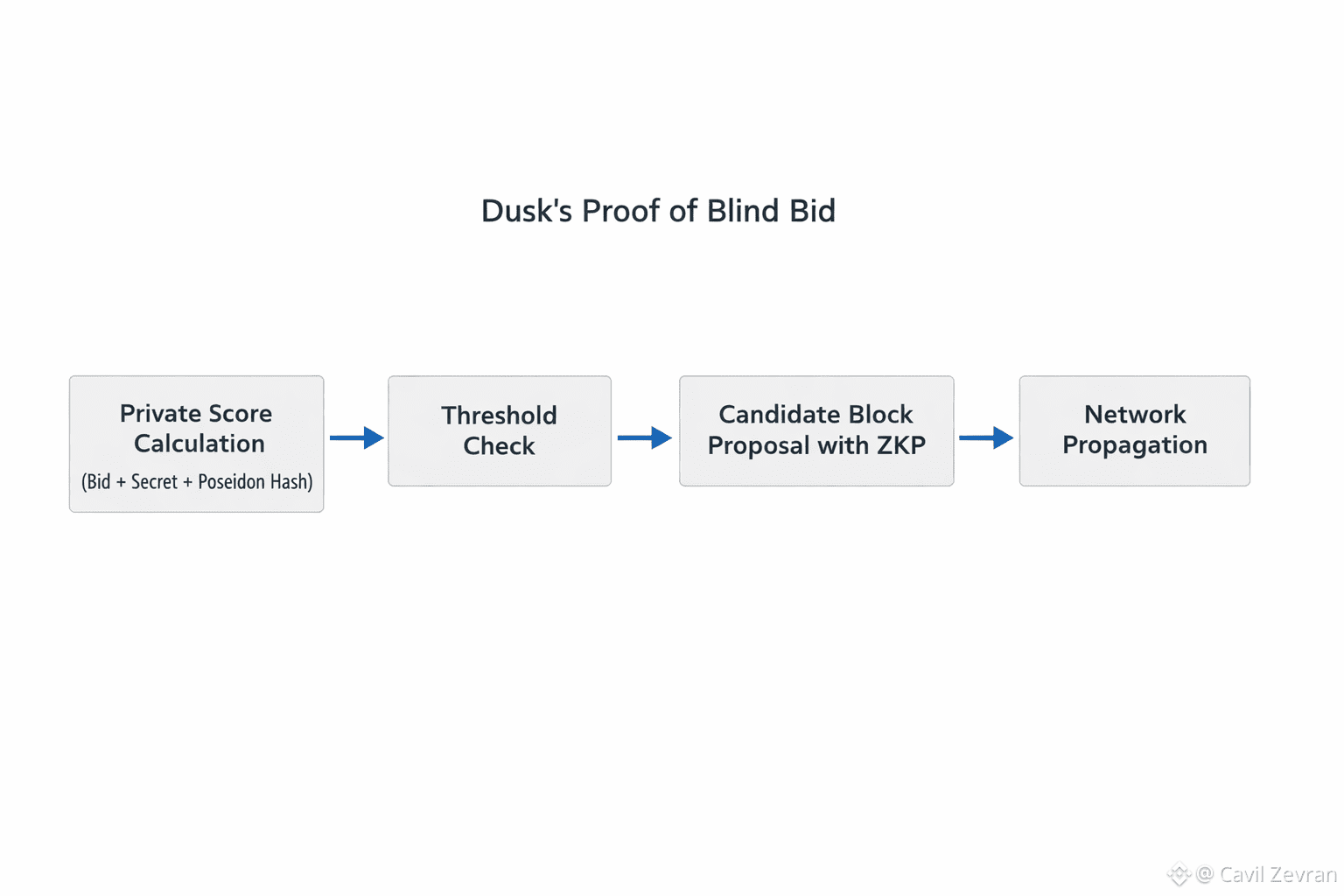
Let’s get into how they pull this off. Dusk’s Proof of Blind Bid is all about fairness. When you join in, you privately calculate a cryptographic score based on your hidden bid and a secret, all mixed up with the Poseidon hash for true randomness. If your score’s high enough, you propose a block—backed by a zero-knowledge proof that proves you followed the rules without revealing your cards. There’s no luck or manipulation here. It shuts out whales and front-runners, so every node—even the ones running on cheap hardware—gets a fair shot at leading, with no need to reveal their stake or identity. Blocks come every 10 seconds, forks barely ever happen, and the system’s designed for high-stakes, regulated assets where downtime or bias isn’t just inconvenient—it’s expensive.
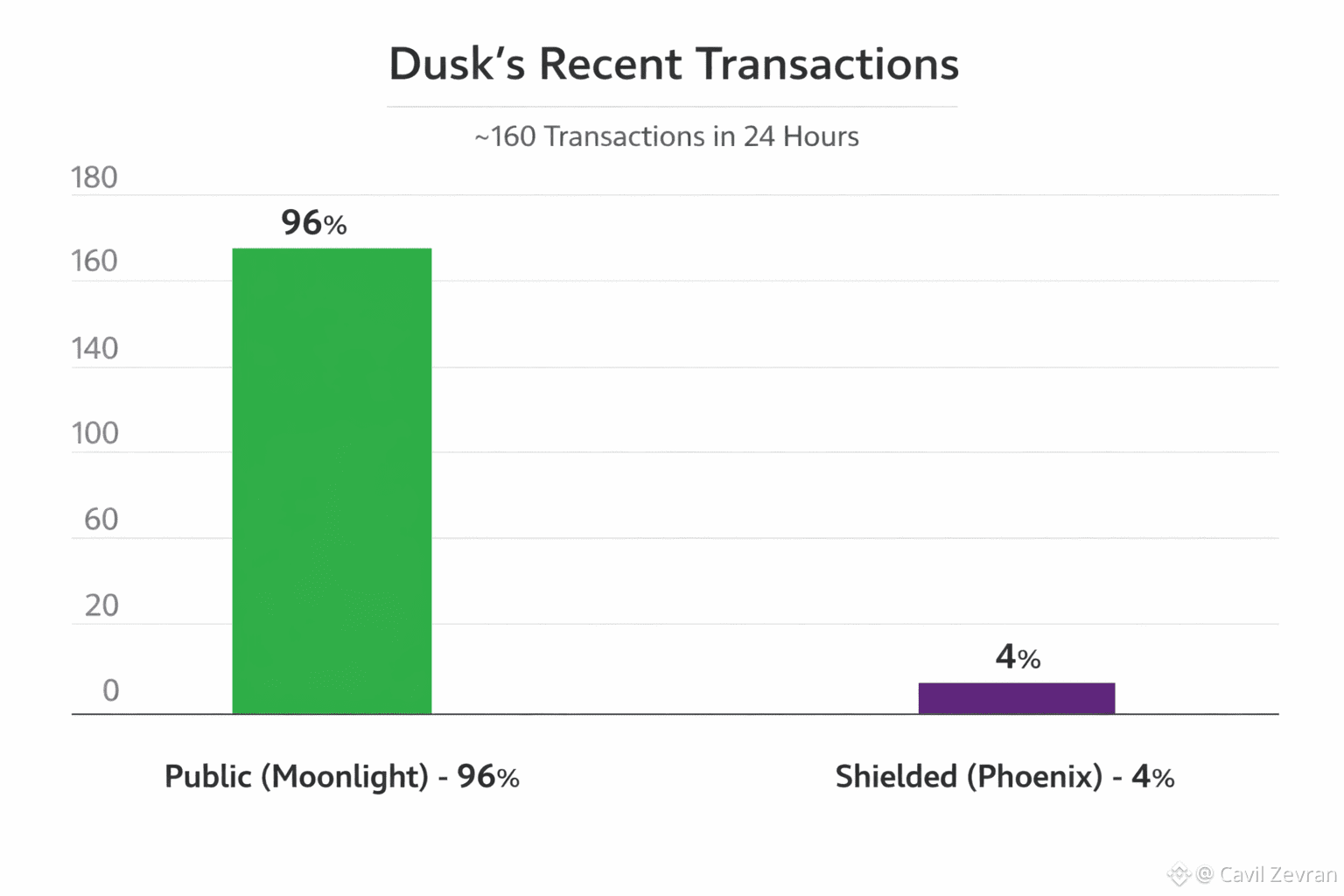
Then there’s Phoenix, Dusk’s twist on the classic UTXO model. It’s a privacy engine that takes the usual setup and cranks it up. You can spend non-obfuscated outputs privately, hiding who’s involved, how much is moving, and what’s really going on, all thanks to zero-knowledge proofs and explicit state steps. Validators check balances and make sure everything adds up, but they don’t actually see the numbers. Execution costs adjust on the fly without leaking info—perfect for smart contracts that need to stay private on Dusk’s Rusk VM. In real life, this lets things like tokenized bonds or stocks move around invisibly, but still prove the math holds up: inputs always match outputs, so there’s no funny business. Look at recent data—160 transactions in 24 hours, with 96% public through Moonlight and 4% shielded via Phoenix. That’s not just theory; people actually use it.
The whole thing hangs on value conservation. Even when amounts are hidden, Dusk uses cryptographic commitments and zero-knowledge proofs to show no extra value sneaks in or out. Validators agree the transaction checks out—without ever seeing the amounts. This trust is built on solid math: completeness (honest proofs always work) and soundness (cheaters basically have zero chance). So you get strong privacy, but still meet rules like MiCA, where you need to prove AML/KYC compliance without oversharing. Dusk does this with tools like whitelistTree_poseidon—a Poseidon-based Merkle Tree that stores approved identities off-chain and lets you verify them with zero-knowledge proofs, no need to reveal public addresses.
Leader selection? Pure privacy. There’s no open lottery. Each round, scores come from secret bids, hidden secrets, round numbers, and steps—all Poseidon-hashed. Nobody can game the system or predict who’s up next. This protects against attacks and makes private staking possible in Dusk’s ZK-SBA (Zero-Knowledge Segmented Byzantine Agreement). You need at least 1,000 DUSK to stake, and it matures in about 12 hours—easy enough to get in, but safe. Mess up, and slashing starts at 10% and climbs from there. Right now, about 40% of the 490 million DUSK in circulation is staked, spread across hundreds of provisioners. Rewards get paid out over a 36-year schedule, all from a 1 billion token cap—no inflation surprises. And it all started with an $8 million ICO at just over four cents a token.
Block timestamps add another layer of security. Every block gets a UNIX time, which keeps bids valid, checks who’s allowed to stake, and keeps consensus tight—without leaking privacy. Smart contracts use this for replay protection and to make sure everything runs on time, anchoring confidential transactions to a timeline nobody can tamper with. On top of that, Citadel’s reusable identity proofs let you handle KYC with minimal info, all self-custodied. That means institutions can manage €300 million in NPEX-tokenized assets without losing sleep over data leaks or angry regulators.
What really sets Dusk apart is how it rewrites the rules of blockchain privacy. Old-school blockchains shout your every move, making you a target. Dusk just whispers proofs, letting you dial privacy up or down while keeping audit trails for compliance. You don’t get total anonymity; you get smart, selective privacy that’s actually legal. And after seven years of R&D, it’s not just a promise—it works. For developers building regulated apps, it means you can launch on a chain where cryptography takes care of the heavy lifting, from manipulation-resistant consensus to private DAOs with anonymous voting. As on-chain volumes keep rising, Dusk’s approach looks less like magic and more like the future.
