


Dusk Foundation was founded in 2018 with a direction that did not match the noise of the crypto market at that time. While many projects were racing to launch fast products or chase attention, Dusk was built around a slower idea. The idea was simple but demanding. If blockchain wants to support real finance, it must work inside rules, not outside them. I’m not talking about theory. I’m talking about real assets, real institutions, real responsibility, and systems that cannot afford to fail.
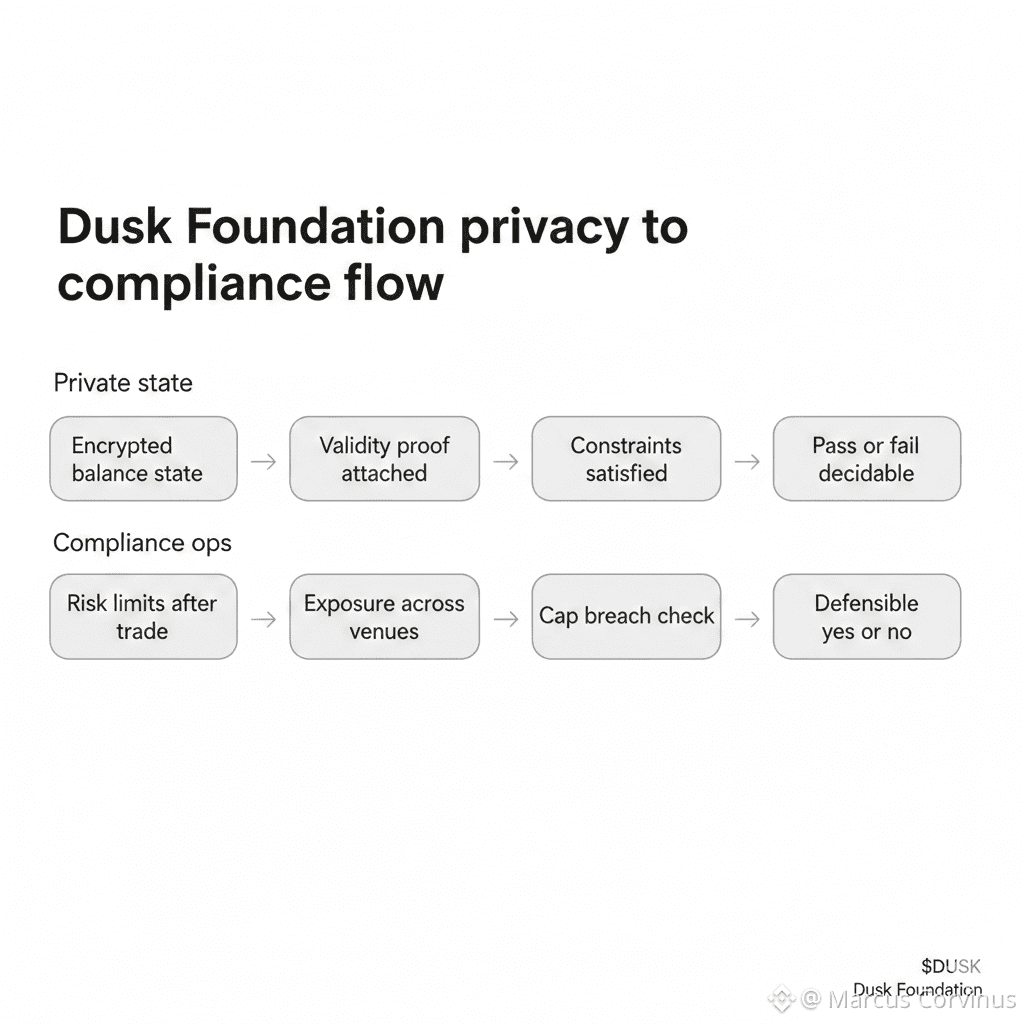
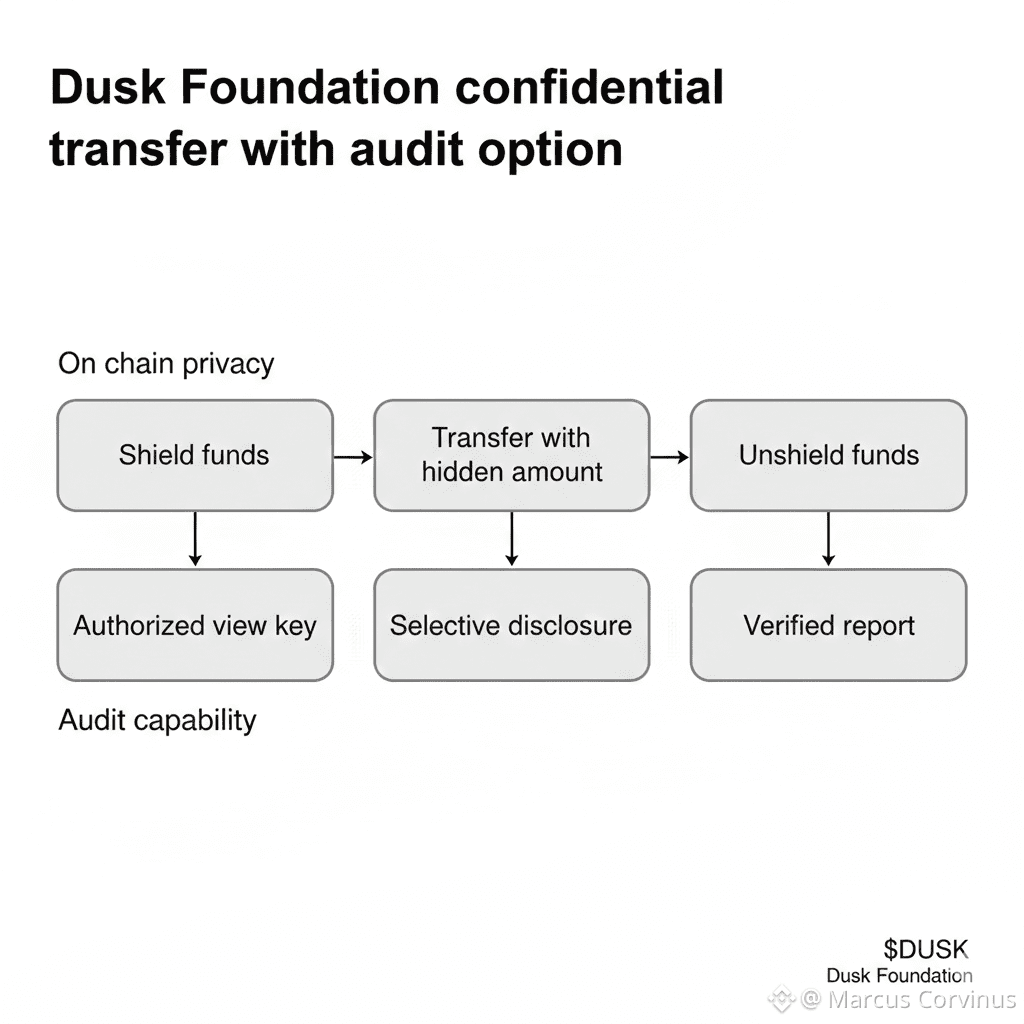
Dusk is a Layer 1 blockchain created for regulated and privacy focused financial infrastructure. This single sentence explains almost every design decision in the network. In traditional finance, privacy is not a preference. It is a requirement. Businesses cannot reveal internal strategies. Institutions cannot expose client data. At the same time, regulators must be able to inspect activity when needed. Most blockchains struggle here. They’re either fully transparent or fully hidden. Dusk was built to support privacy without removing accountability. If proof is required, the system is designed to allow it. If privacy is required, the system protects it.
When I look at how Dusk is designed, it feels careful. The project does not behave like an experiment. It behaves like infrastructure. Infrastructure must be predictable. It must behave the same way today and years from now. Dusk avoids shortcuts because shortcuts break trust. Trust is slow to build and fast to lose.
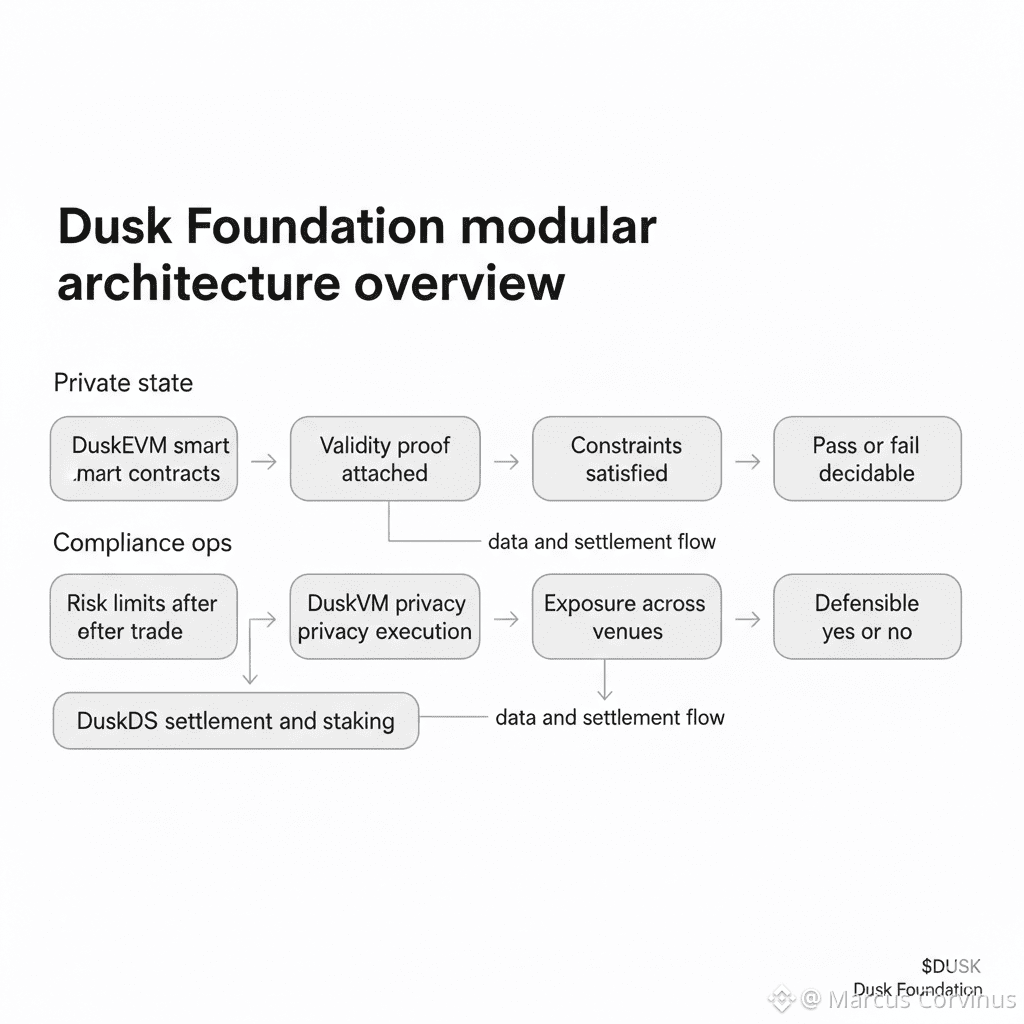
The network follows a modular structure. This means the blockchain is divided into clear functional layers instead of being one rigid system. There is a base layer responsible for security, staking, settlement, and finality. This layer is designed to be stable and reliable. On top of this base, execution layers operate. One execution path supports EVM compatible smart contracts so developers can build using tools they already understand. Another execution path supports advanced privacy logic for financial use cases that require protection at the data level. This separation allows the system to grow without damaging its foundation.
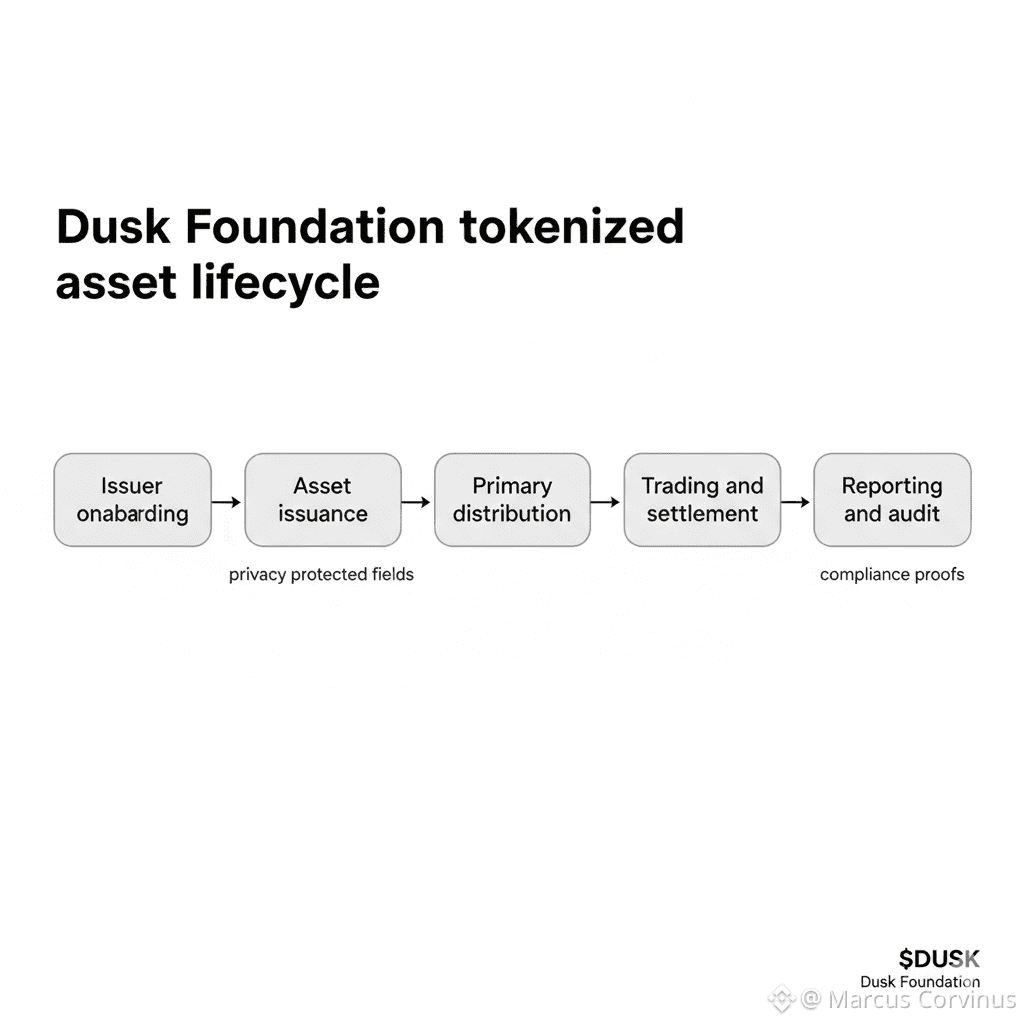
Privacy on Dusk is not forced in one direction. Some transactions do not need strong privacy and can remain simple. Others require protection. Dusk supports both paths. This matters because real finance is not uniform. A payment, a trade, and an asset issuance all have different needs. Dusk allows privacy to scale with purpose instead of forcing every action into the same model.
Security is treated as a core principle. Dusk invests heavily in testing, reviews, and careful protocol design. This work is slow and often invisible, but it defines whether institutions can trust a system. Consensus rules, network communication, and economic incentives are designed to behave consistently. Institutions do not trust promises. They trust systems that work the same way under pressure.
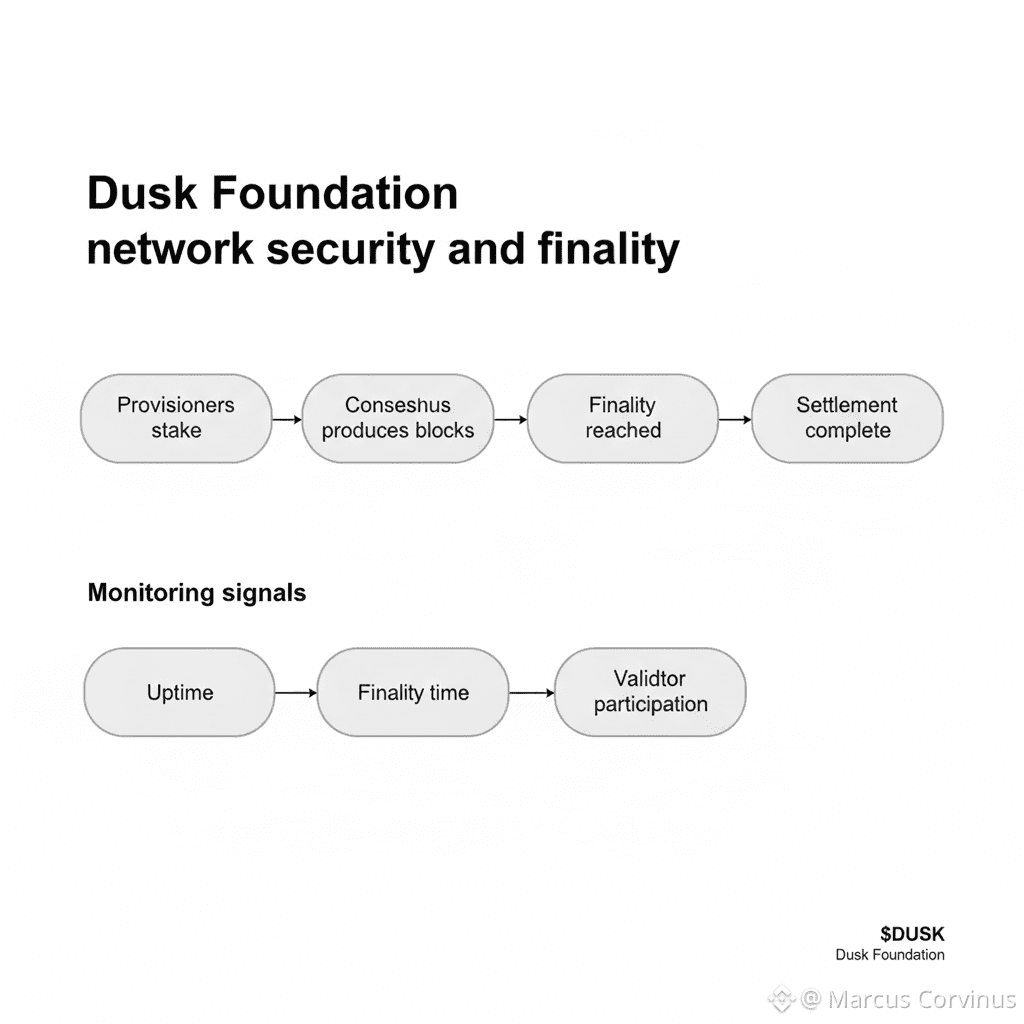
Staking on Dusk is handled by provisioners. These participants commit value to secure the network and help produce blocks. The incentive model encourages long term involvement rather than short term behavior. This approach fits the network’s goal. A blockchain built for finance cannot rely on unstable participation. If I’m trusting a system with real assets, I need to know the people securing it are committed.
Real world assets are central to Dusk’s vision. Many projects talk about tokenization as if it is simple. It is not. Real assets carry legal meaning, ownership rights, and regulatory obligations. Dusk focuses on bringing these assets on chain in a way that respects existing systems instead of ignoring them. This approach is slower, but it is realistic. If tokenized finance is going to scale beyond crypto users, it must fit into the legal world.
Custody is another area where Dusk shows strong understanding. Institutions care deeply about how assets are held. They often require self managed custody where control stays internal. Dusk treats custody as core infrastructure. The goal is clear. Using blockchain should not mean giving up control of keys or processes. If custody fails, confidence disappears instantly.
For developers, Dusk made an important shift by supporting familiar smart contract environments. Early designs relied more on custom systems, which slowed adoption. By allowing developers to build using tools they already know, Dusk reduces friction. At the same time, it keeps its privacy and compliance features intact. This balance allows builders to move faster without losing purpose.
One of the most important parts of Dusk’s progress is how it approaches privacy inside smart contracts. Standard smart contract systems expose everything. That works for open experiments, but it fails for real financial use. Dusk is working toward models where sensitive information such as transaction amounts can remain hidden while logic still executes correctly. If this works fully, it unlocks financial applications that cannot exist on fully transparent networks.
Dusk is not designed to attract attention through trends. It is building rails. Rails are invisible until everything depends on them. Payments, settlement, and issuance do not sound exciting, but they move the global economy. If blockchain becomes part of everyday finance, it will rely on systems built with this level of care.
I’m aware that this path is difficult. Building for regulated finance means slow progress and long timelines. Adoption grows through trust, not excitement. Regulations change. Partners move carefully. Many projects give up when growth feels quiet. Dusk appears willing to accept that challenge.
If I step back and look at the full picture, Dusk feels steady. They’re not trying to impress everyone. They’re trying to build something that lasts. Privacy, compliance, modular design, custody, and real world asset support are not marketing ideas here. They are the foundation.
If blockchain finance becomes normal in the future, it will not feel dramatic. It will feel reliable. And that is exactly what Dusk is working toward.
