
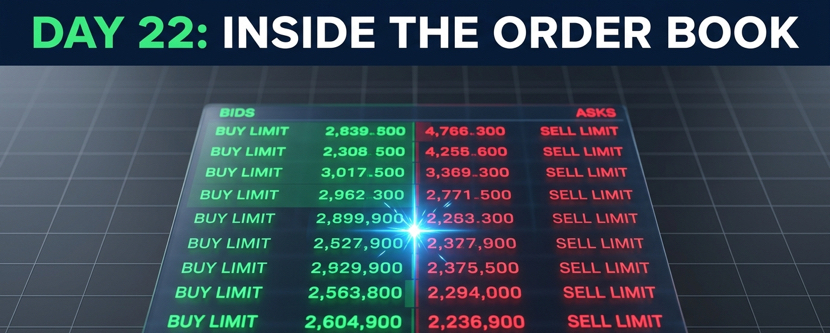

Welcome to the twenty-second day of our educational series, marking the official launch of our final week of advanced market training! Up to this point, we have focused heavily on reading charts, technical indicators, and geometric patterns. Today, we are peering directly behind the curtain of the price chart to explore the engine that actually drives price action: Order Book Dynamics and the role of Market Makers. Understanding how the order book functions allows you to see the real-time matching of supply and demand before it ever prints as a candlestick on your screen.
Anatomy of the Order Book: Bids and Asks
Every centralized and decentralized cryptocurrency exchange relies on an electronic ledger called the Order Book to facilitate trading. The order book is a real-time, constantly updating list of all open, pending limit orders for a specific trading pair. It is divided into two primary columns:
* The Bid Side (Buyers): Displayed in green, this section contains all pending buy limit orders. These are market participants waiting to purchase the asset at specific prices lower than the current trading price. The highest bid represents the absolute best price you can sell your asset for instantly using a market order.
* The Ask Side (Sellers): Displayed in red, this section contains all pending sell limit orders. These are participants waiting to sell their asset at specific prices higher than the current trading price. The lowest ask represents the absolute best price you can buy the asset for instantly using a market order.
The narrow empty space between the highest bid and the lowest ask is known as the bid-ask spread. In highly liquid markets, this spread is incredibly tight, often fractions of a cent, ensuring minimal friction for traders.
Market Liquidity and Order Book Depth
When you look at an order book, you will notice a visual representation often called the Depth Chart. This chart plots the cumulative volume of buy orders on one side and sell orders on the other.
If an asset has thousands of Bitcoins or millions of stablecoins waiting in the order book close to the current price, it is considered a deep order book. Deep order books provide high market liquidity, meaning large institutional traders can buy or sell massive positions without forcing the price to spike or crash. If the order book is thin, even a relatively small market buy order can chew through all the available sell asks instantly, causing severe price slippage against the person executing the trade.
The Crucial Role of Market Makers
In an ideal world, organic buyers and sellers would perfectly match each other's orders at any given second. In reality, market demand fluctuates wildly. To prevent markets from grinding to a halt or experiencing chaotic, unstable price gaps, specialized financial institutions known as Market Makers step in.
Market makers are entities that contract with exchanges to constantly provide liquidity to the order book. They do this by simultaneously placing both buy limit orders (bids) and sell limit orders (asks) 24 hours a day. They do not hold positions to guess whether the price will go up or down; instead, they profit from the volume of trades by capturing the tiny price difference of the bid-ask spread. By always ensuring there is an active order book, market makers stabilize the ecosystem, reduce slippage, and make it possible for retail traders to enter and exit positions instantly.
Creator's Advice: Watch Out for Order Book Spoofing
One of the most vital lessons an advanced trader can learn is that order books can be highly deceptive. Because limit orders are just pending intentions, they can be canceled instantly with zero financial penalty before they are ever executed.
Whales and manipulative trading algorithms frequently practice order book spoofing. This occurs when an entity places a massive, multi-million-dollar buy limit order deep in the bid book to create the illusion of a massive support floor. Retail traders see this huge wall of buying demand, get excited, and start buying the asset, driving the price up. The moment the price drops close to that massive buy wall, the algorithm instantly cancels the order. Never trade purely based on the size of order book walls. Always verify your entry levels using the macro support zones, moving averages, and actual executed trading volume we practiced in our earlier modules.
Tomorrow, we will build on this structural foundation by exploring advanced order routing mechanics, breaking down the critical structural differences between Limit, Market, and Stop-Limit orders to help you execute trades like an institutional professional. For today, your practical homework is to open your spot trading panel in Pro mode, select a highly liquid asset like Bitcoin, watch the rapid matching of red and green orders inside the live book, and observe how the bid-ask spread behaves.