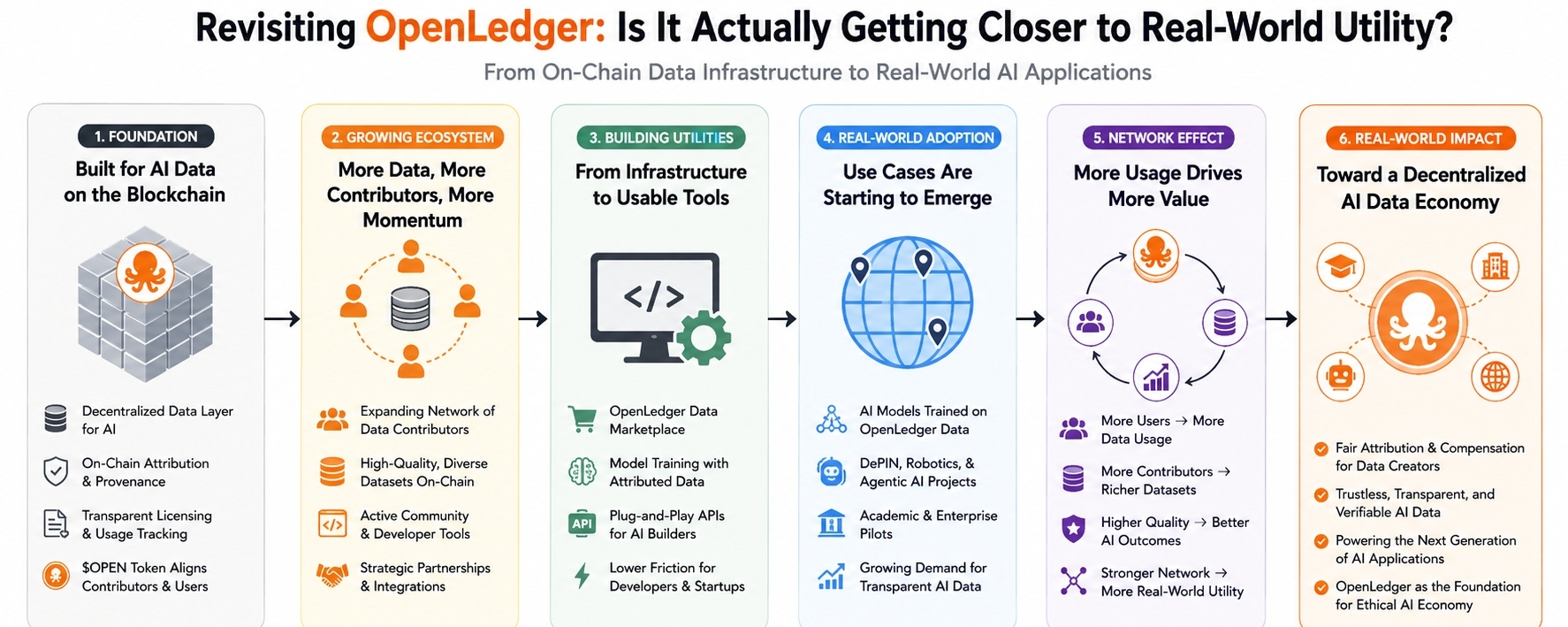
I've been checking back in on OpenLedger recently, partly because a lot has happened and partly because I wanted to challenge my own assumptions about it.
When I first looked at the project, the idea was easy enough to understand. Create a system where data contributors, model builders, and eventually AI agents can be attributed and compensated for the value they create. It's an ambitious vision, and honestly, it's one of those concepts that sounds compelling on paper almost immediately.
The harder question is whether it's becoming meaningfully more real.
Not whether the roadmap looks better.
Not whether the ecosystem is getting bigger.
Not whether the token is attracting more attention.
What I'm really trying to figure out is whether the recent developments change the odds that OpenLedger becomes something people genuinely use rather than something people simply talk about.
After spending some time digging through the latest updates, I think my view has changed—but not in a dramatic way.
The biggest shift is that OpenLedger is no longer operating purely in the realm of ideas.
The launch of the OPEN Mainnet matters because it changes the type of conversation we can have about the project. Before this, most discussions around Proof of Attribution, contributor rewards, and AI data ownership were largely theoretical. People could debate whether the model made sense, but there wasn't much real-world activity to evaluate.
Now there is.
That doesn't mean the system has proven itself. Far from it.
But it does mean we're moving from asking, "Can they build this?" to asking, "Will anyone actually use it?"
To me, that's a much more interesting question.
A lot of crypto and AI projects never make it past the first hurdle. They spend years refining technology without ever finding sustained demand. OpenLedger has at least crossed into the phase where adoption becomes the main thing to watch.
Whether that's encouraging or concerning depends on how confident you are that attribution is something the market actually wants.
Another development that stood out to me was the collaboration with Story Protocol around rights-cleared AI training and creator compensation.
Normally, I don't pay much attention to partnership announcements because most of them don't materially change anything. They're often good for headlines and ecosystem maps but don't necessarily affect how a system functions.
This one feels a little different.
One of the biggest unresolved issues in AI today is ownership. Companies are building increasingly powerful models while legal and regulatory questions around training data remain unsettled. OpenLedger's entire value proposition depends on attribution and compensation. If nobody can reliably establish ownership rights in the first place, attribution alone doesn't solve much.
That's why this integration caught my attention.
In theory, it creates a bridge between identifying contributions and actually enforcing economic rights around them.
The challenge is that I still don't know how much demand exists for this today.
Most AI startups are optimizing for speed. Many aren't prioritizing detailed attribution systems. Compliance and traceability may become critical later, especially if regulation tightens, but it's not obvious that the market is there yet.
So while I see this as a meaningful step forward, I don't see it as validation.
It's progress, not proof.
The same feeling applies to OpenLedger's growing focus on AI agents.
I understand the logic. If autonomous agents become an important part of the AI economy, then questions around accountability, attribution, and revenue distribution become much more important. Having a system that records how agents operate and who contributed to their outputs fits naturally into OpenLedger's broader vision.
The issue is that the AI agent space itself still feels early.
There are plenty of demos.
There are plenty of announcements.
There are far fewer examples of agents operating reliably in environments where mistakes are expensive and incentives are real.
Because of that, I see these developments as laying groundwork rather than demonstrating demand.
The architecture is becoming more complete.
The market case is still being tested.
One area where I remain cautious is the tendency to treat ecosystem metrics as evidence of success.
Node counts, transaction numbers, community growth, and token activity can all be useful signals, but they're not the signals I care about most.
What I want to see is recurring economic activity that would continue even if incentives disappeared tomorrow.
Are developers choosing OpenLedger because it solves a problem they genuinely have?
Are data contributors earning enough value to keep participating?
Are companies building products that would be difficult to build without this infrastructure?
Those questions matter far more than participation statistics.
Ultimately, that's where my current view lands.
I'm more confident than I was before the mainnet launch because the project is finally moving into an environment where real-world behavior can be observed instead of imagined.
At the same time, I don't think the biggest questions have been answered yet.
The central bet behind OpenLedger is that attribution becomes an important economic primitive in AI.
That sounds reasonable.
It might even be inevitable.
But it still needs to be demonstrated.
The update that would genuinely change my mind wouldn't be another partnership, another integration, or another ecosystem milestone.
What I'd want to see is clear evidence that organizations are generating meaningful revenue, running critical AI workflows, or building sustainable businesses on OpenLedger specifically because attribution and automated compensation create a measurable advantage.
That's the kind of proof that would force me to recalibrate.
For now, my takeaway is fairly simple.
OpenLedger feels more real than it did a few months ago.
The infrastructure is arriving.
The vision is becoming easier to test.
Now comes the harder part: proving that people actually need it.