
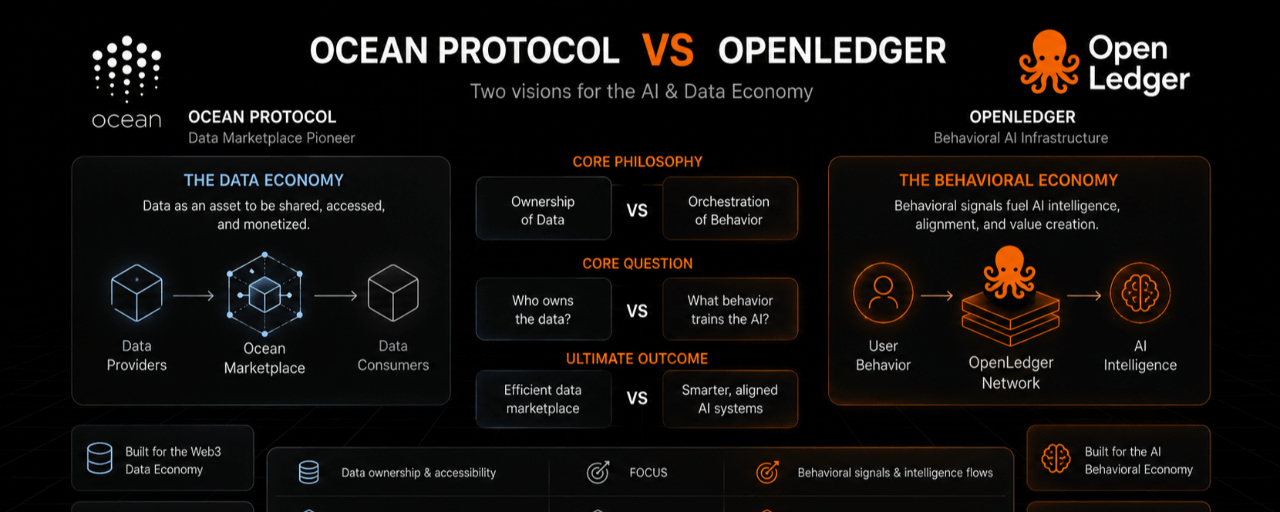
One thing I realized a bit late after watching AI and crypto evolve for years is that most debates still revolve around infrastructure, while the real shift is happening at the behavioral layer.
People talk endlessly about compute, model speed, decentralized inference, or data ownership. But the deeper change may not be about who owns the data at all. It may be about how human behavior changes once AI becomes the intermediary between people and information.
That’s why comparing OpenLedger and Ocean Protocol feels interesting to me.
On the surface, both operate around the idea of an AI and data economy. But philosophically, they seem to represent two very different eras of the internet.
Ocean Protocol emerged during a period when the market believed the internet’s biggest problem was ownership. The thesis was straightforward: data had value, corporations controlled it, and decentralized marketplaces could unlock efficiency by turning data into a tradable asset class.
That was a very early-Web3 way of thinking.
The assumption was that better incentives would naturally create better coordination around resources.
But over time, it becomes clear that raw data alone rarely creates meaningful value. Context, interpretation, timing, and behavioral relevance matter far more. The same dataset can generate insight in one system and noise in another.
And this is where OpenLedger seems to approach the problem differently.
Instead of treating data primarily as an asset to exchange, it appears to focus on AI as a behavioral coordination layer. The important question shifts away from “who owns the data” toward things like:
Which behaviors does AI learn from? What incentives shape those behaviors? What signals are continuously reinforced? What kinds of systems optimize user decision-making?
It sounds subtle, but the implications are enormous.
The old internet was built around information abundance.
The emerging AI internet may revolve around cognitive abundance.
There’s already too much content, too much automation, too many signals, too many recommendations. Access is no longer the bottleneck. Attention filtering and decision quality become the scarce resources.
That’s why I increasingly think the most important aspect of AI isn’t intelligence itself.
It’s behavioral influence.
Or more precisely: how AI gradually changes the way humans think by reducing the need to think independently.
Every optimization system carries that paradox.
GPS weakens our internal sense of direction. Algorithmic feeds increase reaction speed while reducing depth of thought. AI assistants may amplify this dynamic even further.
Because once AI becomes the layer mediating humans and knowledge, people stop interacting directly with reality and instead interact with a model-generated abstraction of reality.
That creates a much bigger question.
If future AI systems are trained continuously through user interaction and behavioral feedback, then the most valuable asset may no longer be raw data.
It becomes behavioral signal.
What people click. What they trust. How long they stay engaged. What questions they ask. How they react emotionally. What patterns get reinforced.
At that point, the AI economy starts looking a lot like the attention economy.
And the attention economy has never optimized for truth. It optimizes for engagement.
If AI inherits the same incentive structure, we may enter a strange era where systems become increasingly effective at reacting to humans without necessarily becoming better at understanding reality itself.
That’s the distinction I see between these two approaches.
Ocean Protocol reflects the belief that the internet’s core problem is ownership.
Systems like OpenLedger seem to reflect the belief that the next internet will revolve around orchestrating behavior, intelligence flows, and cognitive coordination.
Maybe both are necessary stages of the same evolution.
But the longer I observe these markets, the more I feel technological revolutions rarely happen because better tools appear.
They happen when new systems quietly rewrite how humans make decisions without them fully realizing it.