
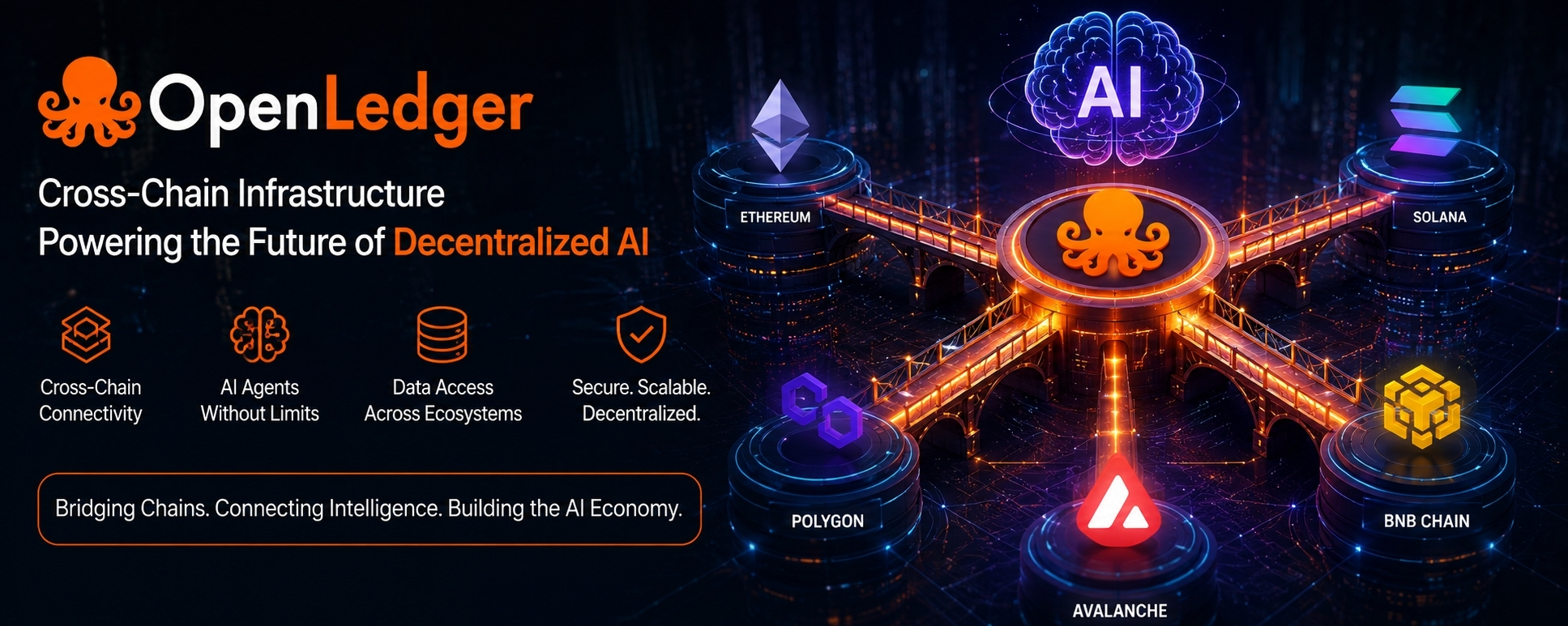

OpenLedger is tackling a problem that many people in crypto and AI still underestimate. Everyone talks about smarter AI models, better agents, and more advanced automation, but very few are paying attention to the infrastructure these systems will depend on. No matter how intelligent an AI application becomes, its potential is limited if it cannot access the data, liquidity, and networks it needs to operate efficiently. That is where OpenLedger is trying to make a difference.
One of the biggest challenges facing decentralized AI today is fragmentation. Data lives in different places, users are spread across multiple ecosystems, and blockchain networks often operate independently from one another. AI systems thrive when they have access to information, but most decentralized environments still make that access difficult. OpenLedger is building with the idea that AI should not be restricted by these boundaries.
What makes this approach interesting is that it focuses on a problem that becomes more important as AI adoption grows. An AI agent that operates in isolation can only work with the information available inside its own environment. The moment it needs to interact with another network, access different datasets, or coordinate activity elsewhere, complexity increases. OpenLedger is working toward an infrastructure layer that can help remove some of those limitations and create a more connected foundation for decentralized intelligence.
The project is also approaching AI from a perspective that goes beyond simple automation. AI systems require constant access to reliable data, and the quality of their decisions often depends on the quality of the information they receive. OpenLedger recognizes that data itself has value and that contributors should be rewarded when their data helps improve AI outcomes. This creates an environment where participants are encouraged to contribute useful information while AI models gain access to richer and more diverse datasets.
That idea could become increasingly important over time. The AI industry is moving quickly, but access to quality data remains one of its biggest challenges. Many platforms focus entirely on building better models while overlooking the source material that makes those models useful in the first place. OpenLedger appears to be taking a different route by treating data as a core asset rather than an afterthought.
Another reason the project stands out is its focus on creating infrastructure rather than chasing short-term trends. Markets often reward the loudest narratives, but lasting ecosystems are usually built on strong foundations. Developers need tools, data access, and reliable systems before they can create products that attract mainstream users. OpenLedger is positioning itself closer to that foundational layer.
The rise of autonomous AI agents makes this even more relevant. Future AI systems will likely perform tasks with minimal human involvement, whether that involves managing assets, analyzing markets, coordinating workflows, or interacting with decentralized applications. These systems will require infrastructure that supports constant communication, efficient execution, and seamless access to information. OpenLedger is building with that future in mind.
There is also a practical side to this vision. Developers often face difficult choices when deciding where to build. One ecosystem may offer speed, another may provide liquidity, while a third might have stronger communities or better tooling. OpenLedger's approach could help reduce those trade-offs by creating a framework where AI applications can operate more flexibly instead of being confined to a single environment.
Of course, infrastructure projects are rarely the most exciting stories during a market cycle. They do not always generate the same attention as consumer applications or speculative narratives. Yet history shows that the strongest ecosystems are usually supported by infrastructure that quietly enables everything else to function. Without reliable foundations, even the most promising applications struggle to scale.
What makes OpenLedger worth watching is that it is addressing a problem that is likely to become more visible over the next few years. As AI continues expanding across blockchain ecosystems, the need for better connectivity, data accessibility, and coordination will only grow. The industry may eventually realize that intelligence alone is not enough. AI systems also need the ability to access resources, interact across environments, and operate without unnecessary barriers.
That is why OpenLedger's vision feels relevant. It is not simply about building another AI project. It is about creating the infrastructure that could help decentralized AI become more practical, more connected, and ultimately more useful. In a space crowded with applications competing for attention, the projects building the foundation often end up having the greatest long-term impact. OpenLedger appears to be focused on becoming one of those foundations.